



India’s Coal Imports Drop Four Point Two Per Cent
COAL & MINING

India’s Coal Imports Drop Four Point Two Per Cent

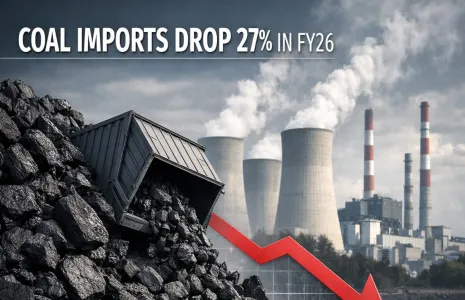
India’s coal imports dropped four point two per cent to 213.10 million tonnes (mn t) in the April–January period of the current financial year as the government prioritised boosting domestic output. The decline took place against a backdrop of firmer seaborne coal prices caused by supply constraints and geopolitical tensions, which are expected to keep imports subdued in the near term. The trend reflects an ongoing push for self?reliance in coal production supported by steady growth in domestic supply.

Data compiled by mjunction services showed non?coking coal imports stood at 127.80 mn t during the period, down from 141.18 mn t a year earlier, while coking coal imports rose to 50.39 mn t from 45.83 mn t, pointing to sustained demand from the steel sector. On a monthly basis, January imports fell 22.1 per cent to 16.64 mn t from 21.37 mn t in the corresponding month last year. The monthly disaggregation showed non?coking imports at nine point four five mn t versus 12.33 mn t and coking imports at four point two three mn t compared with five point two three mn t previously.

Officials expect the government measures to reduce reliance on foreign supplies while meeting rising energy needs, and industry projections indicate domestic coal output will continue to increase. Production is projected to grow at an annual rate of six to seven per cent over the coming years, with output anticipated to reach around one point five billion tonnes (bn t) by 2029–30. The projection underlines plans to strengthen energy security and moderate import dependence.

Minister for Coal and Mines G Kishan Reddy indicated that coal demand is likely to continue rising and could peak around 2040, reinforcing the policy emphasis on ramping up local production. The government has been stepping up measures to expand capacity and ensure long?term supply adequacy for industry and power generation.

India’s coal imports dropped four point two per cent to 213.10 million tonnes (mn t) in the April–January period of the current financial year as the government prioritised boosting domestic output. The decline took place against a backdrop of firmer seaborne coal prices caused by supply constraints and geopolitical tensions, which are expected to keep imports subdued in the near term. The trend reflects an ongoing push for self?reliance in coal production supported by steady growth in domestic supply. Data compiled by mjunction services showed non?coking coal imports stood at 127.80 mn t during the period, down from 141.18 mn t a year earlier, while coking coal imports rose to 50.39 mn t from 45.83 mn t, pointing to sustained demand from the steel sector. On a monthly basis, January imports fell 22.1 per cent to 16.64 mn t from 21.37 mn t in the corresponding month last year. The monthly disaggregation showed non?coking imports at nine point four five mn t versus 12.33 mn t and coking imports at four point two three mn t compared with five point two three mn t previously. Officials expect the government measures to reduce reliance on foreign supplies while meeting rising energy needs, and industry projections indicate domestic coal output will continue to increase. Production is projected to grow at an annual rate of six to seven per cent over the coming years, with output anticipated to reach around one point five billion tonnes (bn t) by 2029–30. The projection underlines plans to strengthen energy security and moderate import dependence. Minister for Coal and Mines G Kishan Reddy indicated that coal demand is likely to continue rising and could peak around 2040, reinforcing the policy emphasis on ramping up local production. The government has been stepping up measures to expand capacity and ensure long?term supply adequacy for industry and power generation.

Next Story
Infrastructure Urban

Urgently Wanted: 2 Million Workers!

Construction, India’s second largest employer by industry, employs about 50 million workers but could additionally absorb another 40 million workers, according to estimates shared by the Construction Skill Development Council of India (CSDCI) in 2023. Within this, citing trade estimates, Rahul Bahl, Managing Director, Krishna Buildestates, says the shortage of trained, skilled workers is currently about 2 million, and is expected to rise to 5 million by 2030.Not only is the construction industry struggling to find workers but construction labour productivity in India significantly trails g..

Next Story
Real Estate

144 Years in the Making!

1. A century-spanning construction storyConstruction began in 1882, making the Sagrada Família one of the longest-running architectural projects in modern history. Today, the project is overseen by the Fundació Junta Constructora del Temple Expiatori de la Sagrada Família, with Chief Architect Jordi Faulí leading its final construction phases.2. The world’s tallest church towerhe Sagrada Família in Barcelona reached its final height of 172.5 m (566 ft) on February 20, 2026, with the installation of the cross atop the Tower of Jesus Christ, making it the tallest church in the world...To ..

Next Story
Infrastructure Transport

Scaling the Skies!

India’s aviation sector is entering a decisive phase – one where ambition is no longer defined by the number of airports being announced but by the system’s ability to deliver, sustain and monetise them.At the Infrastructure Today Airports Conclave held on March 12, 2026, at Courtyard by Marriott in Mumbai, a clear shift emerged: from building airports to building a viable aviation ecosystem. The event was supported by Silver Partner Pidilite, Innovation Partner Piramal Nextgen, Exhibit Partners Rockwool and esri India, and Business Intelligence Partner IMPACCT.Opening the discussion,&nb..

Advertisement

Subscribe to Our Newsletter

Get daily newsletters around different themes from Construction world.

STAY CONNECTED

Advertisement

Advertisement

Advertisement