Government Mandates Sale of 20 Per Cent Ethanol-Blended Petrol
OIL & GAS

Government Mandates Sale of 20 Per Cent Ethanol-Blended Petrol

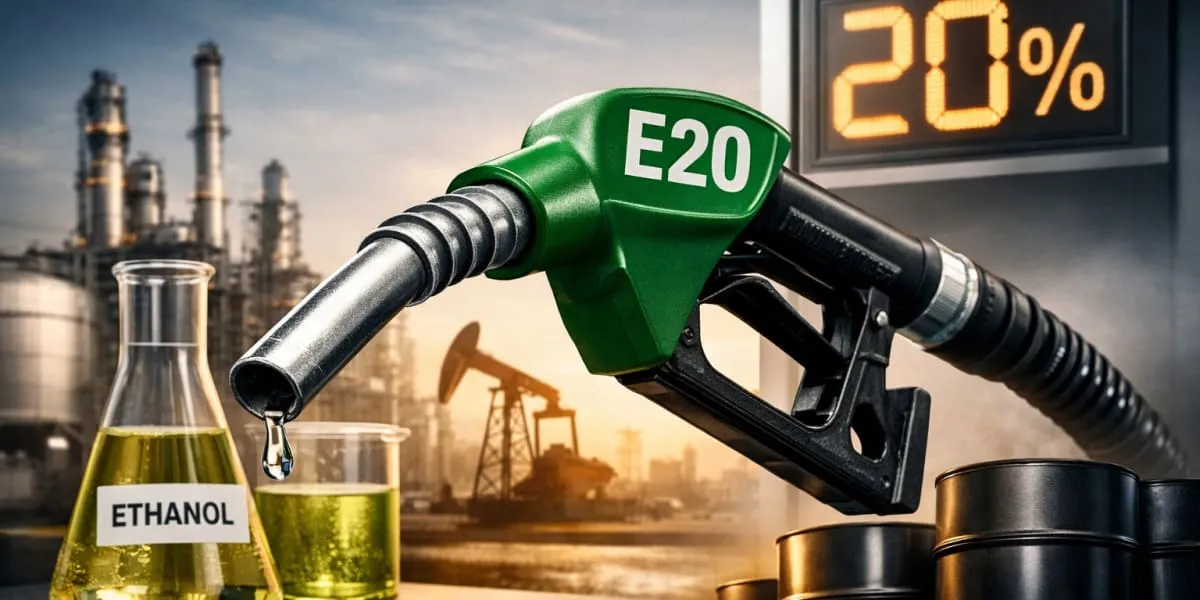
The government has mandated the sale of 20 per cent ethanol blended petrol from April one, requiring fuel retailers to supply the new blend nationwide. The move is framed as a policy to expand domestic ethanol use and to enhance energy security by reducing dependence on crude oil imports. Officials have outlined a timetable for implementation and urged oil marketing companies to finalise procurement and distribution plans ahead of the deadline.

Refineries and fuel distributors will need to scale blending operations and adjust logistics to meet the new standard, with industry sources noting a concentrated effort on storage and transport compatibility. The policy is expected to create stronger demand for ethanol derived from agricultural feedstocks, providing an additional revenue stream for rural producers. Regulators will monitor supply chains and compliance to ensure that stations meet the mandated blend at the pump.

Consumer impact is likely to vary by region as distribution networks are upgraded and as automobile compatibility evolves, prompting advisories for vehicle owners to consult manufacturer guidance. Analysts say transition costs may be absorbed by industry participants or reflected in marginal price adjustments, but officials have emphasised the long term benefits for fuel security and rural incomes. The move aligns with broader efforts to decarbonise the transport sector and to promote renewable alternatives within the fuel mix.

Implementation will require coordination among central agencies, state authorities and private sector operators to prevent supply disruptions as the deadline approaches. Market participants have been advised to finalise contracts for ethanol supplies and to invest in blending infrastructure where necessary to meet the mandate. Observers will watch for developments in supply, pricing and compliance in the weeks following April one.

The government has mandated the sale of 20 per cent ethanol blended petrol from April one, requiring fuel retailers to supply the new blend nationwide. The move is framed as a policy to expand domestic ethanol use and to enhance energy security by reducing dependence on crude oil imports. Officials have outlined a timetable for implementation and urged oil marketing companies to finalise procurement and distribution plans ahead of the deadline. Refineries and fuel distributors will need to scale blending operations and adjust logistics to meet the new standard, with industry sources noting a concentrated effort on storage and transport compatibility. The policy is expected to create stronger demand for ethanol derived from agricultural feedstocks, providing an additional revenue stream for rural producers. Regulators will monitor supply chains and compliance to ensure that stations meet the mandated blend at the pump. Consumer impact is likely to vary by region as distribution networks are upgraded and as automobile compatibility evolves, prompting advisories for vehicle owners to consult manufacturer guidance. Analysts say transition costs may be absorbed by industry participants or reflected in marginal price adjustments, but officials have emphasised the long term benefits for fuel security and rural incomes. The move aligns with broader efforts to decarbonise the transport sector and to promote renewable alternatives within the fuel mix. Implementation will require coordination among central agencies, state authorities and private sector operators to prevent supply disruptions as the deadline approaches. Market participants have been advised to finalise contracts for ethanol supplies and to invest in blending infrastructure where necessary to meet the mandate. Observers will watch for developments in supply, pricing and compliance in the weeks following April one.

Related Stories

Gold Stories

Next Story
Resources

Schindler named among Forbes’ World’s Best Employers 2026

Schindler has been named among Forbes’ World’s Best Employers 2026, a global ranking recognising companies for their workplace environments.Compiled by Forbes in partnership with Statista, the ranking is based on independent employee feedback, including whether employees would recommend their organisation to friends and family.The company said the recognition reflected its focus on creating a workplace where employees can develop their expertise and build careers. ..

Next Story
Infrastructure Urban

India needs an export-execution mindset: Vishesh Jain

Interview with Vishesh Jain, Founder & CEO, EximpleWhat gaps in India’s global trade ecosystem led you to build Eximple, and what problem did you see businesses struggling with most?Eximple came out of a problem that all three founders had seen from different choke points in the trade ecosystem. India has millions of MSMEs and manufacturers, and many of them can make products that are genuinely competitive on quality. Yet only a small fraction is able to build meaningful international businesses. In our experience, the gap is usually not manufacturing capability; it is the ability to exe..

Next Story
Building Material

Nuvoco reports 13.5% revenue growth in Q2 FY27

Nuvoco Vistas Corp. Ltd. reported consolidated revenue of Rs 27.9 billion for Q2 FY27, up 13.5% year on year. Cement sales volume rose 9% to 4.7 million tonnes (MMT), while EBITDA increased 11% to Rs 4.11 billion.The company said it began its cement operations in 2014 with a 2.3 MMT per annum (MMTPA) operation at Nimbol. It now aims to reach 35 MMTPA of cement capacity by FY28, nearly 15 times its initial capacity. Its portfolio spans cement, ready-mix concrete and modern building materials.On sustainability and cost efficiency, Nuvoco partnered with CleanMax for a 46.4 MW wind-solar hybrid re..

Advertisement

Subscribe to Our Newsletter

Get daily newsletters around different themes from Construction world.

STAY CONNECTED

Advertisement

SPECIAL OFFER
QR Code