CERC Proposes Auctioning Connectivity To Ease Grid Congestion
POWER & RENEWABLE ENERGY

CERC Proposes Auctioning Connectivity To Ease Grid Congestion

The Central Electricity Regulatory Commission (CERC) has proposed major reforms to streamline India’s congested transmission network, calling Connectivity a “scarce resource” that should be auctioned for future applications. It also recommended that power purchase agreements (PPAs) replace letters of award (LoAs) as the valid document for granting Connectivity.

The recommendations are part of a consultation paper examining large volumes of renewable energy (RE) capacity for which developers have secured Connectivity under General Network Access (GNA) Regulations by submitting LoAs issued by renewable energy implementing agencies (REIAs), but have yet to sign PPAs.

CERC said there is an urgent need to free up Connectivity granted via the LoA route where PPA or power sale agreement (PSA) signing has been delayed. Stakeholders have been asked to submit responses by 15 December 2025.

The paper comes as the Ministry of New & Renewable Energy (MNRE) undertakes a comprehensive review of 43.9 gigawatts (GW) of RE projects stuck due to poor Discom interest in PSAs. As of June 2025, Connectivity has been granted to 31.802 GW of projects while another 13.541 GW of requests are still pending — a total of 45.343 GW for which PPAs have not been signed.

“This is a very significant quantum of Connectivity, as the corresponding transmission systems are either implemented or under implementation,” the regulator said.

To manage future requests, CERC has suggested that only an auction mechanism be used for granting Connectivity, ensuring firm project commitments by specified deadlines. Alternatively, it proposed removing the LoA route entirely and allowing Connectivity only on the basis of PPAs signed under the Centre’s competitive bidding guidelines — acknowledging that developers typically begin substantive work only after signing a PPA.

CERC has also proposed mechanisms to ensure optimal and timely utilisation of the transmission network. For instance, if a project with LoA-based Connectivity has not secured a PPA within 12 months, developers may substitute the initial LoA with a PPA linked to another LoA, provided the Connectivity start date under the second LoA is at least six months later than the first.

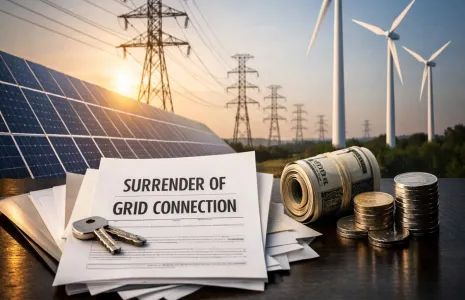
Developers may also choose to surrender Connectivity within one month. In such cases, the Central Transmission Utility of India (CTUIL) will encash Connectivity Bank Guarantee-1 (Conn-BG1) and return Conn-BG2 and Conn-BG3. The developer must continue to pay applicable transmission charges until CTUIL accepts the surrender.

The Central Electricity Regulatory Commission (CERC) has proposed major reforms to streamline India’s congested transmission network, calling Connectivity a “scarce resource” that should be auctioned for future applications. It also recommended that power purchase agreements (PPAs) replace letters of award (LoAs) as the valid document for granting Connectivity. The recommendations are part of a consultation paper examining large volumes of renewable energy (RE) capacity for which developers have secured Connectivity under General Network Access (GNA) Regulations by submitting LoAs issued by renewable energy implementing agencies (REIAs), but have yet to sign PPAs. CERC said there is an urgent need to free up Connectivity granted via the LoA route where PPA or power sale agreement (PSA) signing has been delayed. Stakeholders have been asked to submit responses by 15 December 2025. The paper comes as the Ministry of New & Renewable Energy (MNRE) undertakes a comprehensive review of 43.9 gigawatts (GW) of RE projects stuck due to poor Discom interest in PSAs. As of June 2025, Connectivity has been granted to 31.802 GW of projects while another 13.541 GW of requests are still pending — a total of 45.343 GW for which PPAs have not been signed. “This is a very significant quantum of Connectivity, as the corresponding transmission systems are either implemented or under implementation,” the regulator said. To manage future requests, CERC has suggested that only an auction mechanism be used for granting Connectivity, ensuring firm project commitments by specified deadlines. Alternatively, it proposed removing the LoA route entirely and allowing Connectivity only on the basis of PPAs signed under the Centre’s competitive bidding guidelines — acknowledging that developers typically begin substantive work only after signing a PPA. CERC has also proposed mechanisms to ensure optimal and timely utilisation of the transmission network. For instance, if a project with LoA-based Connectivity has not secured a PPA within 12 months, developers may substitute the initial LoA with a PPA linked to another LoA, provided the Connectivity start date under the second LoA is at least six months later than the first. Developers may also choose to surrender Connectivity within one month. In such cases, the Central Transmission Utility of India (CTUIL) will encash Connectivity Bank Guarantee-1 (Conn-BG1) and return Conn-BG2 and Conn-BG3. The developer must continue to pay applicable transmission charges until CTUIL accepts the surrender.

Next Story
Infrastructure Energy

Coal Ministry Simplifies Disposal of Washery Rejects

The Ministry of Coal has recently simplified the process for disposal of coal washery rejects to enhance ease of doing business and ensure faster utilisation, while maintaining environmental safeguards. The move aligns with the government’s Atmanirbhar Bharat vision and ongoing reform agenda in the coal sector. Under the existing policy issued on 27 May 2021, washery rejects were disposed of through a three-tier priority system. The first priority allows their use for energy extraction, in line with Solid Waste Management Rules, 2016, applicable to waste with calorific value above 1,500 kca..

Next Story
Infrastructure Urban

India, Oman Sign CEPA to Boost Trade and Services Ties

India and Oman have recently signed a Comprehensive Economic Partnership Agreement (CEPA), marking a major milestone in India’s strategic engagement with the Gulf region. The agreement was signed in the presence of Narendra Modi and Sultan Haitham bin Tarik, by Piyush Goyal and Qais bin Mohammed Al Yousef. The CEPA provides unprecedented market access for Indian goods, with Oman offering zero-duty access on 98.08 per cent of its tariff lines, covering 99.38 per cent of India’s exports by value. Major labour-intensive sectors such as textiles, leather, footwear, gems and jewellery, enginee..

Next Story
Technology

TTDF Backs 136 Telecom R&D Projects Worth Rs 5.42 Bn

The Telecom Technology Development Fund (TTDF) Scheme has recently approved 136 projects worth Rs 5.42 billion to strengthen indigenous telecom innovation across India, the government informed Parliament. The scheme focuses on bridging the digital divide by enabling development and manufacturing of advanced telecom technologies for rural and remote areas. In a written reply to the Rajya Sabha, Minister of State for Communications and Rural Development Pemmasani Chandra Sekhar said the TTDF Scheme, launched on 1 October 2022, supports IITs, NITs, MSMEs, start-ups and research institutions work..

Advertisement

Subscribe to Our Newsletter

Get daily newsletters around different themes from Construction world.

STAY CONNECTED

Advertisement

Advertisement

Advertisement

Advertisement

Open In App