+
CM Launches Rs1,597.5 Million Chandni Chowk Underground Power Plan
POWER & RENEWABLE ENERGY

CM Launches Rs1,597.5 Million Chandni Chowk Underground Power Plan

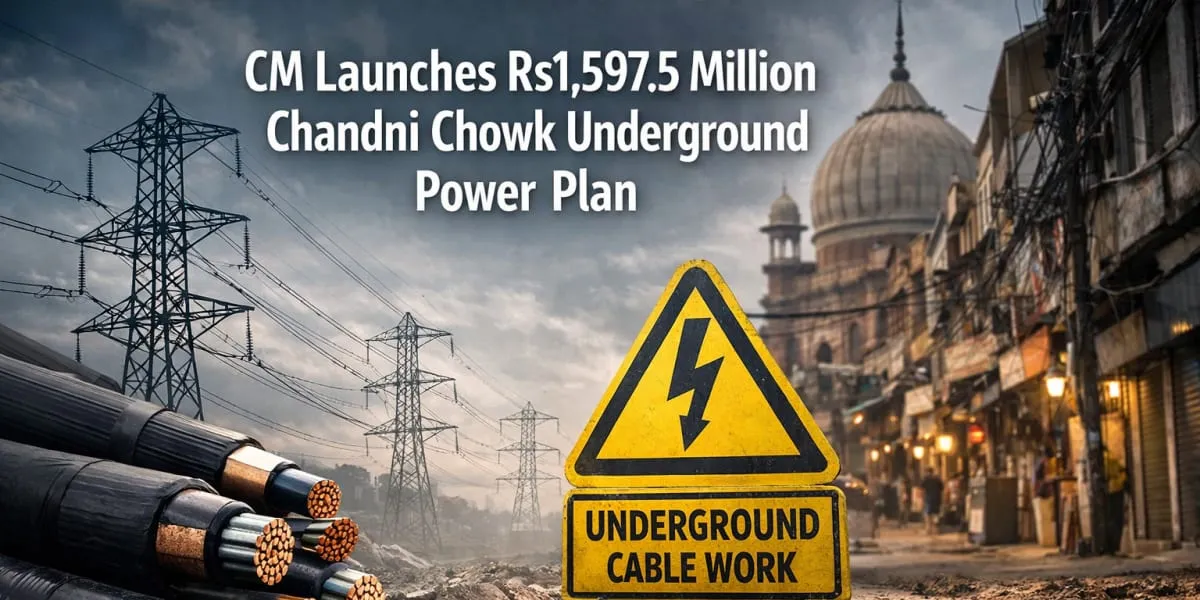
The chief minister launched a plan to shift overhead power lines underground in Chandni Chowk, announcing a project valued at Rs1,597.5 million (mn). The million figure is spelled out on first mention and will be abbreviated thereafter. The initiative targets a densely populated heritage market known for narrow lanes and high pedestrian and vehicular movement. Officials framed the project as a response to long standing infrastructure constraints and recurring supply interruptions.

Authorities indicated the works aim to improve public safety by reducing the likelihood of electrocution and electrical fires while enhancing the visual character of the conservation area. The scheme is described as complementing broader efforts to modernise urban utilities and to strengthen the electricity distribution system against frequent faults. Planners expect that burying cables will reduce exposure to weather and accidental damage which currently contribute to outages and maintenance demands.

Implementation will be phased to limit disruption to traders, residents and commuters, with operations concentrated on particularly congested streets and junctions at different times. The works will involve trenching, relocation of existing cables and the installation of protective conduits and access chambers to permit future maintenance. Coordination with traffic management and civic teams is expected to preserve access for emergency services and allow for staged reinstatement of pavements and carriageways. Temporary arrangements for supply continuity and public communication measures will be necessary to manage the transition.

The announcement provided the project cost but did not set out a detailed timetable, with officials indicating that specific schedules will follow once surveys and design work are completed. Stakeholders were said to be engaged to balance conservation priorities with technical requirements and to minimise commercial disruption during construction. Planners anticipate long term savings in upkeep alongside improved reliability of electricity supply and a more orderly streetscape once the subterranean infrastructure is fully in place.

The chief minister launched a plan to shift overhead power lines underground in Chandni Chowk, announcing a project valued at Rs1,597.5 million (mn). The million figure is spelled out on first mention and will be abbreviated thereafter. The initiative targets a densely populated heritage market known for narrow lanes and high pedestrian and vehicular movement. Officials framed the project as a response to long standing infrastructure constraints and recurring supply interruptions. Authorities indicated the works aim to improve public safety by reducing the likelihood of electrocution and electrical fires while enhancing the visual character of the conservation area. The scheme is described as complementing broader efforts to modernise urban utilities and to strengthen the electricity distribution system against frequent faults. Planners expect that burying cables will reduce exposure to weather and accidental damage which currently contribute to outages and maintenance demands. Implementation will be phased to limit disruption to traders, residents and commuters, with operations concentrated on particularly congested streets and junctions at different times. The works will involve trenching, relocation of existing cables and the installation of protective conduits and access chambers to permit future maintenance. Coordination with traffic management and civic teams is expected to preserve access for emergency services and allow for staged reinstatement of pavements and carriageways. Temporary arrangements for supply continuity and public communication measures will be necessary to manage the transition. The announcement provided the project cost but did not set out a detailed timetable, with officials indicating that specific schedules will follow once surveys and design work are completed. Stakeholders were said to be engaged to balance conservation priorities with technical requirements and to minimise commercial disruption during construction. Planners anticipate long term savings in upkeep alongside improved reliability of electricity supply and a more orderly streetscape once the subterranean infrastructure is fully in place.

Next Story
Building Material

NITI Aayog Unveils Cement Decarbonisation Roadmap

NITI Aayog has released a sector-specific decarbonisation roadmap for cement as part of three green transition reports covering cement, aluminium and MSMEs. The report projects cement production rising to around 2,100 million tonnes by 2070 from 391 million tonnes in 2023, while targeting a reduction in carbon intensity to 0.09–0.13 tCO₂e per tonne. It recommends clinker substitution, refuse-derived fuels, CCUS adoption and carbon trading mechanisms to enable deep decarbonisation. ..

Next Story
Technology

Genesys Launches Advanced GeoRadar System

Genesys International Corporation has launched an advanced Ground Penetrating Radar (GPR) solution from IDS GeoRadar for underground utility mapping in India. The system uses patented Equalised Scrambling Technology (EST) and Wide/Multi-Array Antenna Technology to deliver high-resolution three-dimensional imaging of subsurface infrastructure. The technology enables the detection and mapping of buried assets such as water pipelines, sewer networks, telecom cables and power lines. By providing detailed subsurface insights, the system aims to help urban authorities and infrastructure developers ..

Next Story
Infrastructure Urban

Hindustan Zinc Partners Virginia Tech to Boost Silver Recovery

Hindustan Zinc Limited recently signed a Memorandum of Understanding (MoU) with Virginia Tech to advance research aimed at improving silver recovery across its lead–zinc (Pb–Zn) concentrators. The collaboration will focus on refining flotation techniques and optimising reagent usage to improve concentrate quality and operational efficiency at processing plants.Virginia Tech, based in Blacksburg, Virginia, is globally recognised for its expertise in mining engineering, mineral processing and applied metallurgical research. Through this partnership, Hindustan Zinc will leverage global resear..

Advertisement

Subscribe to Our Newsletter

Get daily newsletters around different themes from Construction world.

STAY CONNECTED

Advertisement

Advertisement

Advertisement

Open In App