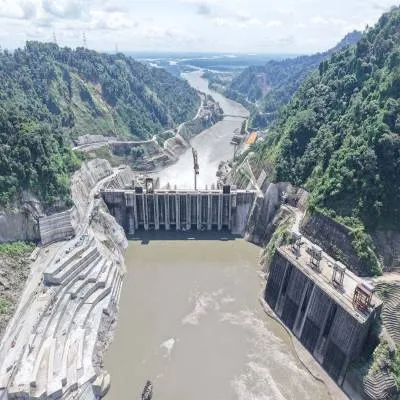
India’s Largest 2,000 MW Subansiri Hydro Project Turns Operational
POWER & RENEWABLE ENERGY

India’s Largest 2,000 MW Subansiri Hydro Project Turns Operational

India’s largest hydropower project, the 2,000 MW Subansiri Lower Hydroelectric Project, has finally become operational with the commissioning of its first unit, marking a major milestone after nearly 20 years of development marked by delays, protests and cost escalation.

The 250 MW Unit-2 of the project, located on the Subansiri River at Gerukamukh on the Assam–Arunachal Pradesh border, was virtually inaugurated from New Delhi by Union Minister of Power Manohar Lal Khattar. The event was attended by Pankaj Agarwal, Secretary (Power), and Bhupender Gupta, Chairman and Managing Director, National Hydroelectric Power Corporation (NHPC), among other officials.

Calling the commissioning a landmark achievement, Khattar said the Subansiri project symbolises India’s commitment to clean and sustainable energy. He added that it will support economic growth in the North-East, strengthen the national power grid and contribute to India’s Net Zero targets. “Commissioning of the unit is not just a technical achievement, but a testament to years of hard work, dedication and teamwork,” he said.

The remaining seven units, each with a capacity of 250 MW, are scheduled to be commissioned in a phased manner during 2026–27. Once fully operational, the project is expected to significantly boost India’s renewable energy capacity and enhance grid resilience, the Ministry of Power said in a statement.

The Subansiri project is also notable for its engineering scale, featuring India’s heaviest hydro generator rotors, the largest stators and main inlet valves, as well as several construction innovations. As the first cascaded dam on the Subansiri River, it provides flood moderation through a flood cushion of 442 million cubic metres, helping protect downstream areas.

Approved in 2003 and initiated in 2005, the project was originally estimated to cost Rs 62.85 billion and targeted for completion by 2012. However, prolonged protests in downstream Assam over safety and ecological concerns stalled work between 2011 and 2019. Construction resumed thereafter, with the project cost rising to around Rs 270 billion.

India’s largest hydropower project, the 2,000 MW Subansiri Lower Hydroelectric Project, has finally become operational with the commissioning of its first unit, marking a major milestone after nearly 20 years of development marked by delays, protests and cost escalation.The 250 MW Unit-2 of the project, located on the Subansiri River at Gerukamukh on the Assam–Arunachal Pradesh border, was virtually inaugurated from New Delhi by Union Minister of Power Manohar Lal Khattar. The event was attended by Pankaj Agarwal, Secretary (Power), and Bhupender Gupta, Chairman and Managing Director, National Hydroelectric Power Corporation (NHPC), among other officials.Calling the commissioning a landmark achievement, Khattar said the Subansiri project symbolises India’s commitment to clean and sustainable energy. He added that it will support economic growth in the North-East, strengthen the national power grid and contribute to India’s Net Zero targets. “Commissioning of the unit is not just a technical achievement, but a testament to years of hard work, dedication and teamwork,” he said.The remaining seven units, each with a capacity of 250 MW, are scheduled to be commissioned in a phased manner during 2026–27. Once fully operational, the project is expected to significantly boost India’s renewable energy capacity and enhance grid resilience, the Ministry of Power said in a statement.The Subansiri project is also notable for its engineering scale, featuring India’s heaviest hydro generator rotors, the largest stators and main inlet valves, as well as several construction innovations. As the first cascaded dam on the Subansiri River, it provides flood moderation through a flood cushion of 442 million cubic metres, helping protect downstream areas.Approved in 2003 and initiated in 2005, the project was originally estimated to cost Rs 62.85 billion and targeted for completion by 2012. However, prolonged protests in downstream Assam over safety and ecological concerns stalled work between 2011 and 2019. Construction resumed thereafter, with the project cost rising to around Rs 270 billion.

Next Story
Real Estate

Modon, Related, Panepinto form JV for Harborside 4 in Jersey City

Abu Dhabi-based Modon Holding PSC has formed a joint venture with US real estate major Related Companies and Jersey City-based Panepinto Properties to develop Harborside 4, a 54-storey luxury residential tower on a prime waterfront site in downtown Jersey City, New Jersey.Under the partnership, Modon will hold a majority equity stake alongside Related and Panepinto, marking another step in the group’s strategy to scale and diversify its global real estate portfolio. The project will be developed on one of the last remaining premium waterfront parcels in the city.Designed by Handel Architects..

Next Story
Infrastructure Urban

P+Ex and Post-Tensioning Institute partner to drive sustainability

P+Ex, the Center of Excellence for Concrete Preservation and Service Life Extension, has announced a strategic partnership with the Post-Tensioning Institute (PTI) aimed at advancing sustainability, durability, and resilience in the built environment.The collaboration brings together P+Ex’s expertise in concrete preservation, repair, and service life extension with PTI’s global leadership in post-tensioning technology. Through this alliance, the two organisations will work to advance best practices in durability-focused design for new structures, while also promoting effective repair, reha..

Advertisement

Subscribe to Our Newsletter

Get daily newsletters around different themes from Construction world.

STAY CONNECTED

Advertisement

Advertisement

Advertisement

Advertisement

Open In App