+
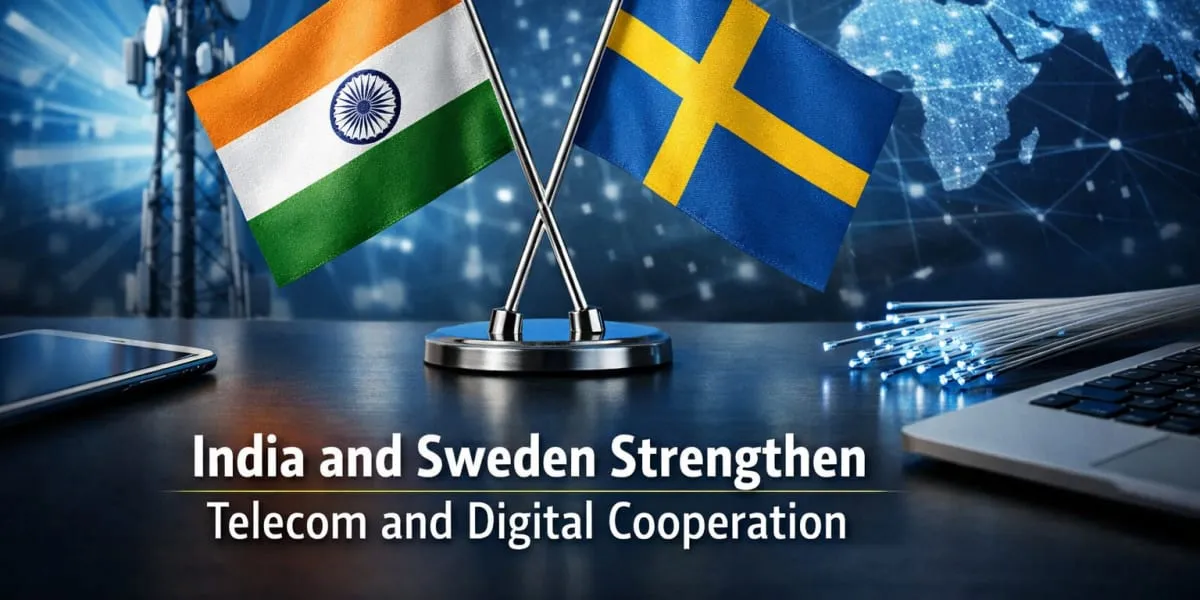
India And Sweden Strengthen Telecom And Digital Cooperation
ECONOMY & POLICY

India And Sweden Strengthen Telecom And Digital Cooperation

A bilateral meeting was held on 18 February 2026 at Sanchar Bhawan, New Delhi, between Union Communications Minister Jyotiraditya M. Scindia and the Deputy Prime Minister of Sweden, Ebba Busch, to review cooperation in telecommunications and digital transformation. The discussions set shared priorities on next generation connectivity, secure digital infrastructure, innovation, growth and sustainability. Both sides acknowledged the India-Sweden Joint Working Group on Digital Technologies and Economy and agreed to schedule the third meeting in Stockholm.

The agenda prioritised expansion of 5G and 5G Advanced use cases across healthcare, agriculture, smart cities and rural connectivity, and emphasised sustainability and inclusive enterprise development. India noted it has over 1.23 billion (bn) telecom subscribers and one billion (bn) internet users, with four operators and 4G coverage extending to 98.5 per cent of the population, targeting universal 4G saturation across villages by June 2026. The minister said the 5G rollout was completed in 21 months with investments of USD 5.5 billion (bn) and public capital expenditure of nearly USD 16.9 billion (bn) to connect Gram Panchayats.

The role of the state owned operator BSNL was highlighted, including its indigenous 4G stack and service to over 93 million (mn) subscribers, alongside measures to increase renewable energy usage in telecom towers and a clean energy transition goal by 2030. India's Digital Public Infrastructure model anchored in Aadhaar, UPI and DigiLocker was presented as an inclusive, scalable framework for secure digital governance and economic participation, described as the invisible highway driving economic growth.

Both sides discussed early engagement in 6G research, spectrum harmonisation and coordinated participation in international standard setting, noting the Bharat 6G Alliance's target to contribute at least 10 per cent of global 6G patents. They identified Open RAN, network modernisation, trusted supply chains and quantum communication as priority domains and agreed work plans under the Joint Working Group. The Indian side sought Swedish support for its ITU nominations and for hosting the ITU Plenipotentiary Conference in 2030, while both parties reaffirmed commitment to build trusted, resilient and inclusive digital ecosystems.

A bilateral meeting was held on 18 February 2026 at Sanchar Bhawan, New Delhi, between Union Communications Minister Jyotiraditya M. Scindia and the Deputy Prime Minister of Sweden, Ebba Busch, to review cooperation in telecommunications and digital transformation. The discussions set shared priorities on next generation connectivity, secure digital infrastructure, innovation, growth and sustainability. Both sides acknowledged the India-Sweden Joint Working Group on Digital Technologies and Economy and agreed to schedule the third meeting in Stockholm. The agenda prioritised expansion of 5G and 5G Advanced use cases across healthcare, agriculture, smart cities and rural connectivity, and emphasised sustainability and inclusive enterprise development. India noted it has over 1.23 billion (bn) telecom subscribers and one billion (bn) internet users, with four operators and 4G coverage extending to 98.5 per cent of the population, targeting universal 4G saturation across villages by June 2026. The minister said the 5G rollout was completed in 21 months with investments of USD 5.5 billion (bn) and public capital expenditure of nearly USD 16.9 billion (bn) to connect Gram Panchayats. The role of the state owned operator BSNL was highlighted, including its indigenous 4G stack and service to over 93 million (mn) subscribers, alongside measures to increase renewable energy usage in telecom towers and a clean energy transition goal by 2030. India's Digital Public Infrastructure model anchored in Aadhaar, UPI and DigiLocker was presented as an inclusive, scalable framework for secure digital governance and economic participation, described as the invisible highway driving economic growth. Both sides discussed early engagement in 6G research, spectrum harmonisation and coordinated participation in international standard setting, noting the Bharat 6G Alliance's target to contribute at least 10 per cent of global 6G patents. They identified Open RAN, network modernisation, trusted supply chains and quantum communication as priority domains and agreed work plans under the Joint Working Group. The Indian side sought Swedish support for its ITU nominations and for hosting the ITU Plenipotentiary Conference in 2030, while both parties reaffirmed commitment to build trusted, resilient and inclusive digital ecosystems.

Next Story
Infrastructure Urban

Implementation Status of Jal Jeevan Mission

Since August 2019 the Government has implemented Jal Jeevan Mission to provide assured potable water through household tap connections in rural India. At the start of the mission only 32.3 million (mn) rural households, representing 16.7 per cent, were reported to have tap water connections. States and union territories have reported that 125.8 mn additional rural households have since been provided with tap connections. As a result, of about 193.6 mn rural households roughly 158.2 mn, or 81.71 per cent, are reported to have tap water supply at home.\n\nThe State, district and village level st..

Next Story
Infrastructure Urban

Jal Jeevan Mission Reaches Eighty One Per Cent Rural Coverage

The Government reported substantial progress under the Jal Jeevan Mission, launched in August 2019 to provide tap water to every rural household. At launch only 32.3 million (mn) rural households had tap connections and states and Union territories reported provision of 125.8 mn additional households by March 2026. Consequently, out of about 193.6 mn rural households around 158.2 mn, or 81.71 per cent, are reported to have tap water at home. The Finance Minister announced extension of the mission until 2028 in the 2025-26 budget speech. The Swachh Bharat Mission Grameen, launched in October 20..

Next Story
Infrastructure Urban

Empowering Local Governance for Sustainable Rural Water Supply

The Ministry of Jal Shakti has aligned the Jal Jeevan Mission (JJM) with the 73rd Amendment to strengthen village level planning and community ownership of water supply. Gram Panchayats, village water and sanitation committees and Pani Samitis are to plan, implement, manage and maintain piped water systems, with gram sabha processes formalising handover and oversight. Implementation support agencies including non government organisations, community based organisations and self help groups have been empanelled to train local committees and promote women participation. Under JJM, the department ..

Advertisement

Subscribe to Our Newsletter

Get daily newsletters around different themes from Construction world.

STAY CONNECTED

Advertisement

Advertisement

Advertisement