+
India Crosses 520 GW Installed Power Capacity
POWER & RENEWABLE ENERGY

India Crosses 520 GW Installed Power Capacity

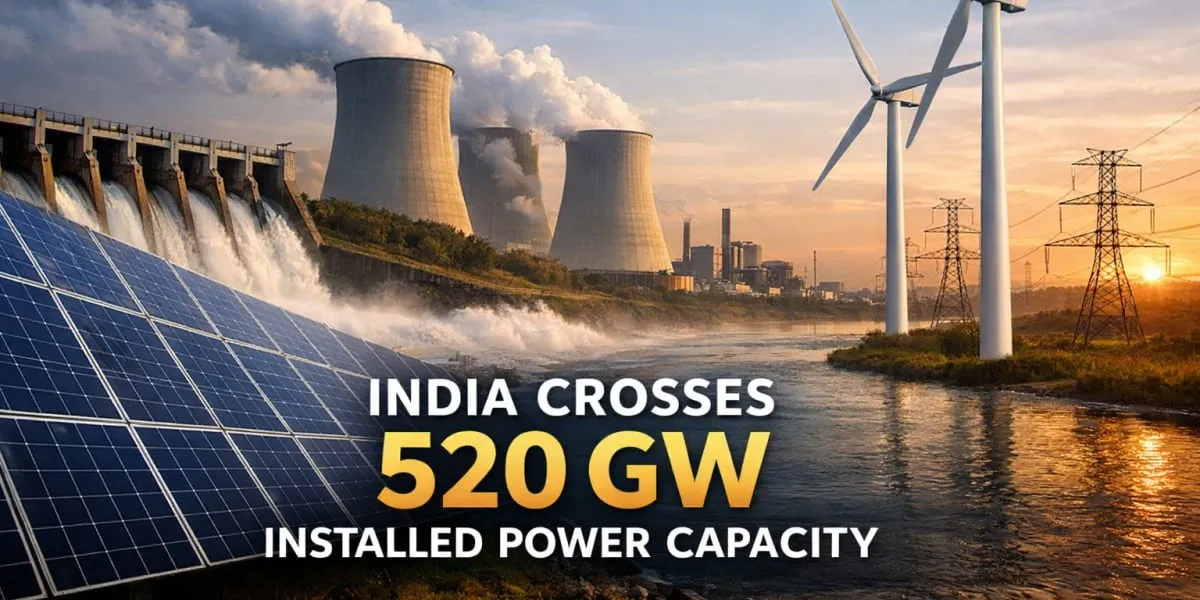
India has surpassed 520 GW of installed power capacity, with more than half of generation coming from non-fossil fuel sources, the Union Minister of State for Power and New and Renewable Energy Shripad Yesso Naik said while addressing the India Energy Transition Summit 2026 organised by the Federation of Indian Chambers of Commerce and Industry (FICCI) in New Delhi. The Minister conveyed that the energy transition is actively underway and is being supported by policy clarity, regulatory measures and sustained investments in renewable infrastructure across the country.

Rapid growth in solar capacity has more than tripled in recent years, reflecting the mainstreaming of renewable energy within the national power mix and widespread uptake by utilities and consumers. Government initiatives such as competitive bidding frameworks, expansion of green energy corridors and targeted support for manufacturing and transmission have accelerated deployment. Ultra-mega renewable energy parks and rooftop solar installations under the PM Surya Ghar Yojana have further strengthened distributed generation, increased consumer participation and diversified the resource base.

India has set a target of achieving 500 GW of non-fossil fuel capacity by 2030 and remains committed to reaching net zero emissions by 2070 as part of its long-term climate strategy. Officials noted that meeting the 2030 target will require coordinated action across central and state agencies, continued investor confidence and attention to grid integration and storage solutions. The shift to cleaner energy sources has been presented as aligned with global climate commitments while also addressing domestic energy security and supply reliability.

The transformation is expected to deliver multiple economic and strategic benefits by enhancing industrial competitiveness, creating employment opportunities across construction, operations and manufacturing and reducing dependence on fossil fuel imports. The Minister underlined that the energy transition is not a distant goal but a structured and ongoing process, and that with installed capacity exceeding 520 GW the country is advancing towards its 2030 and 2070 objectives while strengthening sustainable growth.

India has surpassed 520 GW of installed power capacity, with more than half of generation coming from non-fossil fuel sources, the Union Minister of State for Power and New and Renewable Energy Shripad Yesso Naik said while addressing the India Energy Transition Summit 2026 organised by the Federation of Indian Chambers of Commerce and Industry (FICCI) in New Delhi. The Minister conveyed that the energy transition is actively underway and is being supported by policy clarity, regulatory measures and sustained investments in renewable infrastructure across the country. Rapid growth in solar capacity has more than tripled in recent years, reflecting the mainstreaming of renewable energy within the national power mix and widespread uptake by utilities and consumers. Government initiatives such as competitive bidding frameworks, expansion of green energy corridors and targeted support for manufacturing and transmission have accelerated deployment. Ultra-mega renewable energy parks and rooftop solar installations under the PM Surya Ghar Yojana have further strengthened distributed generation, increased consumer participation and diversified the resource base. India has set a target of achieving 500 GW of non-fossil fuel capacity by 2030 and remains committed to reaching net zero emissions by 2070 as part of its long-term climate strategy. Officials noted that meeting the 2030 target will require coordinated action across central and state agencies, continued investor confidence and attention to grid integration and storage solutions. The shift to cleaner energy sources has been presented as aligned with global climate commitments while also addressing domestic energy security and supply reliability. The transformation is expected to deliver multiple economic and strategic benefits by enhancing industrial competitiveness, creating employment opportunities across construction, operations and manufacturing and reducing dependence on fossil fuel imports. The Minister underlined that the energy transition is not a distant goal but a structured and ongoing process, and that with installed capacity exceeding 520 GW the country is advancing towards its 2030 and 2070 objectives while strengthening sustainable growth.

Next Story
Resources

Deepak Halder Appointed CEO Of Sarvottam India

Sarvottam India has appointed Deepak Halder as its Chief Executive Officer. With over 23 years of professional experience, including nearly two decades in the real estate sector, Halder brings extensive leadership and strategic expertise to the organisation. Halder began his career in real estate in 2007 and has held senior leadership roles with developers such as Bestech Group, Paras Buildtech, Hero Realty, ATS Infrastructure and Rajdarbar Group. During his career, he has been involved in strategic expansion, brand positioning, major project launches and revenue growth across residential and..

Next Story
Real Estate

India Drives APAC Office Leasing Growth in 2025: Colliers

Office demand across Asia Pacific’s 11 major markets reached 9.8 million sq m (105.5 million sq ft) in 2025, marking an 11 per cent year-on-year increase, according to Colliers’ Asia Pacific Office Market Insights February 2026 report. India, Mainland China and Japan accounted for over 90 per cent of the region’s total demand during the year, with India emerging as the dominant leasing market.India alone contributed nearly 68 per cent of total office leasing across the region and accounted for 55 per cent of new office supply among the top 11 APAC markets in 2025. The report highlights t..

Next Story
Infrastructure Urban

Ramky Infra Wins Rs 14.01 Billion Dighi Port Project

Ramky Infrastructure has secured an EPC contract worth Rs 14.01 billion from Maharashtra Industrial Township Limited (MITL) for infrastructure development works at the Dighi Port Industrial Area (DPIA) Phase 1 under the Delhi Mumbai Industrial Corridor (DMIC). The contract value includes GST and revenues from operations and maintenance (O&M).The project will be executed within 930 days from the appointed date, followed by a four-year O&M period starting from the commercial operation date (COD), with the possibility of extension through mutual agreement.MITL is a special purpose vehicle..

Advertisement

Subscribe to Our Newsletter

Get daily newsletters around different themes from Construction world.

STAY CONNECTED

Advertisement

Advertisement

Advertisement

Open In App