India Discovers Rs 5.25 Per Unit RTC Renewable Tariff
POWER & RENEWABLE ENERGY

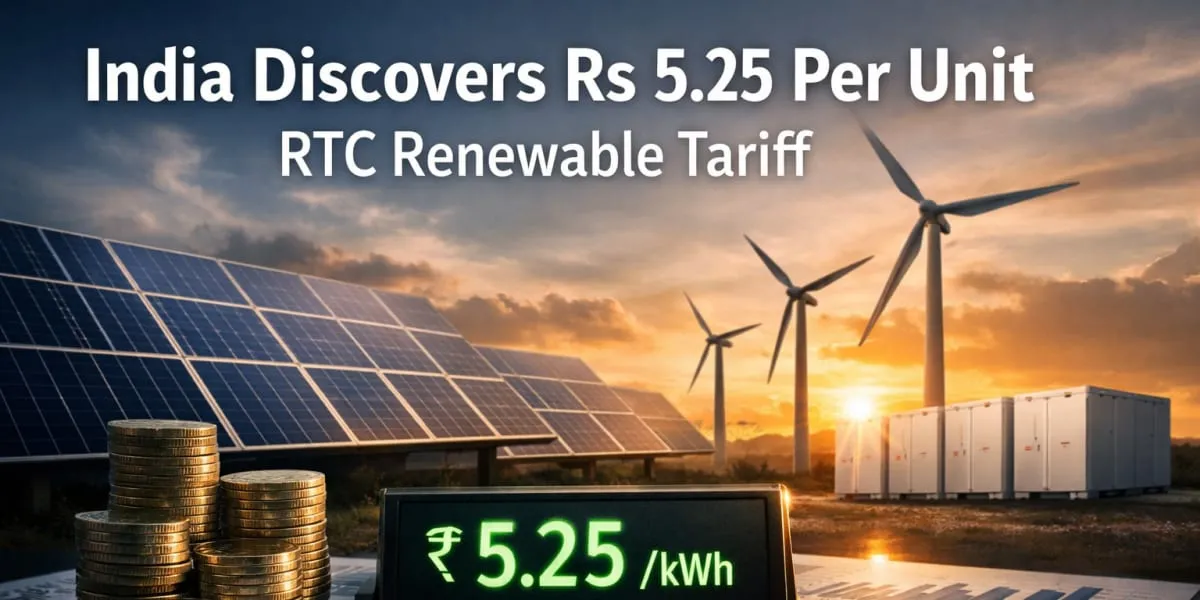
India Discovers Rs 5.25 Per Unit RTC Renewable Tariff

Round-the-clock renewable energy refers to power supply designed for continuous availability across all time blocks of the day and combines solar, wind and energy storage systems to provide dispatchable electricity. The model aims to deliver assured supply rather than generation only during sunlight hours.

The Solar Energy Corporation of India conducted a 1,000 megawatt (MW) Firm and Dispatchable Renewable Energy auction under the SECI-FDRE-RTC-V tender. Five developers won capacity at Rs 5.25 per kilowatt-hour, including Kengeri Prime Solar Power, Resolven Four Energy, Hero Solar Energy, EMIF II Holding and Purvah Green Power. Hexa Climate and Juniper Green Energy secured additional capacity at Rs 5.26 per unit.

The Ministry of New and Renewable Energy tender conditions required developers to maintain a minimum of 90 per cent assured power delivery in every time block during peak hours. The guidelines also required 50 to 60 per cent power supply during solar hours and at least 70 per cent during the remaining periods. These criteria are linked to hybrid generation and storage based supply models used in renewable energy procurement.

Dispatchable renewable projects are relevant for applications that need scheduled and reliable electricity, including data centres and green hydrogen production facilities that rely on low carbon power. India has expanded solar, wind, hybrid and storage based power procurement in recent years and RTC and FDRE tenders form part of the broader shift towards reliable renewable electricity in the national market. The Solar Energy Corporation of India is a central public sector enterprise under the Ministry of New and Renewable Energy.

The bidding framework requires developers to offer scheduled delivery and contractual assurance for each time block, thereby supporting grid integration and commercial predictability. Such arrangements are used by central and state frameworks to procure reliable renewable power. These mechanisms are increasingly important as the market shifts to dispatchable supplies.

Round-the-clock renewable energy refers to power supply designed for continuous availability across all time blocks of the day and combines solar, wind and energy storage systems to provide dispatchable electricity. The model aims to deliver assured supply rather than generation only during sunlight hours. The Solar Energy Corporation of India conducted a 1,000 megawatt (MW) Firm and Dispatchable Renewable Energy auction under the SECI-FDRE-RTC-V tender. Five developers won capacity at Rs 5.25 per kilowatt-hour, including Kengeri Prime Solar Power, Resolven Four Energy, Hero Solar Energy, EMIF II Holding and Purvah Green Power. Hexa Climate and Juniper Green Energy secured additional capacity at Rs 5.26 per unit. The Ministry of New and Renewable Energy tender conditions required developers to maintain a minimum of 90 per cent assured power delivery in every time block during peak hours. The guidelines also required 50 to 60 per cent power supply during solar hours and at least 70 per cent during the remaining periods. These criteria are linked to hybrid generation and storage based supply models used in renewable energy procurement. Dispatchable renewable projects are relevant for applications that need scheduled and reliable electricity, including data centres and green hydrogen production facilities that rely on low carbon power. India has expanded solar, wind, hybrid and storage based power procurement in recent years and RTC and FDRE tenders form part of the broader shift towards reliable renewable electricity in the national market. The Solar Energy Corporation of India is a central public sector enterprise under the Ministry of New and Renewable Energy. The bidding framework requires developers to offer scheduled delivery and contractual assurance for each time block, thereby supporting grid integration and commercial predictability. Such arrangements are used by central and state frameworks to procure reliable renewable power. These mechanisms are increasingly important as the market shifts to dispatchable supplies.

Related Stories

Gold Stories

Next Story
Infrastructure Urban

Sabarmati Riverfront Two Plots Up for Auction at Rs2.24 bn Base Price

Two commercial plots on the western bank of the Sabarmati Riverfront will be auctioned with a base price of Rs 112 crore each, equivalent to Rs 1.12 bn apiece and Rs 2.24 billion in total. The parcels are located adjacent to the Metro Rail Bridge in Ahmedabad and form the first commercial offering after a prolonged pause. The Riverfront Development Corporation has framed the sale as part of a phased commercial release to revive development along the riverfront. The combined base valuation has been set by the corporation to reflect market rates along the riverfront. The corporation has fixed a ..

Next Story
Infrastructure Urban

Andhra Pradesh to Connect Over One Million Streetlights

Andhra Pradesh will undertake a statewide smart streetlighting programme across all 123 Urban Local Bodies (ULBs), bringing around 1.05 million (mn) streetlights under an AI enabled monitoring and management system. The programme will be implemented by Energy Efficiency Services Limited (EESL) with the Commissioner and Director of Municipal Administration under the state Municipal Administration and Urban Development Department. The project aims to convert conventional streetlighting into a digitally managed municipal service monitored and maintained remotely. The initial phase will cover abou..

Next Story
Infrastructure Urban

AMC To Procure Four Machines For Guard Rail Cleaning

Ahmedabad Municipal Corporation will introduce four specialised machines for cleaning guard railings along major roads and the central verges of BRTS and Metro corridors. The civic body plans to replace manual labour with mechanised cleaning to improve maintenance of road infrastructure and greenery. The purchase is estimated at Rs 82.8 million (mn), excluding GST. The proposal sets the base price of each machine at about Rs 20.7 million (mn) so four units total Rs 82.8 million (mn) before GST. 18 per cent GST will be applicable separately. During the warranty period each machine will operate ..

Advertisement

Subscribe to Our Newsletter

Get daily newsletters around different themes from Construction world.

STAY CONNECTED

Advertisement