+
India Reviews Ocean Thermal Energy Conversion Project in Lakshadweep
POWER & RENEWABLE ENERGY

India Reviews Ocean Thermal Energy Conversion Project in Lakshadweep

Union Minister for Earth Sciences and Science and Technology Dr Jitendra Singh reviewed progress on an Ocean Thermal Energy Conversion (OTEC) project during a visit to Kavaratti in Lakshadweep as the government seeks to strengthen freshwater supply and renewable energy in island territories. The project converts the temperature difference between warm surface water and cold deep sea water into energy to run desalination systems and produce potable water for the island community. Officials briefed the minister on technical progress, commissioning timelines and environmental safeguards.

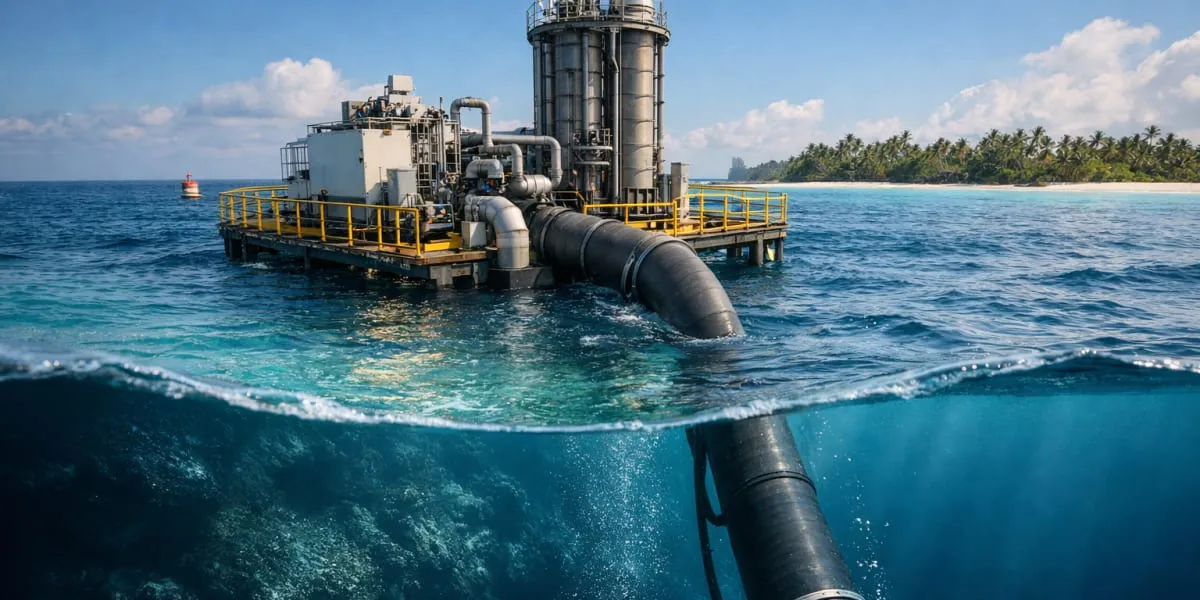
During the inspection the minister examined the seawater intake, the deep sea cold water pipeline, the turbine generator unit and the desalination modules and engaged with scientists, engineers and project personnel. Officials said the OTEC system is intended to function as a continuous renewable energy source and could reduce reliance on diesel desalination units while lowering fuel transportation costs and emissions. The technology was described as more consistent than solar or wind because it does not depend on short term weather.

Project officials explained that development is constrained by seabed conditions such as coral formations, rocky strata and trenches, and that operations are limited by narrow windows during monsoon months and rough sea conditions. They said these logistical and engineering challenges require specialised design and careful planning to protect the marine environment while maintaining timelines. Plans were outlined for an offshore demonstration under the Deep Ocean Mission to test deployment modalities.

Officials said the Kavaratti plant would help address long standing freshwater challenges caused by limited groundwater, salinity intrusion and dependence on seasonal rainfall and that the initiative forms part of the Blue Economy framework to strengthen infrastructure, energy security and climate resilience in island territories. With commissioning of the plant India aims to join other countries operating OTEC facilities and to explore the technology's potential for other tropical island regions and coastal areas. The effort was positioned as a step towards self reliant clean sources and sustained improvement in ease of living for island communities.

Union Minister for Earth Sciences and Science and Technology Dr Jitendra Singh reviewed progress on an Ocean Thermal Energy Conversion (OTEC) project during a visit to Kavaratti in Lakshadweep as the government seeks to strengthen freshwater supply and renewable energy in island territories. The project converts the temperature difference between warm surface water and cold deep sea water into energy to run desalination systems and produce potable water for the island community. Officials briefed the minister on technical progress, commissioning timelines and environmental safeguards. During the inspection the minister examined the seawater intake, the deep sea cold water pipeline, the turbine generator unit and the desalination modules and engaged with scientists, engineers and project personnel. Officials said the OTEC system is intended to function as a continuous renewable energy source and could reduce reliance on diesel desalination units while lowering fuel transportation costs and emissions. The technology was described as more consistent than solar or wind because it does not depend on short term weather. Project officials explained that development is constrained by seabed conditions such as coral formations, rocky strata and trenches, and that operations are limited by narrow windows during monsoon months and rough sea conditions. They said these logistical and engineering challenges require specialised design and careful planning to protect the marine environment while maintaining timelines. Plans were outlined for an offshore demonstration under the Deep Ocean Mission to test deployment modalities. Officials said the Kavaratti plant would help address long standing freshwater challenges caused by limited groundwater, salinity intrusion and dependence on seasonal rainfall and that the initiative forms part of the Blue Economy framework to strengthen infrastructure, energy security and climate resilience in island territories. With commissioning of the plant India aims to join other countries operating OTEC facilities and to explore the technology's potential for other tropical island regions and coastal areas. The effort was positioned as a step towards self reliant clean sources and sustained improvement in ease of living for island communities.

Next Story
Infrastructure Urban

Implementation Status of Jal Jeevan Mission

Since August 2019 the Government has implemented Jal Jeevan Mission to provide assured potable water through household tap connections in rural India. At the start of the mission only 32.3 million (mn) rural households, representing 16.7 per cent, were reported to have tap water connections. States and union territories have reported that 125.8 mn additional rural households have since been provided with tap connections. As a result, of about 193.6 mn rural households roughly 158.2 mn, or 81.71 per cent, are reported to have tap water supply at home.\n\nThe State, district and village level st..

Next Story
Infrastructure Urban

Jal Jeevan Mission Reaches Eighty One Per Cent Rural Coverage

The Government reported substantial progress under the Jal Jeevan Mission, launched in August 2019 to provide tap water to every rural household. At launch only 32.3 million (mn) rural households had tap connections and states and Union territories reported provision of 125.8 mn additional households by March 2026. Consequently, out of about 193.6 mn rural households around 158.2 mn, or 81.71 per cent, are reported to have tap water at home. The Finance Minister announced extension of the mission until 2028 in the 2025-26 budget speech. The Swachh Bharat Mission Grameen, launched in October 20..

Next Story
Infrastructure Urban

Empowering Local Governance for Sustainable Rural Water Supply

The Ministry of Jal Shakti has aligned the Jal Jeevan Mission (JJM) with the 73rd Amendment to strengthen village level planning and community ownership of water supply. Gram Panchayats, village water and sanitation committees and Pani Samitis are to plan, implement, manage and maintain piped water systems, with gram sabha processes formalising handover and oversight. Implementation support agencies including non government organisations, community based organisations and self help groups have been empanelled to train local committees and promote women participation. Under JJM, the department ..

Advertisement

Subscribe to Our Newsletter

Get daily newsletters around different themes from Construction world.

STAY CONNECTED

Advertisement

Advertisement

Advertisement