India's Rooftop Solar Growth Lopsided Across States
POWER & RENEWABLE ENERGY

India's Rooftop Solar Growth Lopsided Across States

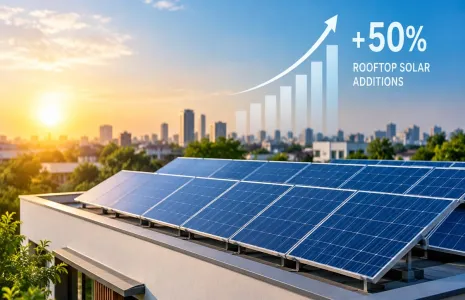
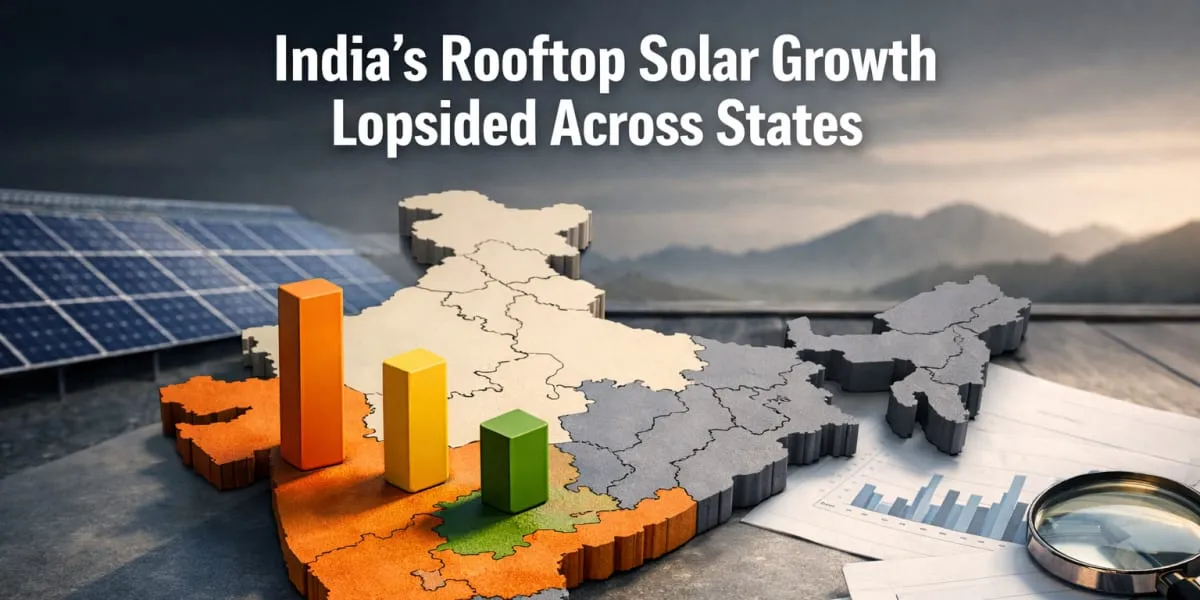
A new analysis finds that India is rapidly expanding rooftop solar capacity but the growth is highly uneven across states. The report indicates significant additions concentrated in western and southern regions while large parts of the east and northeast remain underdeveloped. The study measures capacity in megawatt (MW) and compares state-level deployment using recent central data.

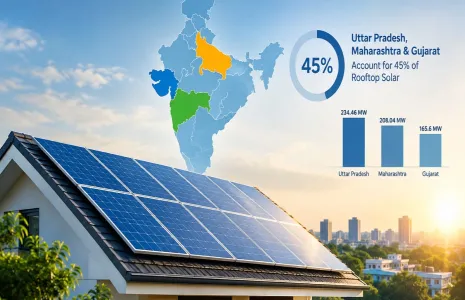
As of March, Gujarat stood at 6,882 MW, Maharashtra at 5,442 MW and Kerala at 1,850 MW of rooftop installations, reflecting strong uptake in those states. The analysis attributes the concentration to stronger market development, more supportive state policies, higher urbanisation and greater availability of financing and technical services in those regions. These factors have helped commercial and residential consumers adopt distributed solar more rapidly than in other areas.

By contrast, eastern and northeastern states recorded much lower deployment: Odisha at 156 MW, West Bengal at 67 MW, Jharkhand at 95 MW and Assam at 344 MW. The analysis notes that the uneven rollout leaves large populations without access to local clean generation and reduces opportunities for local economic benefits. It also observes that grid constraints, limited consumer awareness and weaker incentive programmes in some states have impeded wider adoption.

Meeting national targets of a 47 per cent cut in emissions intensity of gross domestic product and achieving 60 per cent non-fossil installed power capacity by 2035 will require more balanced expansion across all states. The report recommends targeted state-level programmes, improved grid integration, streamlined permitting and enhanced financial support to accelerate rooftop uptake in lagging regions. Effective coordination between central and state authorities, combined with local implementation, is presented as essential to close the regional gap.

"Join industry leaders at RAHSTA Expo, India's premier platform for roads, highways and traffic infrastructure. Register now to explore innovations, network with experts and shape the future of mobility."

A new analysis finds that India is rapidly expanding rooftop solar capacity but the growth is highly uneven across states. The report indicates significant additions concentrated in western and southern regions while large parts of the east and northeast remain underdeveloped. The study measures capacity in megawatt (MW) and compares state-level deployment using recent central data. As of March, Gujarat stood at 6,882 MW, Maharashtra at 5,442 MW and Kerala at 1,850 MW of rooftop installations, reflecting strong uptake in those states. The analysis attributes the concentration to stronger market development, more supportive state policies, higher urbanisation and greater availability of financing and technical services in those regions. These factors have helped commercial and residential consumers adopt distributed solar more rapidly than in other areas. By contrast, eastern and northeastern states recorded much lower deployment: Odisha at 156 MW, West Bengal at 67 MW, Jharkhand at 95 MW and Assam at 344 MW. The analysis notes that the uneven rollout leaves large populations without access to local clean generation and reduces opportunities for local economic benefits. It also observes that grid constraints, limited consumer awareness and weaker incentive programmes in some states have impeded wider adoption. Meeting national targets of a 47 per cent cut in emissions intensity of gross domestic product and achieving 60 per cent non-fossil installed power capacity by 2035 will require more balanced expansion across all states. The report recommends targeted state-level programmes, improved grid integration, streamlined permitting and enhanced financial support to accelerate rooftop uptake in lagging regions. Effective coordination between central and state authorities, combined with local implementation, is presented as essential to close the regional gap.

Next Story
Infrastructure Transport

RITES Expands NUPPL Railway Siding Contract To Rs1,489.3 mn

RITES Limited has expanded the scope of its railway siding contract with Neyveli Uttar Pradesh Power Limited (NUPPL), increasing the contract value to Rs1,489.3 million (mn) from Rs1,201.3 million (mn). The revision covers comprehensive operation and maintenance of the NUPPL/GTPP railway siding and includes hiring of locomotives on a wet-lease basis. The locomotive hire is for a period of 48 months and forms part of the extended operational scope under the agreement. The overall execution period remains five years from the original Memorandum of Understanding dated 13 February 2025, with the e..

Next Story
Infrastructure Urban

India Office Leasing Rises Six Per Cent In H1 2026

A Colliers India report said India's Grade A office market recorded gross leasing of 35.7 million (mn) square feet in the first half of 2026, up six per cent year-on-year despite a softer second quarter amid global trade disruptions. Leasing in April–June totalled 17.4 mn square feet, down two per cent from a year earlier, while Grade A absorption exceeded 15 mn square feet for the ninth consecutive quarter across seven markets. Demand was supported by Global Capability Centres (GCCs), technology firms and flexible workspace operators. Bengaluru led leasing with 10.5 mn square feet in H1 and..

Next Story
Real Estate

PE Investments Fall 23 per cent To Rs 1.13 bn In H1 2026

Private equity investments in the Indian real estate sector fell 23 per cent year-on-year to Rs 1.13 billion (bn) in the first half of 2026, down from Rs 1.47 bn in H1 of 2025, as investors adopted a more selective approach amid elevated global interest rates, tighter financial conditions and heightened geopolitical uncertainty. The finding appears in Knight Frank's Trends in Private Equity Investment in India: H1 2026 report. Despite the overall decline, the office segment remained the preferred asset class, accounting for 89 per cent of private equity allocations in H1 2026, with the residen..

Advertisement

Subscribe to Our Newsletter

Get daily newsletters around different themes from Construction world.

STAY CONNECTED

Advertisement

Advertisement

Advertisement