+
Jharkhand Issues Tender For Solar Mini Grids In Remote Villages
POWER & RENEWABLE ENERGY

Jharkhand Issues Tender For Solar Mini Grids In Remote Villages

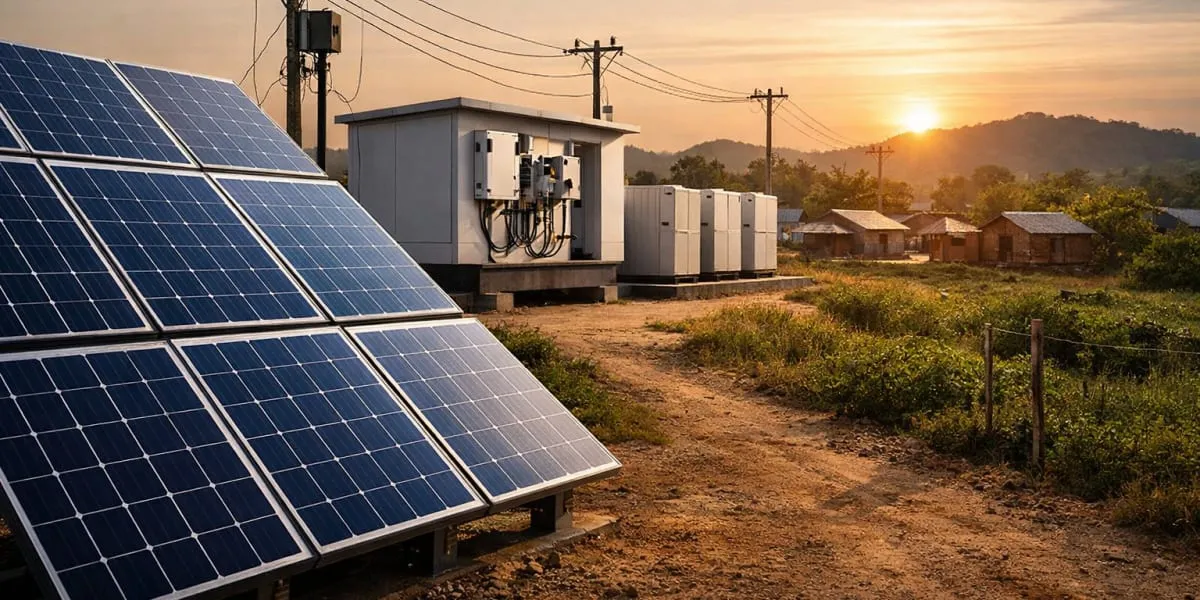
The Jharkhand Renewable Energy Development Agency (JREDA) has invited bids for design, manufacture, supply, installation and commissioning of solar photovoltaic mini and micro-grid systems across villages as part of its rural electrification programme targeting remote and underserved regions. The tender covers projects including battery storage, distribution infrastructure, control rooms and household connectivity under a five-year rate contract. The deadline for submission of bids is May 28.

The tender seeks empanelment of contractors to execute systems grouped by capacity into four categories. Group A covers one to 10 kWp, Group B covers 11 to 50 kWp, Group C covers 51 to 100 kWp, and Group D covers above 100 kWp. The scope includes the supply and commissioning of complete solar mini-grid systems along with the construction of control rooms for battery banks and power conditioning units.

JREDA has fixed estimated benchmark rates excluding GST at Rs 0.258 million (Rs 0.258 million) per kWp for Group A, Rs 0.207 million (Rs 0.207 million) per kWp for Group B, Rs 0.216 million (Rs 0.216 million) per kWp for Group C and Rs 0.227 million (Rs 0.227 million) per kWp for Group D. Agencies will develop distribution networks, install energy meters, provide chain-link fencing and ensure household connections. Bidders must conduct pre-feasibility studies, site surveys and obtain recommendations from village-level committees and local representatives.

The tender mandates deployment of at least two skilled personnel at each village site for round-the-clock monitoring and requires contractors to maintain spare inventory and provide prompt maintenance during the five-year O&M period. Technical eligibility criteria require prior experience in design, engineering, supply, installation and commissioning of solar power plants, with general category bidders needing either one 50 kWp project or three 10 kWp projects in the last seven years to qualify for Group B. Agencies must seek site changes from JREDA where villages are already connected to the conventional grid.

The Jharkhand Renewable Energy Development Agency (JREDA) has invited bids for design, manufacture, supply, installation and commissioning of solar photovoltaic mini and micro-grid systems across villages as part of its rural electrification programme targeting remote and underserved regions. The tender covers projects including battery storage, distribution infrastructure, control rooms and household connectivity under a five-year rate contract. The deadline for submission of bids is May 28. The tender seeks empanelment of contractors to execute systems grouped by capacity into four categories. Group A covers one to 10 kWp, Group B covers 11 to 50 kWp, Group C covers 51 to 100 kWp, and Group D covers above 100 kWp. The scope includes the supply and commissioning of complete solar mini-grid systems along with the construction of control rooms for battery banks and power conditioning units. JREDA has fixed estimated benchmark rates excluding GST at Rs 0.258 million (Rs 0.258 million) per kWp for Group A, Rs 0.207 million (Rs 0.207 million) per kWp for Group B, Rs 0.216 million (Rs 0.216 million) per kWp for Group C and Rs 0.227 million (Rs 0.227 million) per kWp for Group D. Agencies will develop distribution networks, install energy meters, provide chain-link fencing and ensure household connections. Bidders must conduct pre-feasibility studies, site surveys and obtain recommendations from village-level committees and local representatives. The tender mandates deployment of at least two skilled personnel at each village site for round-the-clock monitoring and requires contractors to maintain spare inventory and provide prompt maintenance during the five-year O&M period. Technical eligibility criteria require prior experience in design, engineering, supply, installation and commissioning of solar power plants, with general category bidders needing either one 50 kWp project or three 10 kWp projects in the last seven years to qualify for Group B. Agencies must seek site changes from JREDA where villages are already connected to the conventional grid.

Related Stories

Gold Stories

Next Story
Real Estate

We engineer the way architecture gets built

DALBIR SINGH, Founder, HAACE, on the company’s bespoke approach to translating ambitious architecture into precisely engineered and executed structures.What does bespoke construction mean to HAACE, and how is it different from conventional contracting?For HAACE, bespoke construction means choosing the construction methodology around the design rather than forcing the design into a standard template. Every project is studied around its architectural intent, structural requirements and execution challenges. We deliberately take on a limited number of projects because this approach demands atte..

Next Story
Real Estate

Kamdhenu Realities acquires 4-acre Navi Mumbai land parcel

Kamdhenu Realities has acquired a 4-acre land parcel from RPG Life Sciences on Thane-Belapur Road for approximately Rs 1.5 billion, expanding its commercial real estate portfolio in Navi Mumbai.The parcel has a total developable potential of 1.8 million sq ft, on which Kamdhenu plans to develop a destination-scale commercial and lifestyle ecosystem. The proposed development will combine corporate office suites with high-street retail, F&B outlets, double-height lobbies, business infrastructure and lifestyle amenities.Located close to IKEA and opposite the upcoming Pawane Railway Station, t..

Next Story
Infrastructure Transport

97 Per Cent Of Rongjeng-Mangsang-Adokgre Road Nears Completion

Deputy Chief Minister in-charge of public works Prestone Tynsong said in Shillong on 26 August that 97 per cent physical progress had been achieved on the ongoing Rongjeng-Mangsang-Adokgre road being constructed under the Non-Lapsable Central Pool of Resources (NLCPR). He noted the project was sanctioned in 2017 and that the stipulated time for completion had been 24 months from issue of the final work order. The deputy chief minister informed the assembly that the government had decided to include the remaining work under a World Bank project. In reply to a query from Rongjeng MLA Jim M Sangm..

Advertisement

Subscribe to Our Newsletter

Get daily newsletters around different themes from Construction world.

STAY CONNECTED

Advertisement

SPECIAL OFFER
QR Code