KSERC Seeks Clarity On 59.2 MW Renewable Grid Connectivity
POWER & RENEWABLE ENERGY

KSERC Seeks Clarity On 59.2 MW Renewable Grid Connectivity

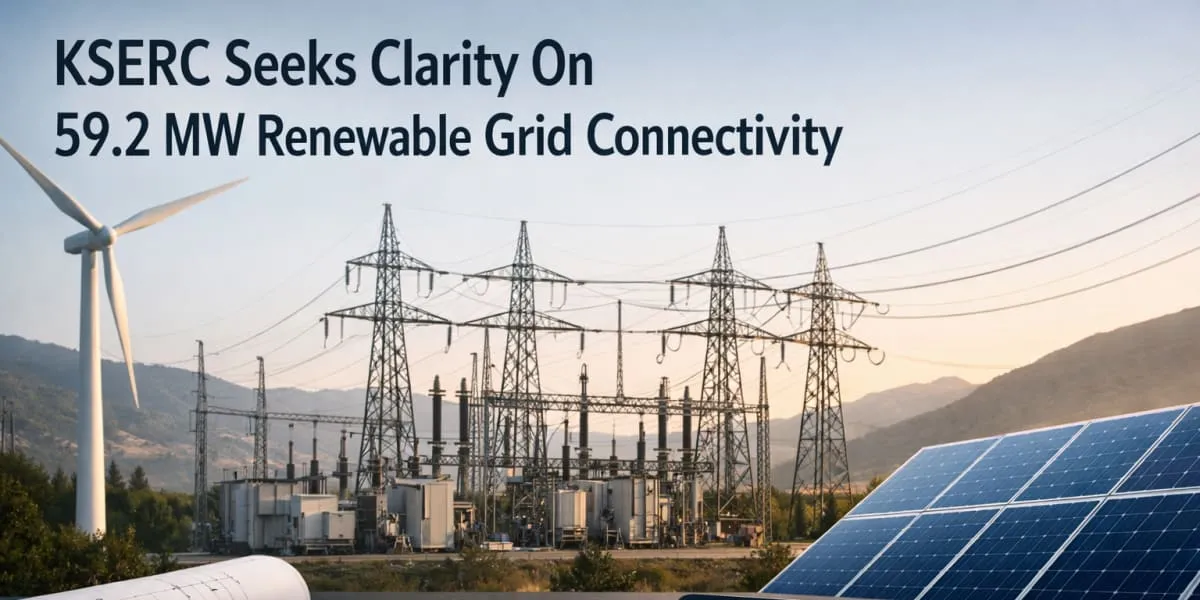
The Kerala State Electricity Regulatory Commission sought technical clarity on grid connectivity for renewable projects totalling 59.2 megawatt (MW) in Palakkad and Malappuram. It directed Kerala State Electricity Board Limited and INKEL to provide additional technical and project details in a dispute over evacuation arrangements. The petition was filed by INKEL and its subsidiaries after KSEB Ltd. restricted connectivity at the 33 kV level to 14.4 MW/14.4 MVA.

INKEL argued that the limits in the Kerala Electricity Supply Code, 2014, apply to consumer loads and should not automatically cap generating stations. It said a 33 kV feeder capacity should be decided by conductor capability and voltage regulation rather than by a fixed ceiling, and sought permission to evacuate full project capacity via parallel 33 kV feeders where feasible. One project is a 36 MW solar?wind hybrid at Vadakarapathy with 18 MW of wind and 18 MW of solar.

The second scheme is a 23.2 MW group captive solar project at Panakkad, where INKEL temporarily reduced interactive capacity to 14.4 MW because of unresolved line interlinking issues, leaving remaining capacity pending. KSEB said evacuation above 14.4 MW would require an upgrade to 110 kV or special approval from the Commission for parallel 33 kV lines. KSEB referred to Regulations 4 and 57 of the State Grid Code and Regulation 8A of the Supply Code and noted that higher voltage limits may be exceeded by up to 20 per cent only under specified circumstances.

KSERC members emphasised the need for a swift resolution, noting that wind generation can support peak hour requirements while solar contributes during daytime and delays could increase project costs. The Commission said KSEB field officials were unable to provide complete technical information at the hearing and therefore directed INKEL to submit detailed PERT charts covering timelines, costs, injection points and execution status. KSEB has been given two weeks to file a counter?affidavit and INKEL will have one week thereafter to respond, while concerned KSEB chief engineers must attend the next hearing with full technical details.

The Kerala State Electricity Regulatory Commission sought technical clarity on grid connectivity for renewable projects totalling 59.2 megawatt (MW) in Palakkad and Malappuram. It directed Kerala State Electricity Board Limited and INKEL to provide additional technical and project details in a dispute over evacuation arrangements. The petition was filed by INKEL and its subsidiaries after KSEB Ltd. restricted connectivity at the 33 kV level to 14.4 MW/14.4 MVA. INKEL argued that the limits in the Kerala Electricity Supply Code, 2014, apply to consumer loads and should not automatically cap generating stations. It said a 33 kV feeder capacity should be decided by conductor capability and voltage regulation rather than by a fixed ceiling, and sought permission to evacuate full project capacity via parallel 33 kV feeders where feasible. One project is a 36 MW solar?wind hybrid at Vadakarapathy with 18 MW of wind and 18 MW of solar. The second scheme is a 23.2 MW group captive solar project at Panakkad, where INKEL temporarily reduced interactive capacity to 14.4 MW because of unresolved line interlinking issues, leaving remaining capacity pending. KSEB said evacuation above 14.4 MW would require an upgrade to 110 kV or special approval from the Commission for parallel 33 kV lines. KSEB referred to Regulations 4 and 57 of the State Grid Code and Regulation 8A of the Supply Code and noted that higher voltage limits may be exceeded by up to 20 per cent only under specified circumstances. KSERC members emphasised the need for a swift resolution, noting that wind generation can support peak hour requirements while solar contributes during daytime and delays could increase project costs. The Commission said KSEB field officials were unable to provide complete technical information at the hearing and therefore directed INKEL to submit detailed PERT charts covering timelines, costs, injection points and execution status. KSEB has been given two weeks to file a counter?affidavit and INKEL will have one week thereafter to respond, while concerned KSEB chief engineers must attend the next hearing with full technical details.

Related Stories

Gold Stories

Next Story
Infrastructure Urban

Bajaj Auto to Raise Monthly Electric 2W Capacity to 80,000 by March

Bajaj Auto plans to raise monthly production capacity for electric two-wheelers to around 80,000 units by the end of March, as demand for its Chetak electric scooter continues to exceed available output. The company currently has capacity for around 60,000 electric two-wheelers a month. Joint Managing Director Rakesh Sharma said production had returned to the existing full capacity after a supply chain disruption affected output. The issue had reduced recent production to around 40,000 units, resulting in a shortfall of 20,000 vehicles despite strong demand. The company expects to remove produ..

Next Story
Infrastructure Transport

India’s Domestic Air Passenger Traffic Falls 6.5% in September

India’s domestic air passenger traffic declined 6.49 per cent month on month to 11.8 mn in September, according to data released by the Directorate General of Civil Aviation (DGCA). IndiGo retained its leading position, carrying nearly two-thirds of domestic passengers, while the Air India Group remained the second-largest operator. IndiGo held a 65.4 per cent market share and transported 7.73 mn passengers during the month. The Air India Group accounted for 26.8 per cent of the market, carrying 3.165 mn passengers, based on data from the aviation regulator. Akasa Air ranked third with a 5.6..

Next Story
Infrastructure Urban

DPIIT Advances Trust-Based Governance Across India

The Department for Promotion of Industry and Internal Trade (DPIIT), under the Ministry of Commerce and Industry, is shifting India’s regulatory approach from permission-based administration to trust-based governance. The reforms seek to reduce business compliance, support startups, attract investment and simplify approvals across the country. According to an official statement, 47,957 compliance requirements have been reduced across Central Ministries and States and Union Territories. Of these, 22,290 have been digitised, 16,141 simplified, 5,255 decriminalised and 4,271 eliminated. The Jan..

Advertisement

Subscribe to Our Newsletter

Get daily newsletters around different themes from Construction world.

STAY CONNECTED

Advertisement

SPECIAL OFFER
QR Code