POM Power Eyes Hybrid Inverters BESS And EV Chargers
POWER & RENEWABLE ENERGY

POM Power Eyes Hybrid Inverters BESS And EV Chargers

POM Power is reporting a steady rise in demand for hybrid inverters across India, driven mainly by residential customers seeking backup-integrated solar systems. The firm is receiving particularly strong interest in Uttar Pradesh, Tamil Nadu and Rajasthan, with enquiry levels having increased significantly over the past two years. Conversion of enquiries into projects remains slow because of financial considerations among buyers.

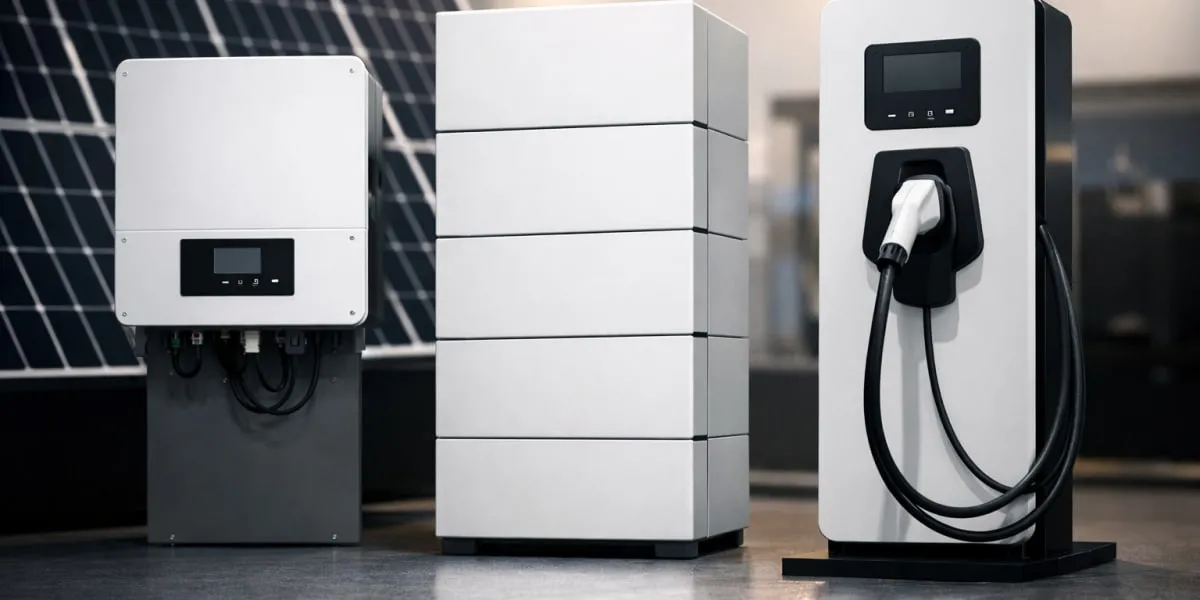
At a recent industry exhibition in Chennai the company showcased a range of products including electric vehicle (EV) chargers, hybrid inverters, energy storage systems and on-grid inverters as well as microinverters. The hybrid inverter portfolio spans from two kilowatt (kW) to 50 kW while the on-grid inverter range extends from two kW to 350 kW. The company has commercially launched its EV chargers after completing testing and certification processes.

The systems are compatible with multiple battery technologies such as lead-acid, tubular and lithium batteries, and the firm emphasises interoperability across chemistries. POM Power is offering lithium-based energy storage systems from 50 kW to two megawatt (MW) capacity and intends to scale up its battery energy storage system offerings. The company reports that sourcing high-quality batteries remains a challenge for larger deployments.

Demand for microinverter solutions is rising gradually, particularly in the residential rooftop segment where space constraints favour modular products. POM Power already markets microinverter units for both on-grid and hybrid applications and is monitoring market uptake. Overseas procurement of batteries has proved time-consuming, prompting exploration of domestic sourcing options.

Beyond inverters and storage the firm has introduced smart solar-powered water heater controllers that use photovoltaic panels and switch to grid power only when solar energy is insufficient. The company has received encouraging responses in domestic and overseas markets and is watching developments around domestic solar cell manufacturing norms and potential supply shortages. It has refrained from making firm projections on installation trends while assessing market and policy signals.

POM Power is reporting a steady rise in demand for hybrid inverters across India, driven mainly by residential customers seeking backup-integrated solar systems. The firm is receiving particularly strong interest in Uttar Pradesh, Tamil Nadu and Rajasthan, with enquiry levels having increased significantly over the past two years. Conversion of enquiries into projects remains slow because of financial considerations among buyers. At a recent industry exhibition in Chennai the company showcased a range of products including electric vehicle (EV) chargers, hybrid inverters, energy storage systems and on-grid inverters as well as microinverters. The hybrid inverter portfolio spans from two kilowatt (kW) to 50 kW while the on-grid inverter range extends from two kW to 350 kW. The company has commercially launched its EV chargers after completing testing and certification processes. The systems are compatible with multiple battery technologies such as lead-acid, tubular and lithium batteries, and the firm emphasises interoperability across chemistries. POM Power is offering lithium-based energy storage systems from 50 kW to two megawatt (MW) capacity and intends to scale up its battery energy storage system offerings. The company reports that sourcing high-quality batteries remains a challenge for larger deployments. Demand for microinverter solutions is rising gradually, particularly in the residential rooftop segment where space constraints favour modular products. POM Power already markets microinverter units for both on-grid and hybrid applications and is monitoring market uptake. Overseas procurement of batteries has proved time-consuming, prompting exploration of domestic sourcing options. Beyond inverters and storage the firm has introduced smart solar-powered water heater controllers that use photovoltaic panels and switch to grid power only when solar energy is insufficient. The company has received encouraging responses in domestic and overseas markets and is watching developments around domestic solar cell manufacturing norms and potential supply shortages. It has refrained from making firm projections on installation trends while assessing market and policy signals.

Related Stories

Gold Stories

Next Story
Products

Koemmerling opens Navi Mumbai experience centre

Koemmerling, a brand of the profine Group, has expanded its presence in the Mumbai metropolitan region with the opening of a new experience centre in Navi Mumbai and launched its Allure S46 minimal sliding door system for the Indian market.Located in CBD Belapur, the facility was inaugurated by Peter Mrosik, Owner and CEO, profine Group, along with Farid Khan, Chairman and Managing Director, profine India, and Kamal Bajaj, CEO, profine India.The company said the new centre will showcase its portfolio of uPVC and aluminium window and door systems to architects, developers and homeowners.The ina..

Next Story
Products

India's waterproofing market nears Rs 150 bn milestone

India's waterproofing industry is approaching a market size of Rs 150 billion and is expected to surpass the $2 billion milestone, according to speakers at the 2nd India International Waterproofers Conference & Expo 2026 organised by the Waterproofers Association of India (WAI) in New Delhi.The two-day event brought together more than 20 speakers, 55 international delegates and 53 exhibition booths, with discussions focusing on climate-resilient construction, advanced waterproofing technologies and international collaboration.Inaugurating the event, Durga Shanker Mishra, former Secretary, ..

Next Story
Real Estate

Dilip Buildcon Q1 FY27 Revenue at Rs 23.78 billion

Dilip Buildcon Limited reported consolidated revenue from operations of Rs 2,378 crore in Q1 FY27, along with EBITDA of Rs 429 crore and profit after tax of Rs 128 crore.Consolidated EBITDA margin stood at 18.1%, improving from 17.1% in Q4 FY26. On a standalone basis, revenue from operations was Rs 1,930 crore, EBITDA stood at Rs 199 crore and PAT was Rs 39 crore, with an EBITDA margin of 10.3%.The company’s order book stood at Rs 27,691 crore as of 30 June 2026, compared with Rs 28,830 crore as of 31 March 2026. Roads and highways accounted for 17.1% of the order book, irrigation and water ..

Advertisement

Subscribe to Our Newsletter

Get daily newsletters around different themes from Construction world.

STAY CONNECTED

Advertisement