Tata Power And University Of Warwick Forge Strategic Alliance
POWER & RENEWABLE ENERGY

Tata Power And University Of Warwick Forge Strategic Alliance

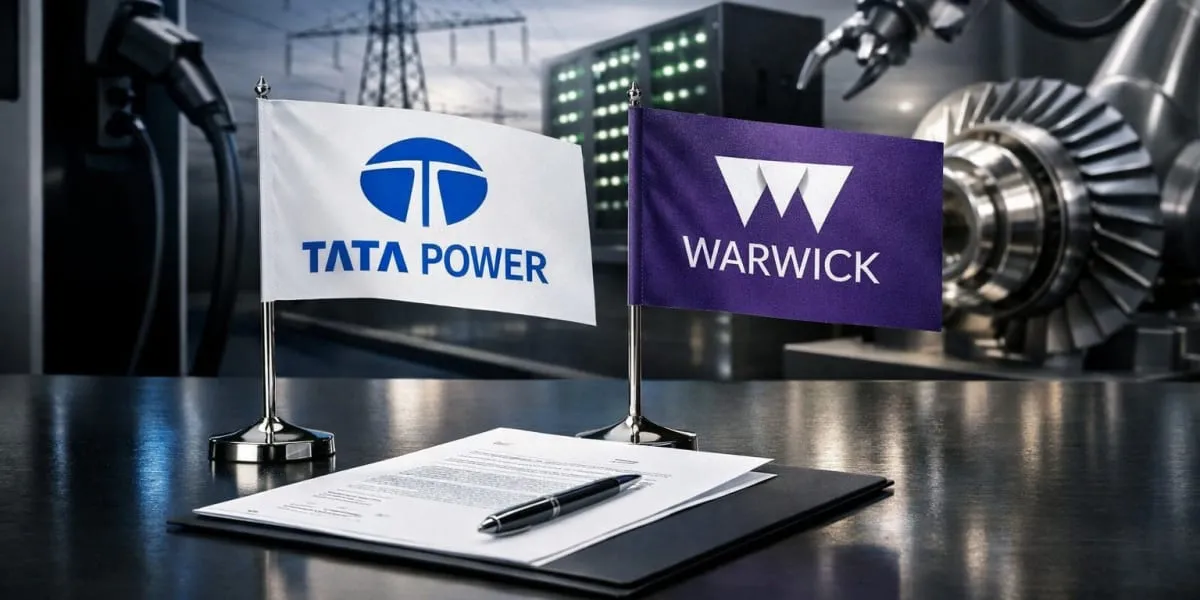
The Tata Power Company Limited has signed a memorandum of understanding with the University of Warwick to advance research and innovation in electricity systems. The agreement will focus on grid modernisation, fast charging, power storage, industrial decarbonisation, digital energy systems, optimisation and advanced manufacturing approaches. The partnership is intended to align academic research with industry priorities to accelerate scalable solutions for the energy transition.

The collaboration will also explore executive education programmes, capability development, exchange opportunities, technical workshops and joint case study development to strengthen long-term research capability and talent development. It builds on expertise at Warwick Manufacturing Group and the School of Engineering and on a renewed institutional focus on energy systems. These measures are expected to support industrial partners in decarbonisation and system-level innovation.

Tata Power has a diversified portfolio totalling 16.3 gigawatt (GW) across the power value chain, including generation, transmission, distribution, trading, storage and manufacturing. The company has seven point five GW of clean energy, representing 46 per cent of its total capacity, and serves 13 million (mn) customers nationwide. Tata Power has set a target of Net Zero by 2045 and the new alliance is intended to accelerate progress towards reliable and affordable decarbonised power.

The University of Warwick will apply systems-level research spanning semiconductors, power electronics, machines and drives, advanced control and artificial intelligence to translate academic capability into industrial impact. Warwick Manufacturing Group has long applied research to industrial and societal challenges and the partnership with Tata Power builds on decades of collaboration and recent recognition, including the Lord Bhattacharyya Award in 2025. Both institutions plan to pursue joint projects that integrate renewable generation, energy storage and hydrogen technologies to develop resilient and economically viable decarbonisation pathways.

The Tata Power Company Limited has signed a memorandum of understanding with the University of Warwick to advance research and innovation in electricity systems. The agreement will focus on grid modernisation, fast charging, power storage, industrial decarbonisation, digital energy systems, optimisation and advanced manufacturing approaches. The partnership is intended to align academic research with industry priorities to accelerate scalable solutions for the energy transition. The collaboration will also explore executive education programmes, capability development, exchange opportunities, technical workshops and joint case study development to strengthen long-term research capability and talent development. It builds on expertise at Warwick Manufacturing Group and the School of Engineering and on a renewed institutional focus on energy systems. These measures are expected to support industrial partners in decarbonisation and system-level innovation. Tata Power has a diversified portfolio totalling 16.3 gigawatt (GW) across the power value chain, including generation, transmission, distribution, trading, storage and manufacturing. The company has seven point five GW of clean energy, representing 46 per cent of its total capacity, and serves 13 million (mn) customers nationwide. Tata Power has set a target of Net Zero by 2045 and the new alliance is intended to accelerate progress towards reliable and affordable decarbonised power. The University of Warwick will apply systems-level research spanning semiconductors, power electronics, machines and drives, advanced control and artificial intelligence to translate academic capability into industrial impact. Warwick Manufacturing Group has long applied research to industrial and societal challenges and the partnership with Tata Power builds on decades of collaboration and recent recognition, including the Lord Bhattacharyya Award in 2025. Both institutions plan to pursue joint projects that integrate renewable generation, energy storage and hydrogen technologies to develop resilient and economically viable decarbonisation pathways.

Next Story
Infrastructure Transport

AFCONS & Navayuga set world records with Missing Link Expressway

Maharashtra’s most ambitious greenfield bypass — a 13.3-km alignment carrying twin record-setting tunnels and India’s tallest cable-stayed road bridge — was thrown open to traffic on Maharashtra Day, finally completing the Mumbai–Pune Expressway after a 23-year wait. CW reports…The 650-m cable-stayed bridge over Tiger Valley at sunset — the package executed by Afcons Infrastructure Ltd carries 182-m pylons, the tallest on any Indian road bridge.On 1 May 2026, Chief Minister Devendra Fadnavis, flanked by Deputy Chief Ministers Eknath Shinde and Sunetra Pawar (representing the late..

Next Story
Infrastructure Transport

Mumbai–Pune Missing Link boosts realty prospects

The recently opened ‘missing link’ on the Mumbai–Pune Expressway is set to significantly transform connectivity between the two cities by reducing travel time and bypassing the challenging ghat section. The new alignment, featuring tunnels and viaducts, is designed to improve safety, ease congestion and ensure a smoother, faster commute for both passenger and commercial traffic.With improved travel efficiency, the corridor is expected to strengthen intercity movement, encouraging more frequent travel for work, leisure and logistics. This enhanced accessibility is likely to benefit real e..

Next Story
Infrastructure Urban

How Hormuz is Hijacking Indian Highways

At the recently held RAHSTA Round Table on 29th April in Pune, and earlier during our webinars for Cement Expo by Indian Cement Review and by FIRST Construction Council on manufacturing construction equipment for the world, one thread lay common: the industry is being subjected to a cost-push chain reaction moving from crude oil → freight/insurance → steel, cement fuel, bitumen, polymers, packaging, logistics and finally project margins. Indeed, the West Asia crisis caused by the war and the Hormuz Strait blockade, which does not directly concern us, has turned around and hit us. If the wa..

Advertisement

Subscribe to Our Newsletter

Get daily newsletters around different themes from Construction world.

STAY CONNECTED

Advertisement

Advertisement

Advertisement