+
TDB Funds Indigenous Supercapacitor Energy System
POWER & RENEWABLE ENERGY

TDB Funds Indigenous Supercapacitor Energy System

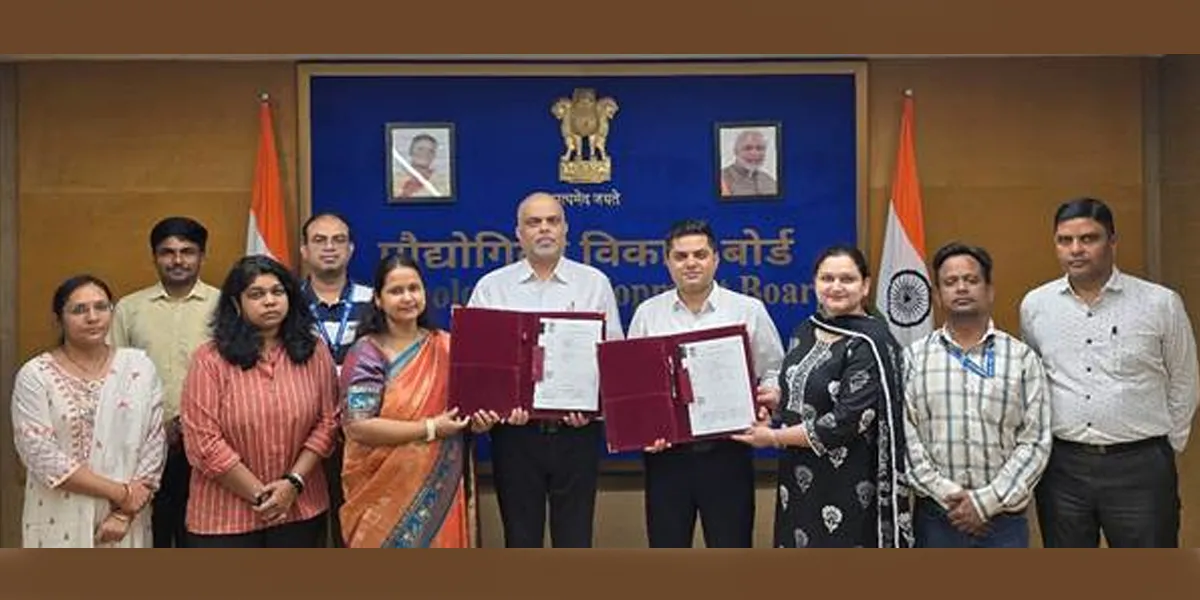
The Technology Development Board (TDB), under the Department of Science and Technology (DST), Government of India, has approved financial assistance to Westech Power Management Pvt Ltd, Pune, Maharashtra, for developing a Mobile High-Power Containerised Supercapacitor Energy Storage System. The initiative aims to strengthen India’s industrial and defence energy infrastructure through advanced indigenous technology.

The project seeks to design and commercialise a modular, high-performance supercapacitor-based energy storage system capable of rapid charging and discharging. These systems are essential for pulse power, grid stabilisation, industrial automation, and field-deployable defence applications—areas where traditional battery technologies often fall short. The innovation will enhance energy resilience, reduce dependence on imports, and promote domestic manufacturing in advanced energy systems.

Founded by Mr Amit Kaul Bamzai and Dr Rohini Bhat, Westech Power Management Pvt Ltd has been developing high-power density cells and medium to high-voltage containerised supercapacitor systems through sustained in-house research. Early-stage support from the Naval Materials Research Laboratory (NMRL), under the Defence Research and Development Organisation (DRDO), helped strengthen the company’s foundation in strategic, defence-oriented energy innovation.

Westech currently holds two granted patents — “A High-Capacity Supercapacitor Cell and Method Thereof” and “108 Volt Supercapacitor Module and Method Thereof” — along with five additional patents pending in electrode materials, pulse power banks, and scalable supercapacitor modules.

Commenting on the collaboration, Shri Rajesh Kumar Pathak, Secretary, TDB, said: “This initiative reflects TDB’s mission to promote the development and commercialisation of indigenous technologies with national impact. Supercapacitor-based systems are a strategic domain for achieving India’s energy independence, merging scientific innovation with industrial and defence applications. Through such projects, TDB continues to advance India’s transformation from a technology importer to a technology developer and exporter.”

The promoters of Westech Power Management expressed appreciation for the support, stating: “TDB’s funding will accelerate our transition from laboratory-scale innovation to full-scale deployment. The project will showcase India’s strength in supercapacitor technology and help build a sustainable, self-reliant energy ecosystem.”

By enabling the commercialisation of indigenous supercapacitor technology, TDB reinforces its role in advancing Aatmanirbhar Bharat, supporting deep-tech entrepreneurship, and driving the Make in India initiative towards globally competitive, high-impact energy solutions.

The Technology Development Board (TDB), under the Department of Science and Technology (DST), Government of India, has approved financial assistance to Westech Power Management Pvt Ltd, Pune, Maharashtra, for developing a Mobile High-Power Containerised Supercapacitor Energy Storage System. The initiative aims to strengthen India’s industrial and defence energy infrastructure through advanced indigenous technology. The project seeks to design and commercialise a modular, high-performance supercapacitor-based energy storage system capable of rapid charging and discharging. These systems are essential for pulse power, grid stabilisation, industrial automation, and field-deployable defence applications—areas where traditional battery technologies often fall short. The innovation will enhance energy resilience, reduce dependence on imports, and promote domestic manufacturing in advanced energy systems. Founded by Mr Amit Kaul Bamzai and Dr Rohini Bhat, Westech Power Management Pvt Ltd has been developing high-power density cells and medium to high-voltage containerised supercapacitor systems through sustained in-house research. Early-stage support from the Naval Materials Research Laboratory (NMRL), under the Defence Research and Development Organisation (DRDO), helped strengthen the company’s foundation in strategic, defence-oriented energy innovation. Westech currently holds two granted patents — “A High-Capacity Supercapacitor Cell and Method Thereof” and “108 Volt Supercapacitor Module and Method Thereof” — along with five additional patents pending in electrode materials, pulse power banks, and scalable supercapacitor modules. Commenting on the collaboration, Shri Rajesh Kumar Pathak, Secretary, TDB, said: “This initiative reflects TDB’s mission to promote the development and commercialisation of indigenous technologies with national impact. Supercapacitor-based systems are a strategic domain for achieving India’s energy independence, merging scientific innovation with industrial and defence applications. Through such projects, TDB continues to advance India’s transformation from a technology importer to a technology developer and exporter.” The promoters of Westech Power Management expressed appreciation for the support, stating: “TDB’s funding will accelerate our transition from laboratory-scale innovation to full-scale deployment. The project will showcase India’s strength in supercapacitor technology and help build a sustainable, self-reliant energy ecosystem.” By enabling the commercialisation of indigenous supercapacitor technology, TDB reinforces its role in advancing Aatmanirbhar Bharat, supporting deep-tech entrepreneurship, and driving the Make in India initiative towards globally competitive, high-impact energy solutions.

Next Story
Infrastructure Transport

MMRDA Installs 325-Tonne Steel Spans on Mumbai Metro Line 4

The Mumbai Metropolitan Region Development Authority (MMRDA) has achieved a key construction milestone on Metro Line 4 with the successful installation of three large steel spans at Bhandup West during overnight operations.The spans, together weighing 325 metric tonnes, were launched using eight heavy-duty cranes and 12 multi-axle vehicles. The operation required precise engineering and meticulous planning to minimise disruption in the densely populated suburban area.Due to effective inter-agency coordination, the work—originally scheduled across four nights—was completed within just two n..

Next Story
Infrastructure Transport

CMRL Targets March 2027 Opening for Vadapalani–Panagal Park

Chennai Metro Rail Limited (CMRL) is progressing as scheduled to open the Vadapalani–Panagal Park section of Phase II’s Corridor 4 by March 2027. The 3.5 km underground stretch is part of the 26.1 km Corridor 4 connecting Lighthouse with Poonamallee Bypass.Construction activities are advancing steadily, with tunnelling works between Vadapalani and Panagal Park already completed. Track-laying operations are expected to commence shortly. At Panagal Park station, structural works have reached the concourse and platform levels, while excavation continues at the lowest level.CMRL is also consid..

Next Story
Infrastructure Transport

Maha-Metro Invites Pune Metro Civil Maintenance Bids

Maharashtra Metro Rail Corporation Limited (Maha-Metro) has invited bids for the annual civil maintenance contract of the Pune Metro Rail Project. The tender, bearing ID and number P1-O&M-20/2025, is scheduled to close on 23 February 2026, with a pre-bid meeting slated for 10 February 2026. The earnest money deposit (EMD) for the contract is Rs 3,50,500, and the duration of the contract is one year.The scope of work includes annual civil maintenance of 28 elevated and underground stations, 28.079 km of elevated viaduct including steel bridges, 12.15 km of tunnels, and two depots under the ..

Advertisement

Subscribe to Our Newsletter

Get daily newsletters around different themes from Construction world.

STAY CONNECTED

Advertisement

Advertisement

Advertisement

Open In App