Winding Wires Poised To Benefit From India's Power Expansion
POWER & RENEWABLE ENERGY

Winding Wires Poised To Benefit From India's Power Expansion

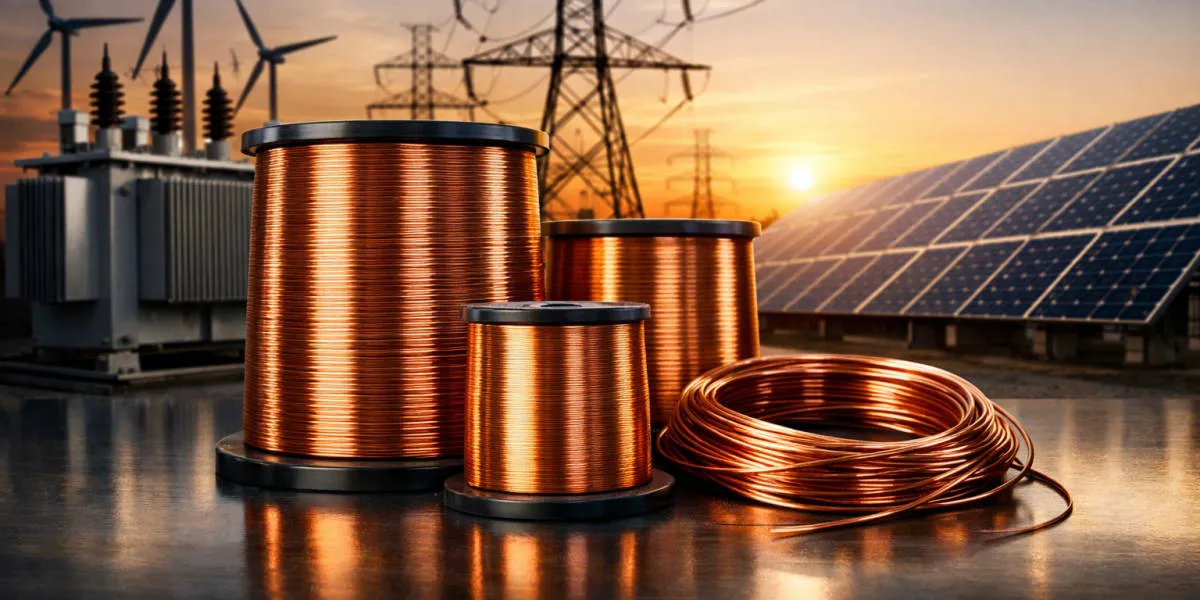
PhillipCapital said India’s winding wire industry is entering a structural growth phase driven by rapid electrification, rising investment in power transmission and distribution and greater renewable energy adoption. Winding wires, essential in transformers, motors and generators, provide direct exposure to the expanding power infrastructure and the energy transition. Demand from electric vehicles, data centres, industrial automation and heating, ventilation and air-conditioning is expected to support steady volume growth and offer margin expansion opportunities for organised manufacturers.

India plans to nearly double installed power generation capacity from around 442 GW in FY24 to about 900 GW by FY32, supported by more than Rs nine trillion (tn) of planned investment in transmission infrastructure. Expansion of substations, transmission lines and transformer capacity should drive long-term demand for distribution, power and speciality transformers, thereby supporting winding wire producers. The scale-up is likely to underpin investment in higher-quality inputs and greater manufacturing capacity across the sector.

Renewable energy and grid modernisation are cited as major growth drivers, with a non-fossil power capacity target of 612.7 GW by 2032 from 194 GW in 2024, implying a 15.5 per cent compound annual growth rate. Deployment of battery energy storage systems, smart grids and green hydrogen projects is expected to add demand for specialised winding wires used in transformers, generators and inverters. The industry is shifting towards higher-value products such as continuously transposed conductors and EV-grade winding wires, which have higher qualification barriers.

The brokerage said industry formalisation and the China plus one strategy could create opportunities as global supply chains diversify and exports of Indian transformers and motors increase. Copper is expected to remain the preferred conductor for critical applications because of its electrical and thermal properties, keeping demand strong from EV traction motors, renewable energy equipment, HVDC transformers, industrial automation and data centres. The report also pointed to a structural opportunity in copper tubes backed by the expanding HVAC market and lower air-conditioner penetration.

PhillipCapital said India’s winding wire industry is entering a structural growth phase driven by rapid electrification, rising investment in power transmission and distribution and greater renewable energy adoption. Winding wires, essential in transformers, motors and generators, provide direct exposure to the expanding power infrastructure and the energy transition. Demand from electric vehicles, data centres, industrial automation and heating, ventilation and air-conditioning is expected to support steady volume growth and offer margin expansion opportunities for organised manufacturers. India plans to nearly double installed power generation capacity from around 442 GW in FY24 to about 900 GW by FY32, supported by more than Rs nine trillion (tn) of planned investment in transmission infrastructure. Expansion of substations, transmission lines and transformer capacity should drive long-term demand for distribution, power and speciality transformers, thereby supporting winding wire producers. The scale-up is likely to underpin investment in higher-quality inputs and greater manufacturing capacity across the sector. Renewable energy and grid modernisation are cited as major growth drivers, with a non-fossil power capacity target of 612.7 GW by 2032 from 194 GW in 2024, implying a 15.5 per cent compound annual growth rate. Deployment of battery energy storage systems, smart grids and green hydrogen projects is expected to add demand for specialised winding wires used in transformers, generators and inverters. The industry is shifting towards higher-value products such as continuously transposed conductors and EV-grade winding wires, which have higher qualification barriers. The brokerage said industry formalisation and the China plus one strategy could create opportunities as global supply chains diversify and exports of Indian transformers and motors increase. Copper is expected to remain the preferred conductor for critical applications because of its electrical and thermal properties, keeping demand strong from EV traction motors, renewable energy equipment, HVDC transformers, industrial automation and data centres. The report also pointed to a structural opportunity in copper tubes backed by the expanding HVAC market and lower air-conditioner penetration.

Next Story
Infrastructure Urban

SCLR Extension Nears Completion Linking BKC With Signal-Free Route

The Santacruz-Chembur Link Road (SCLR) extension towards Bandra-Kurla Complex (BKC) via the Mumbai University campus has entered its final stage, bringing motorists closer to a direct, signal-free connection between the Western Express Highway and the city’s commercial district. The elevated connector is being built as an arm from the SCLR alignment and will link the western suburbs with BKC without surface signals. The link is designed to reduce journey times for commuters travelling from the western suburbs to BKC and to improve access to eastern Mumbai. By carrying through traffic above s..

Next Story
Infrastructure Transport

Raiganj MP Seeks Bengal Only Highway Link To Siliguri

Raiganj Member of Parliament Kartik Chandra Paul met Union Minister for Road Transport and Highways Nitin Gadkari in New Delhi to press for a new stretch of national highway in North Dinajpur district. He urged approval for a Bengal-to-Bengal link that would connect National Highways 12 and 27 to allow vehicles bound for Siliguri to avoid the current route through Kishanganj in neighbouring Bihar. He also submitted a proposed alignment of the new road to the ministry for consideration. At present vehicles from Raiganj travel along NH-12 and join NH-27 at Purnia More in Dalkhola, a route that p..

Next Story
Infrastructure Transport

Airport Kilambakkam Metro Line To Be Extended To Chengalpattu

Chennai Metro Rail (CMRL) has invited tenders for two detailed project reports that would extend its rail network to Chengalpattu in the south and extend Corridor-5 to Wimco Nagar in the north as part of a second wave of expansion beyond the operator's corridors under construction. The move signals an acceleration of planning for suburban links and interchange nodes. The larger of the two studies covers a roughly 27km extension from the planned Kilambakkam metro station to Chengalpattu under Corridor-1, Phase I. CMRL floated the tender at an estimated cost of Rs 21.6 mn. The proposed line woul..

Advertisement

Subscribe to Our Newsletter

Get daily newsletters around different themes from Construction world.

STAY CONNECTED

Advertisement

Advertisement

Advertisement