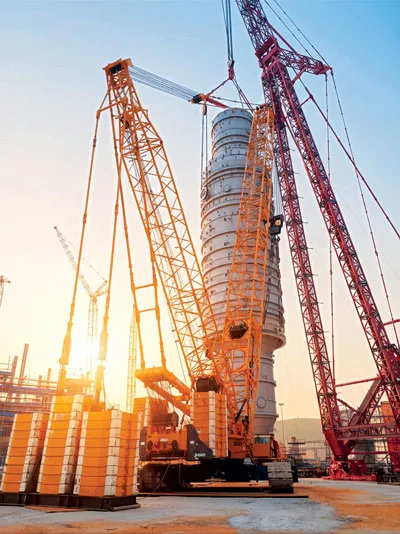
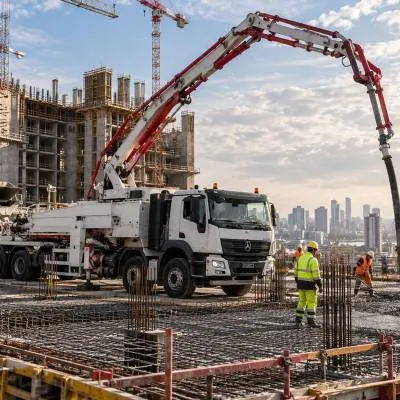
Renting the wrong construction equipment can play havoc with project deadlines and budgets. But what is the right equipment? CW explores further.Project cost overruns, safety incidents and low utilisation rarely come from execution alone – they start much earlier, at the moment a machine is selected, according to Ashishkumar Tiwari, Director, MyCrane. As for cranes, a construction equipment that is frequently rented instead of bought, he says, “Crane selection errors commence with the question ‘which crane is available?’ instead of ‘which crane does the job demand?’. Just this shift in thinking defines whether a project stays controlled or becomes reactive.”“Matching construction equipment capacity to a job is critical for safety, efficiency and cost control,” agrees Nikhil Tiwari, Owner, NVR Crane Services.Rental mythsOne of the biggest misconceptions in selecting a crane or access equipment is treating rated capacity as usable capacity, explains (Ashishkumar) Tiwari. “A 100-tonne crane is rarely a 100-tonne crane on site. Radius, boom configuration, wind, ground condition and cycle time quietly reduce that number long before the first lift.”Consequently, he points out, “Selecting machines operating at the edge of their load charts to save on rental cost often translates into lost days due to slow cycle time, frequent stoppages or last-minute equipment replacement.”When a crane is incorrectly sized or poorly suited to site conditions, (Ashishkumar) Tiwari says, “the impact shows up as extended lift planning and approvals, reduced working hours due to operational limits, increased supervision and standby costs, and higher risk exposure for the client and contractor.”Likewise, a boom lift that barely meets the height requirement often needs frequent repositioning, as a result of which the apparent saving disappears very quickly.Instead, a machine working comfortably within its operating window is not just safer but faster, calmer and more predictable. But true safety comes from suitability, not size. “Equipment with better reach allows operators to work continuously, improving daily output and reducing rental days,” he says.Go beyond capacityLook beyond brochure capacity, (Ashishkumar) Tiwari advises. “Don’t focus on daily or monthly rates. Select equipment based on how it will actually work onsite. Consider the working radius, height, access, ground conditions and daily operating time.”My-Crane.com features a free crane selector tool on its landing pages that helps users identify the right class and configuration of crane based on basic job parameters. A detailed lifting plan with drawings and final site verification can help justify these suggestions.At Express Equipment, the standard practice is to go beyond looking at a crane’s nominal tonnage. “We study the maximum working radius, because in real lifting operations, distance matters as much as weight,” says Karan Gandhi, Promoter. “A crane capable of lifting 50 tonne right next to itself may manage only 5 tonne at a 30 m reach. So, to ensure the equipment we deploy performs safely and confidently within its limits, we always refer to the exact load charts for the farthest point of placement.”Matching capacity to working radius and height, not just load weight, is vital to avoid unsafe lifts and costly remobilisation, agrees (Nikhil) Tiwari. “An 18-tonne load lifted at a 12-m radius may require a 40-tonne crane, as a 20-tonne crane cannot safely handle the load at that distance.”“We factor in the often forgotten element of dead weight,” continues Gandhi. “Payload isn’t the full story – the hook block, slings, shackles, spreader beams, and any specialised rigging gear all contribute to the total lifted load. Calculating the complete rigged weight before identifying a solution ensures no surprises during critical lifts.”A company that needed to place 40 tonne precast pillars on a ring road had thought of using a 60/80 tonne crane operating at 90-95 per cent of its chart limit, which would have been risky, the hydraulics would have been slow with constant safety trips, and higher risk. Instead, Express Equipment Rental & Logistics proposed a 100 tonne or 120-tonne crawler crane working at 50-60 per cent of its capacity, which would deliver exceptional stability, smooth movements and the ability to ‘walk’ the load with confidence.“We proposed precision lifting, not overkill,” shares Gandhi.Site conditions“We also consider the site conditions, he says. A high-capacity crane too large to physically operate onsite may require the selection of more compact equipment or deploying two smaller machines in tandem to achieve what one oversized crane cannot.For instance, an Express Equipment Rental & Logistics client needing to place a 2 tonne chiller on a five storey building in the old city area of Vadodara was proposed a fast-to-setup 40 tonne truck crane with a long telescopic boom instead of a more expensive, larger and hard to manipulate 100 tonne AT crane.Considering site access and ground conditions while selecting equipment led NVR Crane Services to recommend a tyre-mounted articulated boom lift for façade work at 28 m in a confined industrial site, instead of a truck-mounted boom lift, ensuring smooth movement and zero idle time.“Proper equipment selection prevents over-renting, reduces idle time, avoids safety incidents, eliminates replacement costs and ensures timely project completion, ultimately saving both time and money,” says (Nikhil) Tiwari.Consider utilisationIn the construction equipment rental space, true efficiency comes from operating in what we call the ‘sweet spot’ – the perfect balance where a machine performs at peak productivity without being overworked or underutilised, says Gandhi.He points out that in tough working conditions, such as are seen across Gujarat, from Dahej’s petrochemical heat to the busy Gujarat Industrial Development Corporation estates, pushing a machine to its limit leads to hydraulic overheating, downtime and project delays. So, he recommends a 20 per cent safety buffer, which he says almost always pays for itself through lower fuel burn, fewer breakdowns, faster cycle times, safer uninterrupted operations and lower transit costs.Machines chosen with utilisation in mind consistently outperform ‘cheapest available’ options, adds (Ashishkumar) Tiwari. “Utilisation is where real value is created or destroyed. A lower-priced crane working only part of a shift due to constraints is more expensive than a slightly higher-priced machine that completes the scope without interruption.”Matching equipment capacity to a job isn’t just an engineering choice – it’s a financial strategy.The perils of overspecificationCrane models differ from one another by significant increments, which means that once a project’s requirement crosses a certain threshold, the next available crane option may have a considerably higher lifting power capacity than what is strictly necessary as well as more be more expensive to rent and mobilise, observes Rishi C Sanghvi, Managing Director, Sanghvi Movers. “Even though the project might only need a slightly higher capacity, the available options often leap to a much larger machine, a mismatch that leads to paying for unused capability, raising overall expenses.”“Overspecification is a silent cost leak,” says Ashishkumar Tiwari, Director, MyCrane. “Larger cranes bring higher mobilisation costs, heavier foundations, longer setup time and larger crews. Often, these costs are accepted without scrutiny simply because ‘it feels safer’. But the right machine is neither the cheapest nor the biggest; it is the one that fits the job correctly with technical logic and commercial discipline – not emotional comfort.”“Perfect matching ensures that the chosen crane aligns as closely as possible with the actual project demands,” says Sanghvi. By carefully analysing parameters like radius, height and weight, planners can stay within the optimal capacity range and prevent unnecessary jumps to oversized equipment and the payment of a premium of a larger crane.Choose right: Crawler crane or tyre-mounted craneSmall technical parameter changes such as lifting radius, load height or overall weight requirement can significantly affect the suitability of a crawler crane or tyre-mounted crane for a job, explains Rishi C Sanghvi, Managing Director, Sanghvi Movers. So, he recommends a proper feasibility study to ensure a chosen model meets lifting requirements as well as aligns with project efficiency and cost considerations.Crawler cranes, with their immense lifting power and stability, are ideal for projects demanding very heavy lifting and a wide operating radius, especially on challenging terrain. But they have high rental costs and slow mobilisation, which makes them particularly suitable for large-scale, long-term projects such as power plants, bridges, wind farms and shipyards and less practical for smaller or short-duration jobs, continues Sanghvi.In contrast, he says, “Tyre-mounted cranes are chosen when speed, flexibility, convenience and quick relocation between sites are important. Their mobility makes them well-suited for short-term projects, urban construction or jobs where the ground is firm and stable.”In a recent Sanghvi Movers lift in the textile sector, the equipment weighed 107 mt and had to be lifted at a working radius of 50 m. The combination of heavy weight, long radius and the vessel’s extended dimensions made a crawler crane the suitable choice. Its lattice boom provided the necessary reach while maintaining stability, and its high lifting capacity ensured the load could be handled safely without exceeding limits.Sanghvi Movers hoisted a 12-mt load at a 44-m radius using a 500-mt tyre-mounted crane equipped with a luffing jib setup. Although the payload was relatively light, the extensive reach and the elevated positioning of the target equipment demanded a heavy-duty machine. Space constraints at the site made assembling the extended boom needed for the job and allowing efficient operations impractical.