IndiaAI Mission Expands AI Tools Courses and Compute Capacity
Technology

IndiaAI Mission Expands AI Tools Courses and Compute Capacity

The Government of India said the IndiaAI Mission, launched in March 2024, is building a national ecosystem for artificial intelligence to expand access, support innovation and promote India-centric solutions. The mission operates AIKosha, a platform providing models, tools and resources for health, agriculture and education with data privacy safeguards. AIKosha hosts text-to-speech models for Indic languages including Bengali, Gujarati, Kannada and Malayalam and provides secure API access and an AI Sandbox for experimentation. Resources are available on the AIKosha website.

The iGOT Karmayogi initiative is strengthening AI awareness and capacity among government officials and stakeholders and offers over 176 courses on artificial intelligence and emerging technologies. The platform has recorded about 7.30 million (mn) enrolments and 5.38 million (mn) completions, while the YUVA AI for All course has recorded about 0.13 million (mn) enrolments and 0.08 million (mn) completions. The IndiaAI Startups Global programme has selected 10 Indian startups for international acceleration and 30 applications are being developed to address agriculture, health and climate challenges.

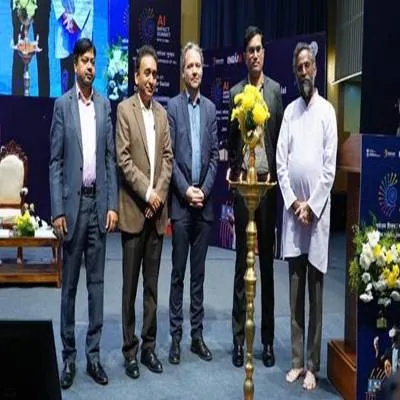
12 teams were shortlisted in the first phase to develop indigenous foundational models and sovereign models from Sarvam AI, BharatGen, Gnani and Socket were launched at the IndiaAI Impact Summit 2026. These models are tailored for Indic languages and in some cases outperform leading frontier models on regional benchmarks, especially in document understanding. Sector-specific hackathons and innovation challenges organised with multiple agencies have identified 10 startups for scaling.

The mission recognises compute access as critical and has empanelled more than 38,000 GPUs through 14 AI service providers across data centres in Mumbai, Navi Mumbai, Hyderabad, Bengaluru, Noida and Jamnagar, accessible via the IndiaAI Compute portal. The Government is expanding capacity by adding 20,000 GPUs and is strengthening the data centre ecosystem, supported by a long-term tax holiday announced in the Union Budget 2026–27 for data centre and cloud investment. The AI Impact Summit 2026 attracted investment commitments of about $250 billion (bn), signalling global confidence in India’s AI ecosystem.

The Government of India said the IndiaAI Mission, launched in March 2024, is building a national ecosystem for artificial intelligence to expand access, support innovation and promote India-centric solutions. The mission operates AIKosha, a platform providing models, tools and resources for health, agriculture and education with data privacy safeguards. AIKosha hosts text-to-speech models for Indic languages including Bengali, Gujarati, Kannada and Malayalam and provides secure API access and an AI Sandbox for experimentation. Resources are available on the AIKosha website. The iGOT Karmayogi initiative is strengthening AI awareness and capacity among government officials and stakeholders and offers over 176 courses on artificial intelligence and emerging technologies. The platform has recorded about 7.30 million (mn) enrolments and 5.38 million (mn) completions, while the YUVA AI for All course has recorded about 0.13 million (mn) enrolments and 0.08 million (mn) completions. The IndiaAI Startups Global programme has selected 10 Indian startups for international acceleration and 30 applications are being developed to address agriculture, health and climate challenges. 12 teams were shortlisted in the first phase to develop indigenous foundational models and sovereign models from Sarvam AI, BharatGen, Gnani and Socket were launched at the IndiaAI Impact Summit 2026. These models are tailored for Indic languages and in some cases outperform leading frontier models on regional benchmarks, especially in document understanding. Sector-specific hackathons and innovation challenges organised with multiple agencies have identified 10 startups for scaling. The mission recognises compute access as critical and has empanelled more than 38,000 GPUs through 14 AI service providers across data centres in Mumbai, Navi Mumbai, Hyderabad, Bengaluru, Noida and Jamnagar, accessible via the IndiaAI Compute portal. The Government is expanding capacity by adding 20,000 GPUs and is strengthening the data centre ecosystem, supported by a long-term tax holiday announced in the Union Budget 2026–27 for data centre and cloud investment. The AI Impact Summit 2026 attracted investment commitments of about $250 billion (bn), signalling global confidence in India’s AI ecosystem.

Next Story
Infrastructure Urban

MIDC and Ramky Unit Sign Concession for Life Sciences Park

Maharashtra Industrial Development Corporation has signed a concession agreement with Maha Integrated Life Sciences City Limited (MILeS City), a wholly owned subsidiary of Ramky Infrastructure Limited (RIL), to develop a high-tech pharmaceutical park at Dighi Port Industrial Area in Raigad. The project will follow a public-private partnership under a DBFOT model and has an estimated cost of Rs 30 billion (Rs 30 bn). The concession will run for 95 years, including a five-year construction phase, with MILeS City responsible for development and management. The development will occupy approximatel..

Next Story
Real Estate

BuzzWorks Leases Hyderabad Office to MyComplianceOffice

Brigade Group’s managed workspace provider BuzzWorks has leased 550 seats at Mindspace Business Park in Hyderabad to Dublin based MyComplianceOffice, in what is the company’s largest office in India. With this signing, BuzzWorks' total leased office space in Hyderabad stands at zero point one one million (mn) square feet. The new premises will house core functions including product engineering, product management, customer success and global operations. Artificial intelligence enabled compliance technology initiatives will also be part of the local delivery model. BuzzWorks will provide wo..

Next Story
Infrastructure Transport

Jindal Stainless Flags Operational Strain From Middle East Crisis

Jindal Stainless warned that the Middle East war crisis has affected its operations because of dependence on industrial gases such as propane and LPG and on natural gas. The scrap-based production route used by the stainless steel maker does not generate blast furnace or coke oven gases internally, unlike the conventional steel industry. Several plant processes have been adversely impacted and production is being run at rationalised capacity. Disruptions in global shipping routes have resulted in vessel diversions, longer transit times and cargo delays, adding pressure to supply chains and to ..

Advertisement

Subscribe to Our Newsletter

Get daily newsletters around different themes from Construction world.

STAY CONNECTED

Advertisement

Advertisement

Advertisement