




India Data Centre Capacity Expands to 1500 MW
ECONOMY & POLICY

India Data Centre Capacity Expands to 1500 MW

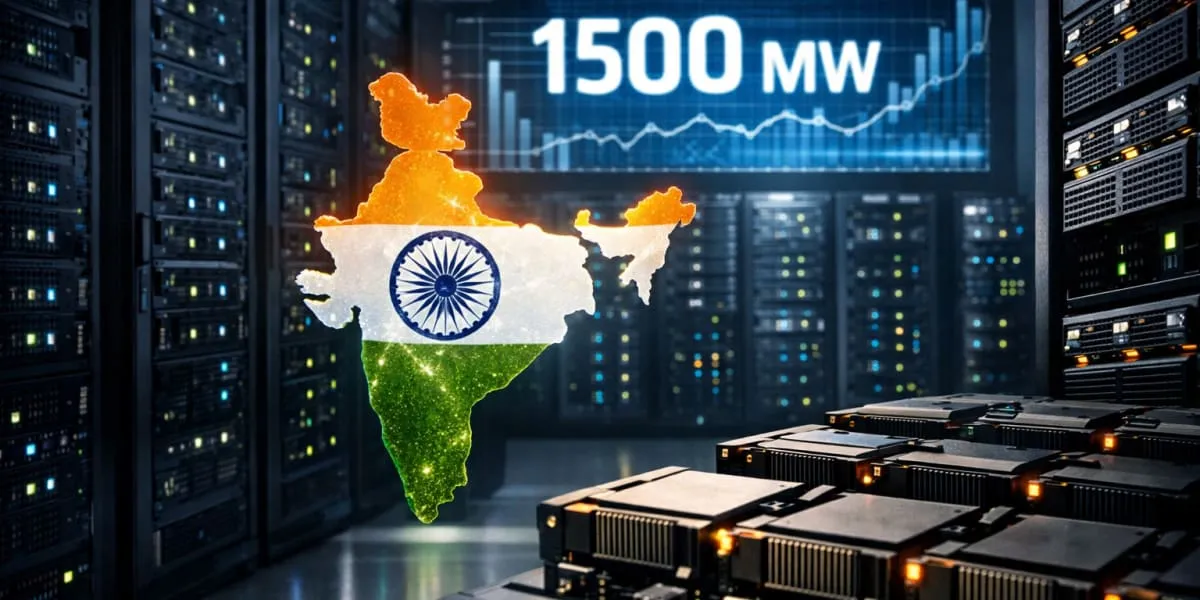
The data centre industry in India has expanded markedly, with total capacity rising from about 375 megawatt (MW) in 2020 to around 1,500 MW by 2025. To support artificial intelligence (AI) development, about 38,231 graphics processing units (GPUs) have been onboarded through 14 empanelled service providers and data centres under the AI compute capacity framework. These resources are being provided to start-ups, researchers, academia and other eligible users at a subsidised average rate of Rs65 per hour, which is about one-third of the global average. Data centres are distributed across Mumbai, Navi Mumbai, Hyderabad, Bengaluru, Noida and Jamnagar.

The government has taken account of the infrastructure needs of the sector, including electricity and water supply. Expected electricity demand from growth in artificial intelligence and other large scale data centres has been factored into planning, with demand estimated to reach 13.56 gigawatt (GW) by 2031–32. National transmission infrastructure is being expanded to meet growing electricity needs and is reported to be adequately prepared to ensure reliable power supply across regions.

The Sustainable Harnessing and Advancement of Nuclear Energy for Transforming India Act, known as the SHANTI Act, has been passed to strengthen the nuclear energy ecosystem. The act is intended to support development of reliable power solutions for emerging sectors such as artificial intelligence and data centres by enabling future deployment of small modular and micro nuclear reactors. Planning for energy supply is therefore positioned to accommodate the anticipated rise in compute intensive facilities.

Water requirements vary according to the cooling technologies deployed, with regulation of groundwater extraction for industrial use governed by guidelines issued by the Ministry of Jal Shakti. To minimise water use, the industry is adopting advanced cooling approaches including direct to chip liquid cooling, adiabatic cooling and immersion cooling. Providers are also deploying high density racks to more efficiently support high performance computing and artificial intelligence workloads, reducing both power and water consumption. The information was submitted to the Rajya Sabha on 13 March 2026 by the Minister of State for Electronics and Information Technology.

The data centre industry in India has expanded markedly, with total capacity rising from about 375 megawatt (MW) in 2020 to around 1,500 MW by 2025. To support artificial intelligence (AI) development, about 38,231 graphics processing units (GPUs) have been onboarded through 14 empanelled service providers and data centres under the AI compute capacity framework. These resources are being provided to start-ups, researchers, academia and other eligible users at a subsidised average rate of Rs65 per hour, which is about one-third of the global average. Data centres are distributed across Mumbai, Navi Mumbai, Hyderabad, Bengaluru, Noida and Jamnagar. The government has taken account of the infrastructure needs of the sector, including electricity and water supply. Expected electricity demand from growth in artificial intelligence and other large scale data centres has been factored into planning, with demand estimated to reach 13.56 gigawatt (GW) by 2031–32. National transmission infrastructure is being expanded to meet growing electricity needs and is reported to be adequately prepared to ensure reliable power supply across regions. The Sustainable Harnessing and Advancement of Nuclear Energy for Transforming India Act, known as the SHANTI Act, has been passed to strengthen the nuclear energy ecosystem. The act is intended to support development of reliable power solutions for emerging sectors such as artificial intelligence and data centres by enabling future deployment of small modular and micro nuclear reactors. Planning for energy supply is therefore positioned to accommodate the anticipated rise in compute intensive facilities. Water requirements vary according to the cooling technologies deployed, with regulation of groundwater extraction for industrial use governed by guidelines issued by the Ministry of Jal Shakti. To minimise water use, the industry is adopting advanced cooling approaches including direct to chip liquid cooling, adiabatic cooling and immersion cooling. Providers are also deploying high density racks to more efficiently support high performance computing and artificial intelligence workloads, reducing both power and water consumption. The information was submitted to the Rajya Sabha on 13 March 2026 by the Minister of State for Electronics and Information Technology.

Next Story
Infrastructure Urban

MIDC and Ramky Unit Sign Concession for Life Sciences Park

Maharashtra Industrial Development Corporation has signed a concession agreement with Maha Integrated Life Sciences City Limited (MILeS City), a wholly owned subsidiary of Ramky Infrastructure Limited (RIL), to develop a high-tech pharmaceutical park at Dighi Port Industrial Area in Raigad. The project will follow a public-private partnership under a DBFOT model and has an estimated cost of Rs 30 billion (Rs 30 bn). The concession will run for 95 years, including a five-year construction phase, with MILeS City responsible for development and management. The development will occupy approximatel..

Next Story
Real Estate

BuzzWorks Leases Hyderabad Office to MyComplianceOffice

Brigade Group’s managed workspace provider BuzzWorks has leased 550 seats at Mindspace Business Park in Hyderabad to Dublin based MyComplianceOffice, in what is the company’s largest office in India. With this signing, BuzzWorks' total leased office space in Hyderabad stands at zero point one one million (mn) square feet. The new premises will house core functions including product engineering, product management, customer success and global operations. Artificial intelligence enabled compliance technology initiatives will also be part of the local delivery model. BuzzWorks will provide wo..

Next Story
Infrastructure Transport

Jindal Stainless Flags Operational Strain From Middle East Crisis

Jindal Stainless warned that the Middle East war crisis has affected its operations because of dependence on industrial gases such as propane and LPG and on natural gas. The scrap-based production route used by the stainless steel maker does not generate blast furnace or coke oven gases internally, unlike the conventional steel industry. Several plant processes have been adversely impacted and production is being run at rationalised capacity. Disruptions in global shipping routes have resulted in vessel diversions, longer transit times and cargo delays, adding pressure to supply chains and to ..

Advertisement

Subscribe to Our Newsletter

Get daily newsletters around different themes from Construction world.

STAY CONNECTED

Advertisement

Advertisement

Advertisement