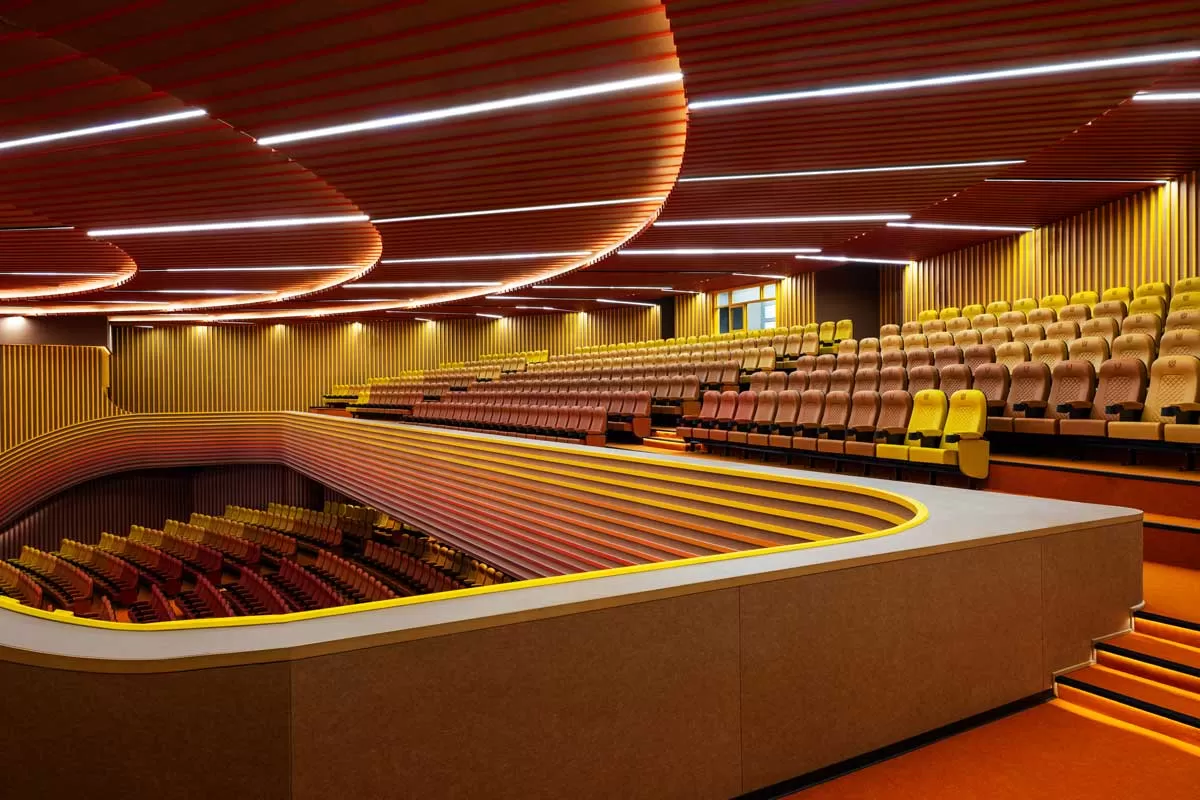
MARC Auditorium
Real Estate

MARC Auditorium

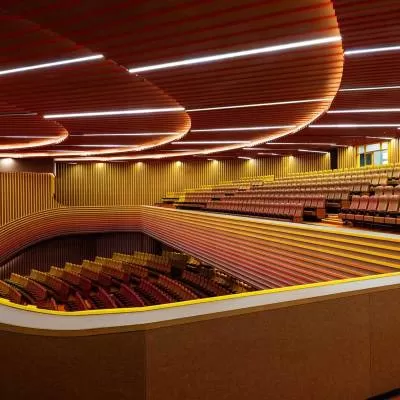
Spanning 80 acre on the outskirts of Bengaluru, the Manipal Academy of Higher Education (MAHE) recently inaugurated the Dr Ramdas M Pai Convention Hall and Food Court (MARC), a 123,000-sq-ft facility comprising a 1,200-seater auditorium above and a two-level food court below.Elabora...

Spanning 80 acre on the outskirts of Bengaluru, the Manipal Academy of Higher Education (MAHE) recently inaugurated the Dr Ramdas M Pai Convention Hall and Food Court (MARC), a 123,000-sq-ft facility comprising a 1,200-seater auditorium above and a two-level food court below.Elaborating on the design framework, Akshay Heranjal, Co-Founder and Principal Architect, The Purple Ink Studio, remarks, “The design programme included two distinct facilities: a food court spanning two (lower) levels and a 1,200-seater auditorium positioned above. A rectangular soft enclosure of a plaza was planned around the building, increasing the visual footprint. The outdoor plaza, with its optical conundrum, extended the interiors seamlessly.”Structural challengesWith a diameter of 52 m, the auditorium serves as the spatial anchor of the entire complex. The immense diameter demanded a highly effective structural solution to avoid any intermediate supports for the auditorium. The robust trussed roof framework not only organises the structure but also defines the façade. The roof is supported by a dense filigree network of trusses, nearly 2 m in height, which also accommodate essential auditorium services. These trusses were prefabricated offsite and assembled onsite using cranes, ensuring precision and efficiency.Material strategy and sustainability This GRIHA-compliant project exemplifies sustainability throughout its lifecycle. Recycling building materials, minimising waste and ensuring universal accessibility through converging ramps underscore its eco-conscious design approach. Climatic simulations informed decisions on fenestration, shading and orientations, enhancing energy-efficiency while reducing dependence on mechanical cooling.The interior design echoes this commitment, employing a strategic mix of materials. Terracotta cladding at the base humanises the building’s scale, while variations in texture and colour add depth and visual appeal. The hierarchy of materials ensures a seamless blend of functionality and aesthetics. Undulating rings wrap around the activities within the building, rendered in hues of orange. Zinc sheets were predominantly used to achieve the curvilinear form of the façade, which is supported by an aluminium framework and the truss system. Each sheet was carefully curved onsite to the desired profile using a specialised roll-forming technique. This choice of material prioritised durability and recyclability, resulting in a structure that is both lightweight and sturdy.A welcoming spaceNatural elements are interwoven into every aspect of the design. Existing trees within the plaza were preserved, serving as focal points for gatherings and enhancing the connection between indoor and outdoor spaces. User movement has been carefully considered, with pathways tailored to the specific needs of this high-traffic, service-intensive space.“This is a one-of-a-kind structure in the city, featuring the latest technology and interiors,” emphasises Naveen Kumar, Director - Purchase, Manipal Academy of Higher Education (MAHE). “It is an ideal venue for events of any kind, with unique elements such as the helical façade resembling an orange peel. The colours transition from deep to light orange shades.” This juxtaposition of visual elements enhances the architectural prominence of the building, reinforcing its identity as a dynamic hub within the campus environment.

Next Story
Infrastructure Urban

India Expands Semiconductor Training To 500 Institutions

Under the Chips to Startups programme of the India Semiconductor Mission, the Union minister responsible for Railways, Information and Broadcasting, and Electronics and IT reported notable progress in talent development. He indicated that over the past four years substantial steps have been taken towards a 10-year target of training 85,000 engineers in semiconductor design. World-class EDA tools have been deployed in 315 academic institutions across the country to provide students with practical exposure to chip design. These EDA tools are supported by leading global firms and are accessible t..

Next Story
Infrastructure Urban

Delhi Institutions Support India Semiconductor Mission

The Government of India has prioritised talent development through training, upskilling and workforce development under the Chips to Startups initiative of the India Semiconductor Mission, with officials noting progress in four years towards a 10-year target of training 85,000 engineers in semiconductor design. Electronic design automation tools provided by Synopsys, Cadence, Siemens, Renesas, Ansys and AMD have been deployed in 315 academic institutions, enabling students to gain practical chip design experience. Chips have been fabricated and tested at the Semiconductor Laboratory, Mohali, a..

Next Story
Infrastructure Urban

NHA Announces Winners Of NHCX Hackathon At IIT Hyderabad

The National Health Authority (NHA) has concluded the NHCX Hackathon under the Ayushman Bharat Digital Mission (ABDM) to stimulate innovation around the National Health Claims Exchange (NHCX). The winning teams presented their solutions at the NHCX Innovation Meet held at IIT Hyderabad during a two-day event in March 2026 that also served as the hackathon grand finale. The hackathon itself ran from 22 to 28 February 2026 and aimed to accelerate paperless, transparent claims processing across India. The event was organised with a range of ecosystem partners, including the Insurance Regulatory a..

Advertisement

Subscribe to Our Newsletter

Get daily newsletters around different themes from Construction world.

STAY CONNECTED

Advertisement

Advertisement

Advertisement