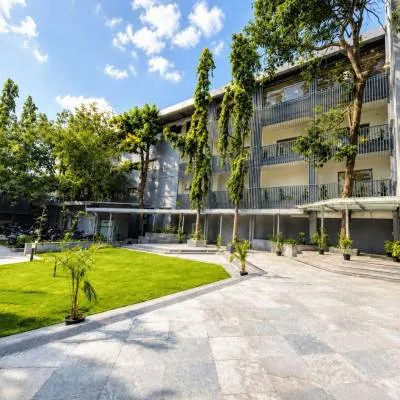
We are redefining the way Urban India lives
Real Estate

We are redefining the way Urban India lives

With over 3,000 operational beds across 21 properties and 7,000 beds in the pipeline, Chennai-based Truliv is building one of India’s fastest-growing organised co-living platforms. Rohit Reddy, Cofounder and CEO, discusses the company’s pu...

With over 3,000 operational beds across 21 properties and 7,000 beds in the pipeline, Chennai-based Truliv is building one of India’s fastest-growing organised co-living platforms. Rohit Reddy, Cofounder and CEO, discusses the company’s purpose-built model and expansion across key urban markets in conversation with CW.How did the idea for Truliv originate? What gap in India’s rental housing market did you identify?The idea for Truliv was that we create alternative assets and operations-led housing for the entire human adult lifecycle. From 18 to 22, you need student housing; from 23 to 30, you need co-living; from 30 to 35, managed apartments; and from 35 onwards, aspirational living like holiday homes and vacation rentals.We chose co-living because we identified the biggest gap there. The market was fragmented and run predominantly by unorganised PGs. There was no purpose-built accommodation in this space across the country for working professionals. It was more apartments taken on rent or unorganised PGs with no standard services. That is where the concept of Truliv came from.Could you walk us through the development model, project partners and key design considerations behind Truliv Hercules in Chennai?Truliv Hercules was conceptualised in 2019 as a purpose-built co-living asset. Initially designed as studio apartments, it was adapted for the local market into two-BHK units.The project spans about 140,000 sq ft and houses 182 two-BHK units of about 768 sq ft each. Every unit includes two compact rooms, a small kitchen area, RO purifiers, a furnished living room with a TV, and a balcony with washing and drying space.From a design angle, every square inch was planned, including about 6,500 sq ft of amenity space on the first floor with a mini theatre, co-working zone, dining area, gym and game area.The conceptualisation, design, location identification and development size were done inhouse by Truliv, while construction was undertaken by its parent company, DRA Homes, Chennai.How does your build-sell-lease-operate framework work in practice and what kind of tieups are necessary to scale such projects?The units are built and sold by DRA, leased back and operated by Truliv. Each of the 182 units has an individual owner and a rental guarantee is given by Truliv. Developers are a key part of the supply funnel for us. This becomes maximisation of FSI and diversification of risk for them. It also opens up markets because it becomes an investment product. We approach developers and say these are the locations we have identified and we are looking actively for build-to-suit co-living in these regions. In some cases, we identify the land and sit with developers and conceptualise the full working financial model.Could you share details on your current pipeline and the timelines for bringing these developments online?We are not going after a hockey stick kind of growth. We want to be very specific about certain micro-markets. We also want to phase them out. We do not want to have all the beds come in at one time because it will be hard for us to fill and operate. What we do is phase them across an 18-month window, where about 300 to 400 beds are added every quarter. We have about 7,000 beds across India in the pipeline, with 3,000 beds already operational. In two years, we are looking to hit about 10,000 operational beds.How do you plan to deploy the recent strategic investment from Bennett, Coleman & Co.?The Bennett investment was more of a strategic investment, where we intend to deploy the capital towards marketing and give us marketing muscle across the country. Operationally, we ensure that we are profitable at a property level itself. What are the key design, safety and infrastructure considerations you prioritise when developing purpose-built co-living assets?We comply with all residential standards and we take a step further because we are inherently going to operate that. All access points are biometric controlled. We have CCTV and now we also have AI-based monitoring to ensure safety of residents. Further, there is an app for residents where any issues can be highlighted to us. Community zones are very important for us and non-negotiable. They create a sense of oneness and togetherness. Though the units are compact, they have elements that give you a sense of airiness and ventilation.What are Truliv’s expansion plans over the next three to five years?In 18 months, 10,000 beds is our goal, and we want to do it profitably and in a structured format. Bengaluru is the largest co-living market and we want to establish 5,000 to 7,000 beds there. Pune is very up and coming for us, with about 4,500 beds in the pipeline and six to seven developers. We will enter Hyderabad by the end of this year. The goal is for us to hit about 20,000 beds in the next five to six years. We are a company that is redefining the way Urban India lives.

Next Story
Infrastructure Energy

The next five years will expose the capability gap in transmission EPC

India’s transmission expansion is redefining EPC priorities, shifting focus from scale to specialised execution. Rajesh Kumar Singh, CEO, Jyoti Structures, explains how engineering capability, disciplined project selection and delivery experience will determine competitiveness in the evolving market.India is witnessing a major push to expand its transmission network to integrate renewable energy and strengthen grid resilience. From your perspective, how will this wave of transmission investment reshape opportunities for EPC companies over the next five years?What is happening in Indian ..

Next Story
Infrastructure Urban

A Responsibility to Shoulder

India’s Cooling Action Plan forecasts cooling demand to grow nearly eight times in the next 20 years. In light of the fact that cooling is no longer just a comfort product but lies at the intersection of national development, public health, climate action and energy security, this means the HVAC industry shoulders a very serious responsibility. Mihir Sanghavi, Managing Partner, Auro Engineering Company, Immediate Past President RATA, Secretary, ISHRAE, and Regional Representative, ASHRAE Region XV, describes that responsibility as “identifying a system that can serve for 15 to 20..

Next Story
Real Estate

The Stone Theatre

Stone is usually sold in places built for inventory. Rows of slabs. Dust in the air. Decisions made in haste. Function leads; feeling follows. Megaphone by HMG in Jigani, on the southern edge of Bengaluru, flips that script. Instead of asking visitors to browse stone as commodity, it stages the material as experience – dramatic, tactile, immersive and unmistakably architectural. Spread across 6,000 sq ft, the centre is not conceived as a conventional showroom but a ‘Stone Theatre’: a place where stone is read, felt and understood before it is bought. If natural stone is one of the m..

Advertisement

Subscribe to Our Newsletter

Get daily newsletters around different themes from Construction world.

STAY CONNECTED

Advertisement

Advertisement

Advertisement