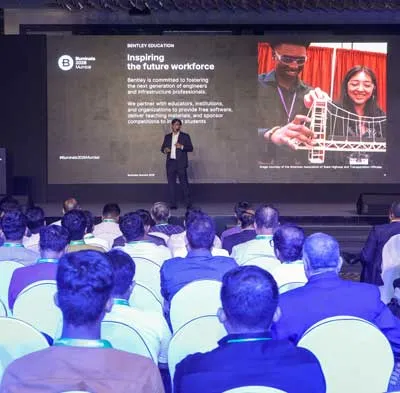
At Illuminate Mumbai 2026, industry leaders highlighted how AI, digital twins and connected data ecosystems are reshaping infrastructure delivery, enabling greater efficiency, resilience and long-term asset performance. India's infrastructure sector is entering a new phase of digital maturity. While the initial years focused on digitising workflows, the industry is now moving towards deploying intelligent, connected and data-driven systems that can improve project outcomes across the asset lifecycle.This transition was at the centre of discussions at Illuminate Mumbai 2026, organised by Bentley Systems, which brought together infrastructure leaders, policymakers, technology experts and academia to explore how AI, digital twins and open data ecosystems can support India's Viksit Bharat 2047 vision.Opening the event, Kamalakannan Thiruvadi, Regional Executive - Asia South, Bentley Systems, underscored India's opportunity to emerge as a global leader in infrastructure innovation by leveraging AI, digital twins and connected data environments. One message resonated throughout the conference: Technology is no longer an optional add-on but a strategic imperative.“Technology must be viewed as a strategic investment that drives value, rather than a mere operational expense, said Thiruvadi. He noted that when asset owners recognise the long-term value delivered by digital tools, adoption accelerates across the entire ecosystem – from consultants and contractors to developers and public agencies.A leadership dialogue between Kaushik Chakraborty, Senior Vice President, Asia Pacific, Bentley Systems, and Amit Sharma, Managing Director & CEO, Tata Consulting Engineers, further emphasised how AI-enabled infrastructure can transform project planning, delivery and operations.The discussions reflected a broader industry shift – from isolated digital interventions to integrated infrastructure ecosystems built on open, connected data environments. According to Francois Valois, Senior Vice President, Open Applications, Bentley Systems, the real value of digital transformation lies in establishing a robust data foundation.“The primary focus should be on building a robust data foundation through open and connected systems,” said Valois. “When data flows seamlessly across the asset lifecycle and between stakeholders, it enables better decision-making, improves operational efficiency and ensures long-term sustainability.”Several project examples presented during the event demonstrated how such connected ecosystems are already delivering measurable outcomes. A digital twin implemented for Orange City Water in Nagpur, for instance, has helped reduce non-revenue water losses from 72 per cent to 30 per cent by integrating IoT data with advanced analytics.Digital twins are also increasingly influencing project delivery. Sharing his experience from the Fairmont Udaipur Palace project, Siddharth Sharma, Principal Consultant & Director, AVS Engineers, said Bentley's structural software suite enabled the team to automate drawing generation and cost estimation, resulting in timeline savings of four to five months while improving coordination through a project digital twin.Beyond operations, speakers repeatedly highlighted that the greatest return on digital investments is realised much earlier – during design and engineering.“The strongest return definitely comes from upfront design,” said Andy Rahden, Vice President, Solution Engineering, Bentley. “Most downstream project challenges can be traced back to gaps or omissions in the initial design phase.”Rahden explained that detailed, data-rich models allow teams to identify clashes and resolve conflicts in a virtual environment before construction begins, thereby reducing costly rework, delays and material wastage. He cautioned that the pressure to fast-track infrastructure projects can sometimes compromise planning and engineering, ultimately increasing lifecycle costs.The industry's growing confidence in AI was evident across sectors. Sudesna Biswas, Head, Hydraulics, L&T Construction, highlighted how AI-enabled workflows have dramatically improved productivity in hydrological modelling. By combining cloud-based workflows with scripting and satellite datasets, tasks that previously required several months can now be completed within hours.However, she emphasised that validation remains critical. “While AI tools can generate outputs quickly, ensuring their accuracy and reliability remains essential,” she observed, pointing to the need for stronger calibration and standardisation frameworks.The transmission and distribution sector is also witnessing rapid digitalisation. Vikas Pawar, Assistant Department Manager, Burns & McDonnell India, explained that Bentley's engineering applications, coupled with Cloud-based collaboration platforms, have significantly improved coordination between teams operating across geographies. Meanwhile, Ujjal Das, Senior Electrical Engineer, Burns & McDonnell India, highlighted the potential of AI-driven tools such as AMBER, which automate structural and analytical workflows, enabling engineers to focus on high-value, technical decision-making.As India pursues ambitious infrastructure targets, speakers agreed that digital adoption is set to accelerate. While sectors such as transportation and rail have emerged as early adopters, cross-sector learning and growing awareness are expected to drive broader implementation. “The transformation is well underway and rapidly accelerating,” concluded Thiruvadi. “Digital technologies will undoubtedly play a central role in delivering resilient, sustainable and future-ready infrastructure.”- KAVITA PARAB