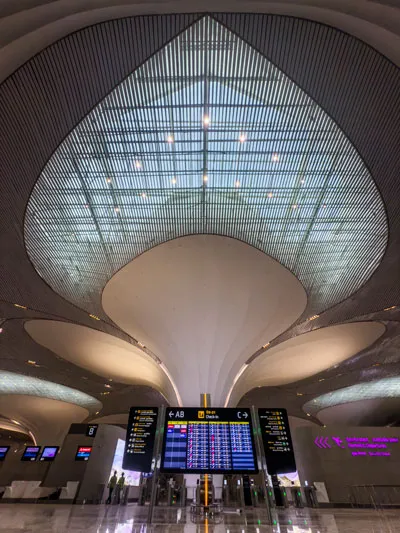
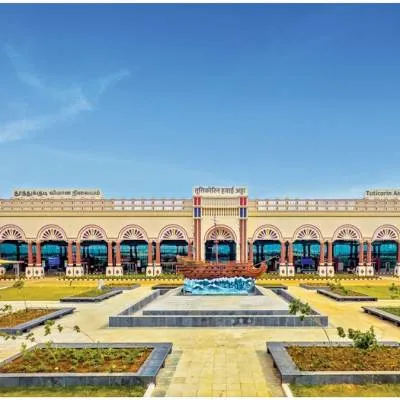
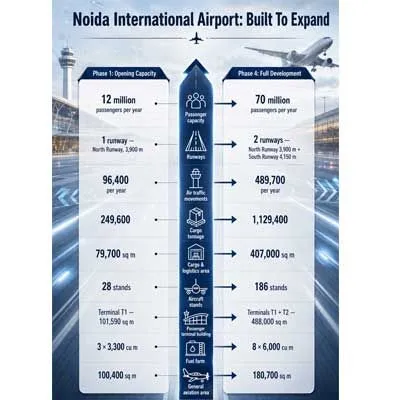
A lotus-inspired terminal design in Navi Mumbai International Airport. A terminal in a garden in Bengaluru’s Kempegowda International Airport. A peacock-inspired canopy in Chhatrapati Shivaji Maharaj International Airport. A nature-inspired terminal in Guwahati’s Lokpriya Gopinath Bordoloi International Airport.Truly, “India’s airports are no longer constrained by architectural ambition,” avers Ravikanth Mididhodi, Chief Technical Officer, J&F, a German-based engineering firm with over 25 years of global legacy in delivering advanced engineering and BIM services for airport infrastructure. However, he adds, “India’s airports are constrained by operational synchronisation.”With the Udan scheme promising to add 170+ new airports through to 2029, questions arise on whether innovatively designed airport terminals have the capacity to meet growing passenger expectations and India’s need for space-and-energy-efficient, sustainable transportation, especially in the face of climate change.Capacity isn’t just a measure of the number of take-offs and arrivals the airport facilitates but also whether the infrastructure adequately caters to passengers and how it uses resources. Ultimately, passenger experience helps define preference for a terminal, and its profitability potential. In that context, the functioning of check-in systems and baggage handling systems (BHS) and heating, ventilation, air-conditioning (HVAC) all help ensure efficiency and passenger comfort. Even a terminal’s lounges must transcend their role as mere waiting rooms to deliver extraordinary experiences.CW explores the role of these different elements in enhancing airport capacity.Tech enhancementsAt major airports such as Delhi, Mumbai, Ahmedabad, Kolkata, Chennai, Bengaluru, Hyderabad and Cochin, strides have been made towards increasing capacity both on the landside and airside.They have installed technologies such as fast-track immigration trusted traveller programme (FTT-TTP), e-gates and contactless immigration; DigiYatra; self-service kiosks; automated baggage drop; IoT-enabled smart infrastructure and Unified Total Airside Management.In fact, at Delhi International Airport Limited (DIAL), advanced digital and AI-enabled technologies have been implemented across baggage handling, check-in and passenger communications to enhance efficiency, predictability and passenger experience. Citing examples, Videh Kumar Jaipuriar, CEO, Delhi International Airport (DIAL), points out that self-service bag drop units allow passengers to process a bag in nearly 30 seconds, with integrated systems automatically validating baggage allowance, capturing weight and activating bag tags for the BHS, significantly reducing queues and manual intervention. Common user self-service kiosks further streamline passenger processing by enabling check-in, seat selection, boarding pass and bag tag printing, along with digital travel document validation, on a single platform. To strengthen security while improving turnaround time, “DIAL has deployed virtual baggage reunion and virtual security bag check solutions, enabling real-time virtual association of passengers with their check-in baggage through live video support when secondary physical examination is required, eliminating the need for passengers to be recalled to counters,” continues Jaipuriar. Integration with the Government of India’s Trusted Traveller Programme enables eligible passengers to move faster through key touchpoints using digital identity verification. Consequently, in DIAL’s domestic terminal, the security queue wait time has been reduced by 26 per cent and length by 25 per cent. Correspondingly, in the international terminal, the reductions are 50 per cent and 40 per cent, respectively. At the operational level, DIAL’s Airport Operations Control Centre acts as a central digital nerve centre, leveraging real-time data, predictive analytics and AI-driven decision-support tools to coordinate stakeholders, manage disruptions, optimise resource deployment and improve on-time performance. To further strengthen airside operations, DIAL launched the Unified Total Airside Management system in March 2025, an AI-powered, inhouse developed platform designed to enhance airside safety, efficiency and sustainability by optimising operations for over 1,300 daily flights at India’s busiest airport. AI-based tools are also deployed for demand forecasting, queue management, passenger flow optimisation and proactive passenger communications. Together, these digital interventions have reduced processing time to 10-15 minutes (gate to security checks), enhanced operational resilience and reinforced DIAL’s position as a smart, technology-led global aviation hub.Efficient layoutTechnologies are helping Indian airports handle more passengers efficiently without expanding physical space, points out Sajjad Zaidi, Country Operations Manager, ICAD. Indeed, “technologies reducing dependency on manual counters and traditional queuing formats are making terminal layouts more efficient, flexible and modular,” agrees Raman Sikka, Associate Principal, Sikka Associates Architects, a firm with the design experience of more than 35 airport terminals.The right design underscores this capacity enhancement.Airport planning is primarily driven by passenger traffic forecasts, peak-hour demand analysis and international aviation standards, according to Sikka, while Harsh Varshneya, Principal Architect, STHAPATI, identifies passenger movement, operational sequencing and adaptability as the key defining points. Broadly, Sikka says, “Terminal space allocation must balance landside areas (entry, ticketing, check-in), airside areas (security hold, boarding gates), commercial and retail zones, baggage handling and reclaim and back-of-house utilities and operational areas.” Standards and planning guidelines issued by bodies such as the Airports Authority of India (AAI) and International Air Transport Association (IATA) provide benchmarks for space per passenger, level of service standards and safety compliance. Adhering to these helps improve the capacity of an airport. Typically, Sikka explains, “Check-in and security zones require high flexibility due to peak hour congestion. Integrating waiting lounges and retail areas optimises passenger dwell time while ensuring smooth boarding access. Baggage systems must be efficiently connected to aircraft stands while remaining segregated from passenger flows for security reasons.”“Circulation from entry to boarding should be clearly sequenced to avoid congestion and cross-movement,” adds Varshneya. “Waiting areas must balance capacity with comfort and may integrate local material expression and curated elements to reflect regional identity. Baggage areas and back-end systems must function seamlessly within this ecosystem, supported by integrated infrastructure planning. Airports are also expanding beyond pure transit functions, incorporating mixed-use components and community-oriented features that reinforce their role as civic anchors.”Underscoring the role of technology to come up with the most efficient layout, Sikka says, “Technology enhances passenger flow modelling, enabling architects to design more efficient circulation patterns, and improve the overall passenger experience.”Terminal sustainabilityAirport terminals must be designed as coordinated systems where structure, envelope and services work together, according to Varshneya. “Terminal design must integrate passive measures such as extended roof projections, controlled daylight and shaded façades or high-performance building envelopes that reduce heat gain. Active strategies like energy-efficient HVAC systems, renewable energy integration such as solar power and environmental management during construction support long-term operational continuity. Overhangs and shaded façades reduce direct exposure and improve envelope performance.”Modern IBMS systems, coupled with a high level of BIM technology, help in better design integration and thereon working at site even in the operational phase, says Varshneya. However, he explains that long-term performance depends less on a single material and more on integrated planning, detailing and future-proof strategies.Sustainability technologies such as energy-efficient HVAC systems, daylight optimisation, BMS and solar integrations also influence façade design, orientation and material selection, prompting Sikka to point out that airport architecture today must seamlessly integrate physical infrastructure with digital ecosystems. It is also essential to design spaces that allow for future technological upgrades without major structural alterations. That, he says, “involves designing ceiling voids, service corridors and underfloor ducts with higher capacity to accommodate evolving IT and electrical infrastructure.”Best practicesHeavy rainfall can cause leakages, equipment damage and operational disruptions, causing passenger inconvenience, such as happened at Indira Gandhi International Airport in 2025. In the face of climate change, such events may be expected to increase, raising questions about design and material choices and installation best practices.“Modern aviation design involves totally negating the down takes of rainwater from the passenger travel areas, taking it to the extreme ends to ensure no disruption even in the worst-case scenario,” says Varshneya. For this to happen in large-span buildings, the roof geometry, slope calibration, drainage planning and joint detailing must be resolved within the architectural design. Sikka recommends standing seam metal roofs with concealed fasteners and high-grade sealants that perform well against leakage. In regions experiencing heavy rainfall, particular attention must be paid to roofing systems, drainage design, façade sealing and waterproofing technologies.Further, multiple layers of roofing systems add to the safeguarding of airports in extreme weather conditions, adds Varshneya. “To prevent long-term water ingress, the interfaces between roof, façade and structural systems require execution precision.”Material selection should prioritise durability and fabrication control, he continues. “Pre-engineered steel systems improve accuracy in large terminals and reduce onsite variability. Lightweight, high-performance materials enhance structural efficiency. Glass-reinforced concrete may be used selectively in façade systems where consistent fabrication and reduced load are required. Insulated interior systems improve thermal comfort and lifecycle performance.”“Airports demand highly durable, low-maintenance materials due to their scale and operational intensity,” adds Sikka. “For façades, high-performance curtainwall systems with pressure-equalised glazing and weather-resistant silicone sealants help prevent seepage. Corrosion-resistant structural steel, epoxy-coated reinforcement and high-density concrete mixes improve longevity in humid conditions.” Most important, material performance must be supported by robust detailing and periodic maintenance protocols, Sikka emphasises, as “design alone cannot prevent leakages; execution quality and lifecycle planning are equally vital.”Technology installation best practices can also help prevent operational disruptions and losses. Zaidi identifies waterproof roofing, sealed cable entry points and weatherproof (IP-rated) enclosures to protect electrical and IT systems from water damage; proper drainage systems such as efficient roof drains, gutters and sump pumps to prevent water accumulation and leakage inside terminals; the elevation of critical equipment such as servers, electrical panels and control systems on raised platforms; the installation of IoT water leak detection and monitoring systems; and backup power and network systems.Handling baggage Baggage handling systems play a key role in ensuring that hold bags are efficiently united with passengers and loaded onto the correct aircraft for timely flight departures. “Focusing on minimising the baggage handling system footprint is both efficient and sustainable,” says Michael Doughty, BHS Specialist at NACO, Netherlands Airport Consultants, a company contracted for the early-stage design and specification of the baggage handling system for Noida International Airport. For that project, Doughty says the focus was to “fully integrate the baggage handling system with the terminal design, including architecture, security and IT systems.”“As part of a multidisciplinary design team, all aspects of the terminal building functionality were developed in parallel,” he shares. “Close coordination with the architects, structural and mechanical engineers allowed us to remove the basement, which is a typical requirement for baggage handling areas. This not only saved construction costs but also reduced the potential for operational risks related to heavy rain and flooding of the terminal building. Additionally, with a modular design, we allowed flexibility for the implementation of future innovations and reducing the cost of terminal reconstruction and future impact on operations.”Coming to system technologies, those that deliver high sort accuracy, predictable flow and operational resilience at peak are the most efficient, according to Abhay Agarwal, Regional Sales Manager, India and Middle East, Alstef Group. While modern airports have various baggage handling system technologies to choose from, such as more expensive carrier-based (ICS-style) systems offering strong bag-level control, and lower cost modern belt-based architectures equipped with high-performance cross-belt sorters, Agarwal points out, “Efficiency is less about the technology label and more about intelligent system design, with optimised layout, effective buffering and strong controls and maintainability all contributing.” The “best” baggage handling system, he says, depends on passenger growth, airline mix, transfer volumes and available footprint.For Noida International Airport, while more traditional technologies were considered, it was ultimately decided to implement an Individual Carrier System (ICS). For large baggage handling systems spread over a wide area or across multiple terminal buildings, Doughty believes the transportation speed of ICS can help maximise on-time delivery and minimise baggage transfer connection times.“Beyond the tracking accuracy and transportation reliability, ICS technology was selected to future-proof the airport for future growth and allow for modular expansion of baggage handling capacity,” he explains. “This was determined to be a more robust expansion strategy, compared to expansion using more traditional technology or later retrofitting of ICS technology.”In smaller airports, too, Doughty says the tracking accuracy and transportation reliability of ICS systems can apply. However, he emphasises that airports should focus on maximising the potential of existing baggage handling assets before investing in new assets.Many existing terminals with conventional belt-based systems can significantly improve capacity and reliability by upgrading sortation technology, controls and tracking systems without replacing the entire backbone at a more moderate cost than ICS systems and without requiring a complete architectural shift, according to Agarwal. Especially, introducing cross-belt sortation in key areas such as transfer or make-up can materially enhance throughput and accuracy within existing space constraints. As part of recent terminal developments, major Indian airports like Kochi and Bengaluru have invested in modern baggage handling systems incorporating high-speed sortation, advanced controls and improved passenger interface technologies, which can achieve comparable throughput and reliability as ICS in many applications at a lower cost because they don’t have as many mechanical components and complex controls. While the main challenges include limited footprint, maintaining live airport operations during installation, and integrating new technology with legacy screening and control systems, Agarwal points out that “careful phasing and design can ensure retrofit programmes deliver substantial efficiency gains with lower risk and disruption than full system replacement.”Operational synchronisationFlagship developments such as Kempegowda International Airport (T2), Noida International Airport and Rajiv Gandhi International Airport, Mididhodi notes, “demonstrate globally benchmarked peak-hour planning aligned to IATA standards”. However, unprecedented passenger growth, banked airline scheduling patterns, runway saturation, security throughput pressures and landside congestion increasingly compress theoretical capacity into systemic operational stress, he adds. “True peak performance extends beyond infrastructure expansion,” explains Mididhodi. “It demands digital twins, real-time passenger analytics, A-CDM integration and automated facility management convergence. When airside, terminal and landside ecosystems function as a unified digital enterprise, peak capacity transforms from a planning benchmark into resilient, executable performance.”At Rajiv Gandhi International Airport in Hyderabad, since December 2024, an AI-powered digital twin serves as a real-time virtual replica of the entire airport, seamlessly integrating airside, landside and terminal operations through the Airport Predictive Operation Centre (APOC). By aggregating live data from across the airport ecosystem and applying advanced analytics, the digital twin provides all stakeholders with a unified, real-time operational view, enabling better coordination, smarter decisions, and smoother passenger movement. The platform also runs virtual simulations to predict congestion, delays and potential disruptions, allowing teams to plan proactively rather than reactively, thus shifting airport management from firefighting to predictive, data-driven operations. The impact, according to SGK Kishore, Executive Director and Chief Innovation Officer, GMR Airports, has been transformative. “Reduced congestion and wait times, better gate and terminal utilisation, optimised staffing and resource allocation and lower operational costs,” he lists. “Also, the system boosts operational resilience – issues are detected earlier, recovery is faster and disruptions are managed more systematically – making the airport more stable, efficient and future-ready.” For instance, prior to APOC, service-level agreement breaches were identified manually. Now, with real-time data, breaches are flagged instantly, allowing for swift corrective action.During Operation Sindoor in May 2025, alerts at ATRS 11-12 enabled immediate coordination with CISF to open additional lanes, significantly reducing wait times for passengers.APOC predictive analytics revealed that Indigo required more counters than previously allocated during peak hours, leading to a revision in the seasonal plan to allocate 21 agent-based counters and self bag drop units, easing congestion and improving passenger flow.APOC’s landside operations team uses real-time data on an ongoing process to manage cab availability, reduce ramp congestion and ensure efficient entry/exit at the main car park. This includes proactive coordination for pay booth staffing and traffic flow management. In time, this digital twin platform will be adopted as the standard operating model across all GMR-operated airports. Air-con comfortWith the performance of HVAC playing a key role in ensuring passenger comfort in airport terminals, KD Singh, Managing Director, Aircon Engineers, sees room for performance contracting in airports.“Capping the power consumption in terms of the Energy Performance Index (EPI) and kW power consumed per kW of air-conditioning produced would help achieve energy-efficiency targets, and bring in the most reliable, energy-efficient equipment,” he says.In the bigger picture, considering the proposed expansion of airport infrastructure through the Udan scheme alongside the need to conserve energy and depleting natural resources, this approach would also help meet India’s 2070 carbon neutrality goal.However, Singh points out that a shift to performance contracting would entail a shift in the approach of the AAI.“The AAI focuses on the upfront cost as opposed to the lifecycle cost and, hence, we see a gap,” he says. “Installed HVAC choices aren’t always optimal and the best suited for the climate.”For instance, terminals like T1, T2 and T3 in Delhi use water-cooled systems, which are more reliable in adverse weather conditions such as severe summers or extreme rainfall/humidity because they are installed in plant rooms and closed spaces unlike air-cooled units that are generally installed in the open where they are subject to atmospheric wear and tear.Generally, “water-cooled units have at least 2.5 times the life of air-cooled units,” says Singh. Conversely, small terminals under the Udan scheme would have to depend on small capacity (less than 50 TR) air-cooled units as they will not justify the upfront expense on water-cooled units.Out-of-the-box thinking for mid-sized airports would help introduce energy-efficient available HVAC systems that perform better than the “safe and conventional” choice, says Singh. For instance, he points out that Udaipur airport is using air-cooled units, apparently because they have a water scarcity. However, they could have tapped wastewater and considered a hybrid system combining water-cooled and air-cooled systems.“When temperatures touch 50° Celsius, air-cooled HVAC systems tend to fail because air, the medium of heat exchange, can no longer perform efficiently,” he continues. “Water is always at a lower temperature and hence a more reliable medium of heat exchange.”The AAI generally works through consultants and these professionals need to bring innovation to the table, through greater knowledge-sharing, according to Singh. For example, organic waste can be converted into energy (biogas) used to run chillers.Lounge experiencesModern travellers expect a sanctuary that anticipates their physical and emotional needs, an environment that effortlessly shifts them from the chaotic frenzy of the terminal into a state of restorative calm, explains Smriti Raheja Sawhney, Principal Architect, DesignEX Design Studio.At the Oasis Lounge in Mumbai’s T1, Sawhney achieved this through a careful alchemy of tactile materials and atmospheric zoning.“Travellers expect distinct spaces for different moods, so we curated the floorplan to offer both social dining enclaves and intimate, cocooning corners,” says Sawhney. “By introducing deep, plush sapphire blue seating, warm walnut textures and bespoke geometric screens, we broke away from the clinical, metallic vernacular of the traditional airport. Cascading biophilia was introduced to breathe life into the space, offering visual relief.”Coming to sizing, she says it is best approached not as a calculation of square footage but a choreography of spatial flow. “We begin by analysing the cadence of the terminal, projecting peak hour volumes and the rhythmic dwell time of the guests. We advocate a generous allocation of personal space, roughly 2-3 sq m per seated guest, ensuring the atmosphere never feels compromised or claustrophobic, even at full capacity.”Specifications are then curated much like a tailored suit. “We map out the space in experiential ratios: dedicating around 40 per cent to relaxed, conversational seating landscapes, 30 per cent to dynamic food and beverage experiences, and carving out intimate pockets for deep focus or quiet reflection,” adds Sawhney.She recommends steering away from a homogenised, cookie-cutter corporate aesthetic that could be anywhere in the world, and weaving India’s rich heritage of artisanship, regional textures and local art into these spaces, which ground the traveller and provide a distinct sense of place.Recognising the true luxury of silence, Sawhney also advises using innovative sound absorbing ceiling treatments and plush textiles to protect the lounge’s serenity from the terminal’s relentless hum. Flexible, modular design solutions that maintain an air of exclusivity, spatial elegance and luxury, even when accommodating peak hour footfall are vital. Just like so many other elements that enhance the capacity of an airport!
Retrofitting challenges: Get it right the first time
Ravikanth Mididhodi, Chief Technical Officer, J&F, observes that integrating advanced technology into operational airports is significantly more complex than embedding it within new terminals. Greenfield developments integrate digital backbones, smart MEP systems, BMS and analytics at inception. Brownfield upgrades, by contrast, must adapt to fixed geometries, limited service voids, legacy power infrastructure and outdated IT architectures – often while maintaining uninterrupted operations.
Phased implementation, disruption mitigation, system compatibility constraints, cybersecurity upgrades and prolonged coordination contribute to lifecycle cost premiums that Mididhodi estimates can exceed greenfield integration by 15-30 per cent. “Retrofitting,” he concludes, “is not merely a technology installation – it is a high-risk transformation within a live, mission-critical ecosystem.”
Capacity-enhancing technologies
Rising passenger traffic and the need for higher efficiency are rapidly transforming Indian airports into smart, digital hubs, says Sajjad Zaidi, Country Operations Manager, ICAD. Here are some key technologies being implemented:
Biometric facial recognition systems (DigiYatra): Speeds up identity verification and reduce queues, allowing faster passenger movement through the terminal
Self-service kiosks and baggage drop systems: Reduce waiting time, automate check-in and increase the number of passengers processed per hour
AI-monitored passenger movement: Predicts congestion and helps airports allocate staff and resources efficiently
IoT-enabled smart infrastructure using sensors: Generates real-time data to optimise gate usage, monitor congestion, assets and facilities and improve overall operations.
Integrated control systems: Improve internal coordination, reduce delays and improve efficiency.