+
NMP 2.0 Launched With Rs 16.72 Trillion Asset Pipeline
ECONOMY & POLICY

NMP 2.0 Launched With Rs 16.72 Trillion Asset Pipeline

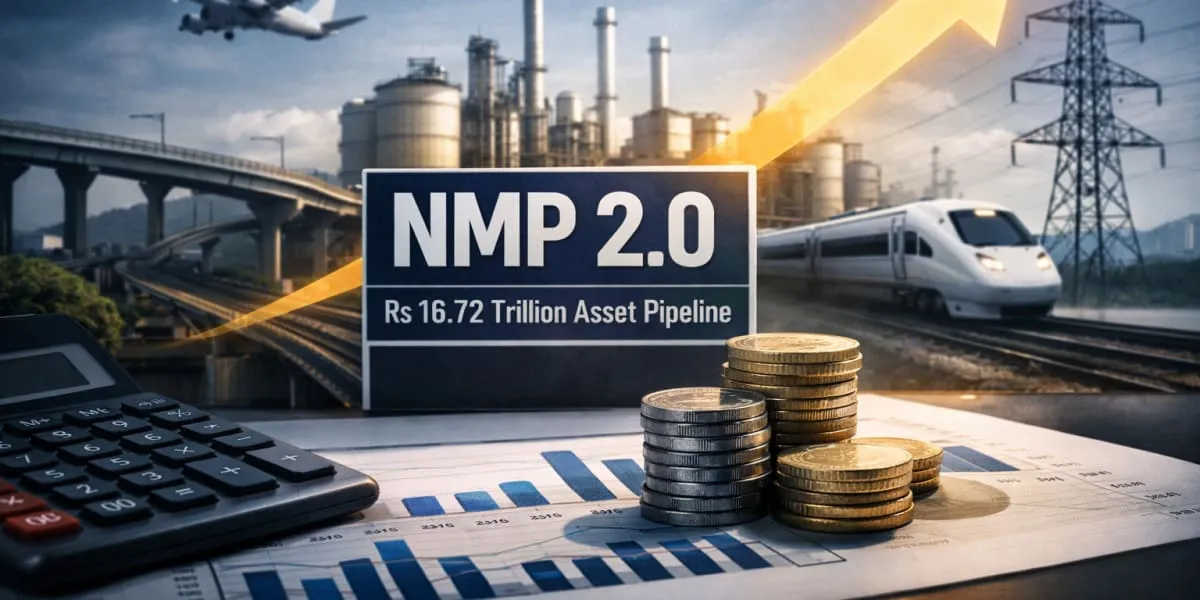
Union Finance Minister Nirmala Sitharaman launched the National Monetisation Pipeline 2.0, a second phase of asset monetisation prepared by NITI Aayog in consultation with infrastructure line ministries. The five-year period from fiscal year 2026 to 2030 (FY 2026–30) identifies an aggregate monetisation potential of Rs 16.72 trillion (tn), including estimated private sector investment of Rs 5.8 trillion (tn). The pipeline follows the mandate set out in the Union Budget 2025–26 and seeks to provide visibility to public asset owners and to potential investors.

Officials reported that authorities met nearly 90 per cent of the target of Rs six tn set over four years under NMP 1.0, and that best practices and lessons learned will guide the second phase. Ministries and departments have been urged to focus on process simplification and standardisation to make monetisation seamless and time bound. An empowered Core Group of Secretaries on Asset Monetisation will continue to monitor progress.

NMP 2.0 is positioned as a catalyst for the Viksit Bharat infrastructure agenda and for recycling productive public assets to unlock resources for reinvestment in capital expenditure. The approach is designed to mobilise funds for public CAPEX while reducing direct budgetary outgo, and to attract direct private investment into projects that involve construction or major maintenance. The programme scope covers highways, railways, power, petroleum and natural gas, civil aviation, ports, urban infrastructure, coal, mines, telecom and tourism.

Sectoral highlights include highways, MMLPs and ropeways at about Rs 4.42 tn; power at around Rs 2.77 tn; ports at roughly Rs 2.64 tn; railways at near Rs 2.62 tn; coal at about Rs 2.16 tn; and mines at approximately Rs 1.00 tn. Proceeds are expected to flow principally to the Consolidated Fund of India, followed by direct private investment, allocations to public sector undertakings or port authorities and state consolidated funds. Transactions are to be structured through a mix of contractual and capital market instruments, including public private partnership concessions and infrastructure investment trusts.

Union Finance Minister Nirmala Sitharaman launched the National Monetisation Pipeline 2.0, a second phase of asset monetisation prepared by NITI Aayog in consultation with infrastructure line ministries. The five-year period from fiscal year 2026 to 2030 (FY 2026–30) identifies an aggregate monetisation potential of Rs 16.72 trillion (tn), including estimated private sector investment of Rs 5.8 trillion (tn). The pipeline follows the mandate set out in the Union Budget 2025–26 and seeks to provide visibility to public asset owners and to potential investors. Officials reported that authorities met nearly 90 per cent of the target of Rs six tn set over four years under NMP 1.0, and that best practices and lessons learned will guide the second phase. Ministries and departments have been urged to focus on process simplification and standardisation to make monetisation seamless and time bound. An empowered Core Group of Secretaries on Asset Monetisation will continue to monitor progress. NMP 2.0 is positioned as a catalyst for the Viksit Bharat infrastructure agenda and for recycling productive public assets to unlock resources for reinvestment in capital expenditure. The approach is designed to mobilise funds for public CAPEX while reducing direct budgetary outgo, and to attract direct private investment into projects that involve construction or major maintenance. The programme scope covers highways, railways, power, petroleum and natural gas, civil aviation, ports, urban infrastructure, coal, mines, telecom and tourism. Sectoral highlights include highways, MMLPs and ropeways at about Rs 4.42 tn; power at around Rs 2.77 tn; ports at roughly Rs 2.64 tn; railways at near Rs 2.62 tn; coal at about Rs 2.16 tn; and mines at approximately Rs 1.00 tn. Proceeds are expected to flow principally to the Consolidated Fund of India, followed by direct private investment, allocations to public sector undertakings or port authorities and state consolidated funds. Transactions are to be structured through a mix of contractual and capital market instruments, including public private partnership concessions and infrastructure investment trusts.

Next Story
Infrastructure Urban

We’ve cut 50,000 tonnes of carbon emmissions since 2019

MatchLog is challenging a decades-old logistics norm and empty container miles by directly matching import flows with export demand. Indeed, the platform is unlocking measurable cost savings, cutting emissions and driving structural change in landside operations. Dhruv Taneja, Founder and Global CEO, outlines the quantified impact, adoption  journey and the evolving future of container reuse in an exclusive interview with Construction World. MatchLog has partnered with carriers such as Maersk, ONE and HMM in India. Could you share quantified outcomes from one specific corri..

Next Story
Infrastructure Transport

Airports: Capacity is Key

A lotus-inspired terminal design in Navi Mumbai International Airport. A terminal in a garden in Bengaluru’s Kempegowda International Airport. A peacock-inspired canopy in Chhatrapati Shivaji Maharaj International Airport. A nature-inspired terminal in Guwahati’s Lokpriya Gopinath Bordoloi International Airport.Truly, “India’s airports are no longer constrained by architectural ambition,” avers Ravikanth Mididhodi, Chief Technical Officer, J&F, a German-based engineering firm with over 25 years of global legacy in delivering advanced engineering and BIM services for air..

Next Story
Real Estate

In 2025, Amaravati attracted ₹ 28,075 crore in investments

In an exclusive interview with Construction World, Kanna Babu, IAS, Commissioner, Andhra Pradesh Capital Region Development Authority (APCRDA), reveals how Amaravati is entering a decisive new phase of capital city development. With 36 MoUs worth ₹ 45,589 crore, a ₹ 58,000 crore tender pipeline, and rising institutional investments, he explains the strategic execution, infrastructure rollout, and governance framework driving Amaravati’s emergence as a structured, investment-ready, and future-focused capital.APCRDA has recently secured major financial tie-ups, including loans from NA..

Advertisement

Subscribe to Our Newsletter

Get daily newsletters around different themes from Construction world.

STAY CONNECTED

Advertisement

Advertisement

Advertisement

Open In App