+
Over 1,000 Construction Sites In Mumbai Served Stop-Work Notices
ECONOMY & POLICY

Over 1,000 Construction Sites In Mumbai Served Stop-Work Notices

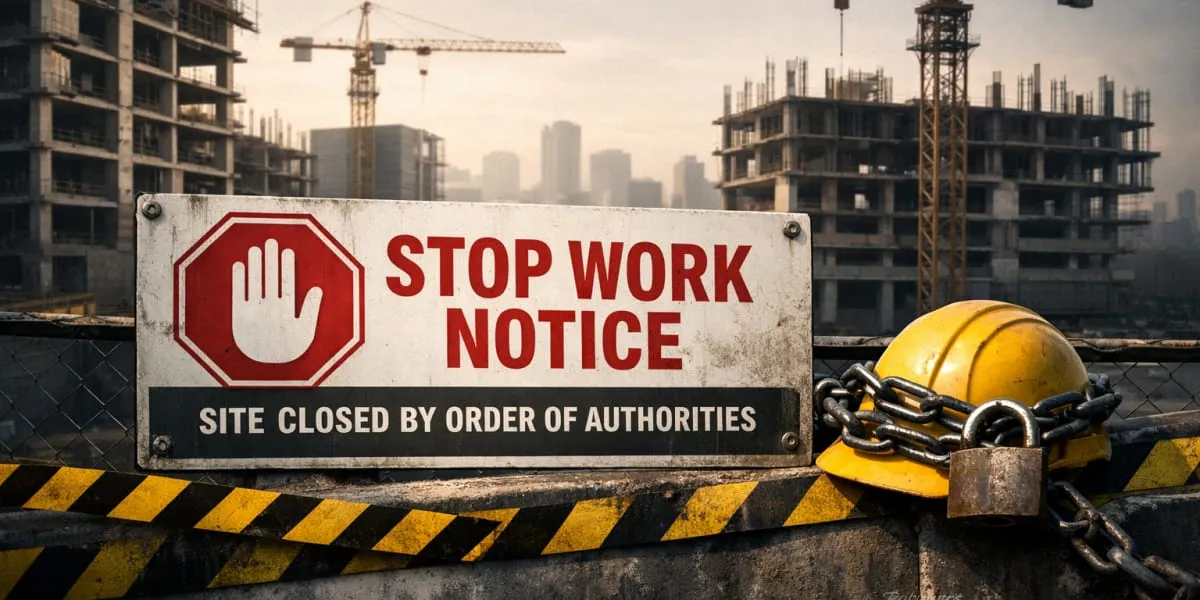
The minister reported that over 1,000 construction sites in Mumbai have been served stop-work notices as part of an enforcement drive targeting unauthorised and non-compliant activity across the city. Municipal authorities have carried out inspections across multiple wards and have identified sites where work must be suspended pending compliance checks and remedial measures. The announcement signalled a stepped-up approach to regulatory oversight aimed at ensuring structural safety and adherence to planning norms.

Site owners and contractors have been required to halt operations immediately and to submit plans for rectification within the timelines set by the municipal authorities, with failure to comply liable to result in penalties and further legal action. Enforcement teams will monitor progress and may seek court intervention where notices are ignored or where risks to public safety are identified. The minister indicated that the move forms part of a broader effort to regularise construction activity and to protect residents.

Officials said the notices cover a range of infractions, from permit lapses to apparent deviations from approved plans, and that each case will be examined on its merits before further steps are taken. Authorities will allow work to resume only after satisfactory remedial action and formal clearance, and inspections will continue to verify compliance. The process is intended to provide a clear pathway for corrective work while maintaining strict oversight.

The enforcement drive is expected to affect project timelines and may prompt developers to review compliance procedures, with potential implications for completion schedules but also for long-term safety standards. Stakeholders were urged to cooperate with regulators to expedite resolutions and to prioritise corrective measures over speed of delivery. The minister reiterated that vigilance will be maintained and that similar action may be taken where non-compliance persists and to preserve public trust in safety standards across urban developments.

The minister reported that over 1,000 construction sites in Mumbai have been served stop-work notices as part of an enforcement drive targeting unauthorised and non-compliant activity across the city. Municipal authorities have carried out inspections across multiple wards and have identified sites where work must be suspended pending compliance checks and remedial measures. The announcement signalled a stepped-up approach to regulatory oversight aimed at ensuring structural safety and adherence to planning norms. Site owners and contractors have been required to halt operations immediately and to submit plans for rectification within the timelines set by the municipal authorities, with failure to comply liable to result in penalties and further legal action. Enforcement teams will monitor progress and may seek court intervention where notices are ignored or where risks to public safety are identified. The minister indicated that the move forms part of a broader effort to regularise construction activity and to protect residents. Officials said the notices cover a range of infractions, from permit lapses to apparent deviations from approved plans, and that each case will be examined on its merits before further steps are taken. Authorities will allow work to resume only after satisfactory remedial action and formal clearance, and inspections will continue to verify compliance. The process is intended to provide a clear pathway for corrective work while maintaining strict oversight. The enforcement drive is expected to affect project timelines and may prompt developers to review compliance procedures, with potential implications for completion schedules but also for long-term safety standards. Stakeholders were urged to cooperate with regulators to expedite resolutions and to prioritise corrective measures over speed of delivery. The minister reiterated that vigilance will be maintained and that similar action may be taken where non-compliance persists and to preserve public trust in safety standards across urban developments.

Next Story
Infrastructure Urban

Implementation Status of Jal Jeevan Mission

Since August 2019 the Government has implemented Jal Jeevan Mission to provide assured potable water through household tap connections in rural India. At the start of the mission only 32.3 million (mn) rural households, representing 16.7 per cent, were reported to have tap water connections. States and union territories have reported that 125.8 mn additional rural households have since been provided with tap connections. As a result, of about 193.6 mn rural households roughly 158.2 mn, or 81.71 per cent, are reported to have tap water supply at home.\n\nThe State, district and village level st..

Next Story
Infrastructure Urban

Jal Jeevan Mission Reaches Eighty One Per Cent Rural Coverage

The Government reported substantial progress under the Jal Jeevan Mission, launched in August 2019 to provide tap water to every rural household. At launch only 32.3 million (mn) rural households had tap connections and states and Union territories reported provision of 125.8 mn additional households by March 2026. Consequently, out of about 193.6 mn rural households around 158.2 mn, or 81.71 per cent, are reported to have tap water at home. The Finance Minister announced extension of the mission until 2028 in the 2025-26 budget speech. The Swachh Bharat Mission Grameen, launched in October 20..

Next Story
Infrastructure Urban

Empowering Local Governance for Sustainable Rural Water Supply

The Ministry of Jal Shakti has aligned the Jal Jeevan Mission (JJM) with the 73rd Amendment to strengthen village level planning and community ownership of water supply. Gram Panchayats, village water and sanitation committees and Pani Samitis are to plan, implement, manage and maintain piped water systems, with gram sabha processes formalising handover and oversight. Implementation support agencies including non government organisations, community based organisations and self help groups have been empanelled to train local committees and promote women participation. Under JJM, the department ..

Advertisement

Subscribe to Our Newsletter

Get daily newsletters around different themes from Construction world.

STAY CONNECTED

Advertisement

Advertisement

Advertisement