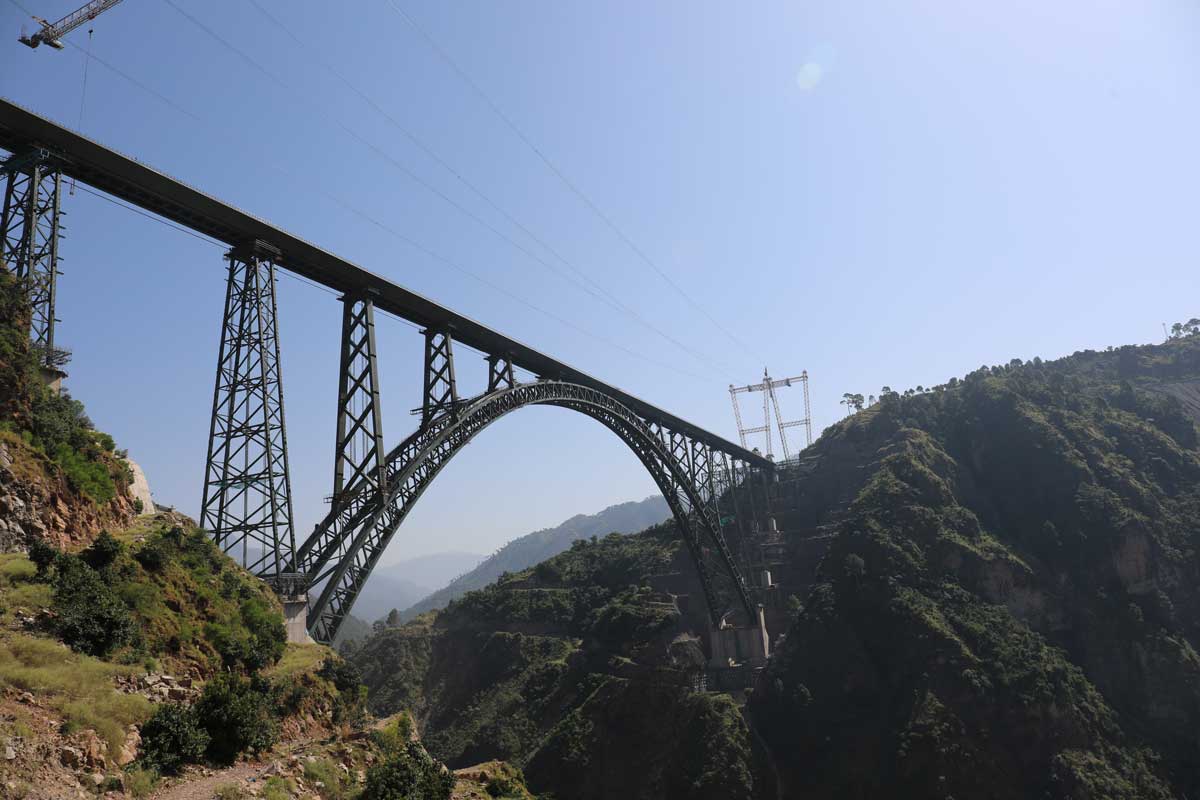
The world’s highest single-arch railway bridge - the Chenab Bridge - witnessed the completion of its steel arch last year. What’s more, the overarch deck was also recently completed.
The overarch deck launching of the Chenab Railway Bridge was recently completed with a golden joint– truly a global milestone for India at the world’s highest railway bridge.
So, what’s this achievement all about? Ninety-eight deck segments, each weighing about 85tonne, have been simultaneously launched from both ends of the valley over the mighty steel arch. Both ends finally met to complete the bridge overarch deck.The segments have been joined with the help of high strength friction grip (HSFG) bolts to mark the golden joint. This not only completes the bridge over the Chenab River valley, but creates a new chapter in the history of Jammu & Kashmir.
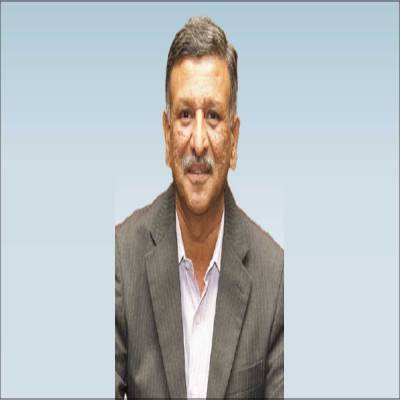
“Afcons has been doing technologically complex projectsright from the early days,” says S Paramasivan, Managing Director, Afcons. “I must say Chenab Bridge will be on the top of the list, for the simple reason that this is a once-in-a-generation project. With all humility, I can say that India has not seen such a project so far. Technology will continue to be a key driver in the infrastructure sector and we will continue to focus on operational excellence to deliver such challenging projects even in the future.”
Giridhar Rajagopalan, Deputy Managing Director, Afcons, adds, “The overarch deck completion, 359m above the Chenab riverbed, will be an extraordinary achievement. I have my highest respect for every engineer and worker who has contributed to this engineering achievement. This golden joint will usher in a golden moment in the history of Indian Railways and will become a golden chapter in the history of Jammu &Kashmir. The construction engineering was completely done by Indian engineers, which makes the Chenab Railway Bridge a symbol of Atmanirbhar Bharat.”
Indeed, the Chenab Railway Bridge is a construction mammoth. Around 30,350 mt of steel has been used in the 1,315-m bridge construction; 10,620 mtof steel has been consumed in the construction of the gigantic arch; and 14,504 mt of steel has gone into the construction of the bridge deck. The bridge, on the upstream of Salal Dam, is situated near Kauri village in the Reasi district of Jammu &Kashmir. Constructed by Mumbai-based infrastructure major Afcons, the execution plan has taken into consideration safety, quality and productivity as the driving parameters.
“For the first time in Indian Railways, incremental launching was done on transition curve and a longitudinal gradient, both occurring at the same location, for the deck launching of the viaduct portion of the Chenab Bridge,” shares Rajagopalan. “Typically, bridges have been constructed incrementally on a straight or curved platform with a uniform radius. Executing launching activities in inclement weather and stormy wind conditions was extremely challenging.”
Both Northern Railways (NR) and Konkan Railway Corporation (KRCL) have played a huge role in finalising the design of the iconic bridge. Reflecting on their involvement at crucial stages of construction, Rajagopalan adds, “We received tremendous support for any technical issue, approval for drawings, method statements and, most important, both NR and KRCL played an important role in generating local employment. KRCL constructed all the access roads to the project site. These roads have provided connectivity to far-flung villages in the region. NR allowed us to use the phased array ultrasonic testing machine for inspection of welds. This was done for the first time in India.”
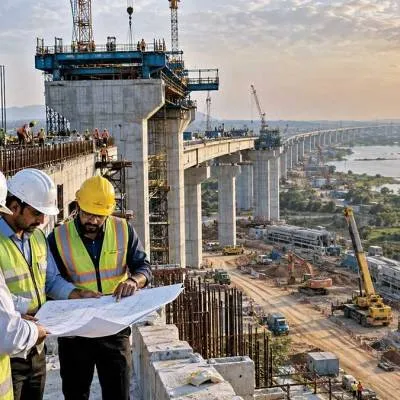
Fabrication was carried out in sophisticated workshops set up at both ends of the bridge. Heavy and bulky segments were transported to the launching pad with the help of SPMT, a specialised modular trailer. “Considering the treacherous hilly terrain, a temporary launching platform with segment lifting capacity of 120 mt and for a height of about 39m was designed,” he shares. “We developed and implemented a number of innovative methods to overcome the challenges of the hilly terrain for successfully executing our launching activities.”
For the first time in India, a fully equipped NABL laboratory was set up to ensure that quality was monitored at every stage of the project. “We set up the NABL lab at site to conductweld sample tests. This saved a lot of time,” says Rajagopalan. Afcons carried out a mock-up of all main bridge components before executing the original work, which gave confidence to the engineers. This was super critical in ensuring quality and safety of staff and workers.
Once completed, the Chenab Railway Bridge will be 35m higher than the Eiffel Tower.
Besides completing the world’s highest single-arch railway bridge in Jammu &Kashmir, Afcons also holds the distinction of refurbishing Bihar’s iconic Mahatma Gandhi Setu and converting it into India’s longest steel bridge.
Project highlights
The Chenab Railway Bridge comes under the aegis of the Konkan Railway Corporation (KRCL) and is part of the ambitious Udhampur-Srinagar-Baramulla-Rail Link (USBRL) project.
It is the world’s highest single-arch railway bridge – standing 359m (1,178ft) above the Chenab riverbed, 35m higher than the Eiffel Tower.
The bridge is envisaged to boost the socioeconomic development of Jammu & Kashmir.
It is the key to providing all-weather and reliable connectivity between J&K and the rest of the country by the railway network, apart from providing connectivity by rail to the far-flung areas of the state.
It is designed to withstand any critical seismic activity and is perhaps the first bridge designed to resist loads, including contact blast loads.
The bridge factors for any kind of redundancy.This means that if there is damage to any part of the bridge, like a pillar, it will not lead to the collapse of the entire bridge or render it useless.
World’s largest crossbar cable crane has been installed over tall pylons 127m high and 915m apart at both ends of the arch for erection of all elements of the arch, piers, trestles in the valley. The lifting capacity of bothcranes is limited to 20mt each; the same can be increased to 36mt when operated in tandem.
On April 5, 2021, Afcons completed the steel arch of the bridge in one of the most windy and hostile terrains of J&K.
Chenab Railway Bridge is a true example of extreme engineering, and the erection of the arch was most critical owing to its intricate design and geometry.- Shriyal Sethumadhavan