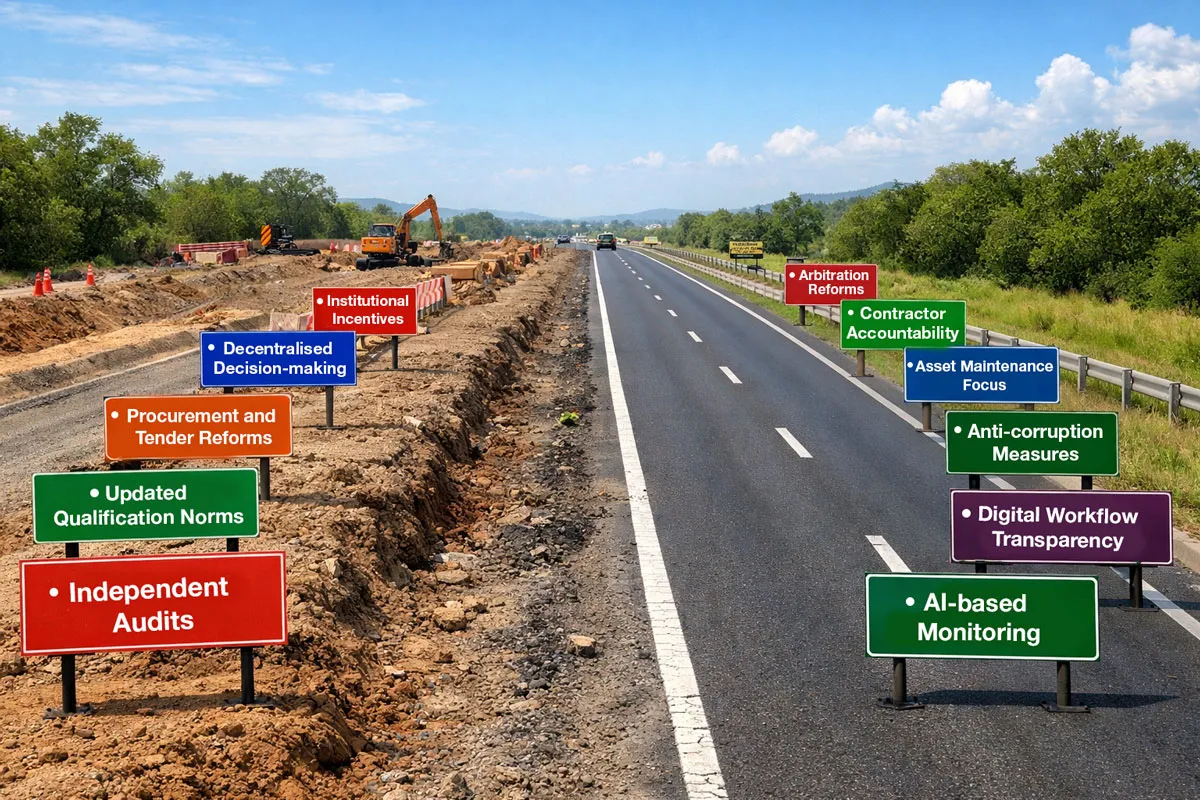
Project delays and inefficiencies continue to bedevil the progress of India’s National Highways network. A multi-pronged reform agenda is needed to inject greater transparency and accountability at every stage – from planning and procurement to execution, maintenance and oversight. This article offers key recommendations and reform strategies that government stakeholders – from the Ministry of Road Transport & Highways (MoRTH) and the National Highways Authority of India (NHAI) to state agencies and oversight bodies – should pursue to put highway development on a better track.Decentralise and streamline decision-makingLarge organisations often suffer from overcentralisation, leading to slow decision cycles and opacity. Reforms should empower field offices to take more decisions on the spot while ensuring transparency. Delegating appropriate financial powers to project directors and regional officers can speed up execution, as long as their decisions are logged in the system for audit. A balanced approach is needed to cut redundant hierarchy but increase accountability through real-time oversight. One example to emulate is the Border Roads Organisation (BRO), which reportedly managed to reduce corruption to near-zero by streamlining processes – it achieved 90 per cent of bill payments within nine days and earned a Gold Certificate for two consecutive years for bringing in this revolutionary change for a transparent and efficient system.Strict procurement and tendering reformsThe contracting process must be reformed to prevent both corruption and future disputes. First, detailed project reports (DPRs) and estimates need to be realistic and vetted – no project should be bid out without all basic clearances (land, environment) in place and a thorough design to minimise later changes. Second, the practice of accepting abnormally low bids should be curtailed. If a bid is far below the estimated cost, there should be a mechanism to either reject it or demand additional performance guarantees and proof of how the contractor will maintain quality. This prevents the ‘suicide bidding’ that often leads to poor work or cost escalation claims later. All tendering should be through e-procurement portals with clear rules to curb human interference. Also, contract conditions need reform: include provisions that make the contractor responsible for any defects for a longer period and liable for reconstruction costs if failures occur. This will compel builders to ensure quality rather than just finish and forget. A fair and efficient dispute resolution clause is also critical.Evolving qualification normsThe current Indian system, largely driven by L1 (lowest bidder) criteria, needs to evolve into a value-based, quality-centric procurement regime. This requires giving weightage to the contractor’s past performance, timely delivery record and project complexity handled, on a par with financial and technical criteria. Contractors with consistent delays or quality lapses will naturally be disqualified without needing blacklisting. We must build a centralised digital contractor evaluation portal linked to MORTH/NHAI/CPWD projects. Performance scoring after every project (timeliness, quality, safety, client satisfaction) should be mandatory. We should include only CPARS (Contractor Performance Assessment Reporting System)-qualified contractors in select tenders, especially for high-value expressways or BOT projects.Institutionalising incentives: Reward-based contractingA robust mechanism to incentivize timely or early completion must be institutionalised within all EPC/PPP contracts. A bonus clause of 5-10 per cent of the contract value should be tied to measurable, third-party-certified early completion, without compromising quality. Such a framework will motivate contractors to plan better, mobilise faster and work efficiently; decongest arbitration pipelines, as projects completed ahead of schedule rarely enter disputes; and reduce interest burden and escalations by compressing the overall project cycle.Independent audits and oversightRobust oversight is vital to keep the system honest. In addition to internal vigilance, external audits by agencies like the Comptroller & Auditor General (CAG) and independent monitors must be strengthened. CAG performance audits (such as the one that exposed the Dwarka Expressway cost inflation) should be acted upon, not dismissed. Forming empowered teams of experts (from IITs and other institutions) to inspect project sites can catch quality issues early. Importantly, audit findings and action taken should be made public. Transparency is a disinfectant: when audit results, project statuses and contractual deviations are published openly, there is pressure on officials and contractors to avoid wrongdoing.Focus on maintenance and asset managementThere is a tendency to lay emphasis on new highway construction while neglecting maintenance of existing assets. This must change. Given budget constraints, asset monetisation is a useful strategy: NHAI can raise funds by leasing out completed highways to private investors (through Toll-Operate-Transfer or Infrastructure Investment Trusts) and plough back that money into maintaining other roads. Innovative long-term maintenance contracts (like performance-based maintenance where a contractor is paid regularly to keep a stretch pothole-free to defined standards) should be expanded. Investing in resilience – for example, better drainage to prevent flooding of roads and using improved materials that can withstand heavy rains – will save money in the long run by reducing the need for emergency repairs each year. Essentially, a rupee spent on maintenance today can save several rupees of rehabilitation tomorrow.Accountability for contractors and engineersReforms must ensure that those who build and supervise our highways are strictly accountable for their performance. Contractors who consistently deliver quality work on time should be rated well and earn faster security deposit releases or preference in bidding. On the other hand, nonperformers must face tangible consequences. Further, the Government must introduce a rigorous rating system for authority engineers and consultants. Those who oversee projects should be graded on performance and poorly rated engineers barred from future assignments. Last, quality control mechanisms like third-party audits, independent testing of materials and sensor-based monitoring (for example, using devices embedded in concrete to track curing and load) should be standard. Arbitration reformsTo course-correct, India needs urgent and systemic reforms, including:A completely independent arbitration pool, with conflict-of-interest-free empanelmentAmendments to the Arbitration Act to allow scrutiny of arbitrator misconductMandatory use and empowerment of DRBs and CCIEsLinking officer appraisals and financial accountability to arbitration outcomesStrengthening government legal teams, with dedicated legal officers for each major projectReal-time third-party audits and digital documentation of project progress to build defensible positions.Without these, India risks turning its most ambitious infrastructure programme into a perpetual litigation machine, bleeding public money without delivering public good. Measures to deter corruptionOn the broader front of fighting corruption, India has the legal framework in place; it now needs stringent enforcement. Fast-track courts for corruption cases (especially involving large public works) could help ensure timely justice – delayed trials only embolden wrongdoers. The Government should also empower bodies like the Central Vigilance Commission (CVC), State Vigilance Bureaus and Lokayuktas to proactively investigate highway project complaints. The contract procurement process can include clauses debarring firms or personnel convicted of misconduct. Leveraging technology, all project payments and transactions should be traceable online to reduce scope for under-the-table deals. Additionally, India’s recent push for a ‘Right to Services’ in some states – guaranteeing citizens timely government services, or else compensation – can be extended to infrastructure delivery: for example, if a completed road is found substandard, the responsible parties owe damages. Ultimately, an ethical environment has to be cultivated from the top down, with leadership in MoRTH and NHAI making it clear that integrity is non-negotiable.Digital transparency & workflow monitoringEmbrace e-governance tools to make processes transparent and minimise human discretion. Project management software should be used to track all project data and file movements and analytics used to forecast delays and disputes, issuing early warnings. Similarly, important project milestones should be geo-tagged and photo/video documented to deter false reporting. Overall, automation and IT-enabled monitoring can greatly reduce opportunities for petty corruption and delay by making the workflow visible to all stakeholders and higher authorities.Digital twins & AI-based central monitoringTo address the rampant information asymmetry and fake reporting in highway construction, digital-twin technology should be mandatorily deployed in all projects exceeding Rs 100 crore. It will enable predictive maintenance and lifecycle optimisation, reducing total cost of ownership. Live dashboards can be opened to CAG, MoRTH, Parliament committees and even public observers for critical corridors.Whistle-blower incentives and citizen vigilanceEncouraging citizens and honest insiders to report malpractices can greatly enhance oversight. Going forward, highway users should be empowered via grievance portals and apps to report issues like poor maintenance, contractor malpractices or toll irregularities, with assurance of prompt action. Enhanced surveillance and integrity at toll plazasToll collections are a significant revenue source but also prone to leakages and local corruption. We must resort to barrier-free tolling using automatic number plate recognition (ANPR), aiming to eliminate cash handling entirely. These measures should be accelerated and expanded nationwide. By plugging toll revenue leaks and removing manual handling, corruption is curbed and users also benefit from reduced congestion.Enabling citizen engagementAn aware and engaged public is perhaps the best watchdog. All project information should be put on an open website and continually updated – including project progress dashboards, contract awards and quality ratings of contractors/consultants. In sum, transparency, citizen engagement and social accountability will ensure that the whole system stays honest and oriented towards the public good.In conclusion: Driving reforms to restore trustIndia stands at the crossroads with respect to its infrastructure development. On one hand, never before have resources and political will been so firmly behind building world-class highways. On the other hand, the spate of recent road collapses, pothole embarrassments and audit revelations have shaken public confidence. It is evident that business as usual will not suffice – pouring more money is not a solution unless it is accompanied by deep-seated governance reforms. When bridges fail and roads crumble soon after inauguration, it is not merely an engineering failure but a failure of ethics and oversight. Each such incident erodes the people’s trust in the system and, tragically, sometimes their lives. We cannot afford to continue on this path. As the Prime Minister himself has emphasised, the focus now has to shift not just to expanding the highway network, but widening and maintaining it to the highest standards. The economy and citizens both depend on safe, reliable connectivity – every rupee wasted or siphoned off is a betrayal of both development and public safety.Yet, hope springs eternal. With greater transparency, stricter accountability and active public vigilance, the cycle of waste and corruption can be broken. It is time to reclaim India’s roads from the quagmire of graft and inefficiency. By instituting the reforms discussed – beyond corruption, beyond short-term fixes – we can pave a highway infrastructure that is worthy of India’s aspirations. The road ahead during Amrit Kaal to 2047 can indeed be smooth if we collectively choose not to be corrupt and, instead, to be accountable. The nation deserves nothing less. The recommendations above provide a blueprint for change. Implementing them will not be easy; it requires breaking the status quo of entrenched interests and overcoming bureaucratic inertia. Yet, implement them we must.About the author: Lt Gen Rajeev Chaudhry (Retd), former DG Border Roads, doubled the pace of work to meet stringent targets after the Galwan clash and worked to get an incremental budget allocation of 160 per cent for GS roads during his tenure. He infused at least 18 new technologies to enhance speed and quality of projects. He brought transparency in expenditure through increased use of GeM and ensured timely payments to the firms for which BRO was awarded Gold Certificate for two consecutive years. He also ensured desired dignity, social security and visibility to the unsung BRO Karmayogis.