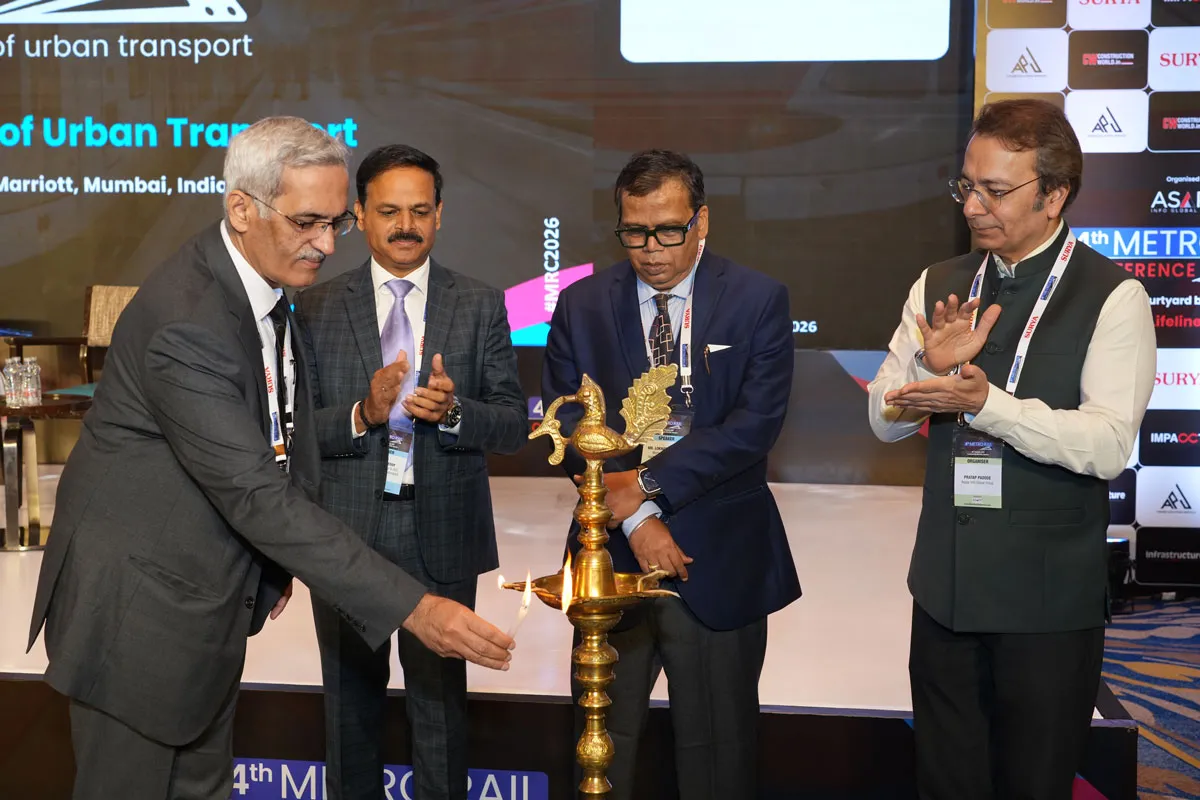
India’s metro rail programme has entered a new phase—one where the focus is no longer only on adding kilometres, but on building integrated, reliable and financially sustainable urban transit systems. With more than 1,000 km of metro lines already operational and daily ridership exceeding 10 million, the challenge now lies in execution quality, underground risk management, multimodal integration, viable funding structures, and large-scale digital adoption. These themes framed deliberations at the 4th Metro Rail Summit 2026, held in Mumbai, under the theme Accelerating the Lifeline of Urban Transport.The conference, organised by FIRST Construction Council, brought together metro operators, project authorities, consultants, contractors, financiers, and technology providers to examine how India can future-proof its metro expansion. Surya Roshni participated as Platinum Sponsor, while APJ Cranes was the Gold Partner. The programme also included partner showcase presentations by Krishna Kant Agrawal, DGM–Marketing (Professional Lighting), Surya Roshni, and Rituraj Vikram, Director – Business Development, APJ Cranes, highlighting industry solutions aligned with metro infrastructure requirements.Discussions consistently pointed towards a shift from corridor-led development to network-led planning, from isolated engineering solutions to system-level integration, and from descriptive DPRs to truly execution-ready project documentation.In his opening address, Pratap Padode, Founder, FIRST Construction Council, emphasised that urban transport systems must move beyond a narrow focus on track execution and engineering capability to deliver a seamless, safe and reliable user experience. Metro success, he noted, should be measured by whether people willingly choose public transport in their daily lives. When this happens, cities attract talent, industry, and foreign investment, creating a virtuous cycle of economic growth.He pointed to milestones such as India’s first underwater metro tunnel in Kolkata and Kochi’s water metro as evidence of how engineering capability is converging with innovation in multimodal transport. Metro systems, he added, are increasingly central to addressing road safety, congestion, emissions and public health. Projections indicating that Delhi Metro alone could remove nearly 10.9 lakh vehicles from city roads by 2031 underline the scale of potential impact. The larger message was clear: the next stage of metro growth must be people-centric, multimodal, low-carbon, and digitally enabled.Visibility into the metro pipelineAn industry data presentation by Tanveer Padode, CEO, IMPACCT, highlighted the scale and depth of India’s metro rail pipeline. Operational networks stand at around 1,090 km, while the long-term pipeline could exceed 4,000 km by 2040 based on conceptual and approved projects. Mumbai currently leads in under-construction kilometres, followed by Chennai, Bengaluru and Delhi.Approved metro projects worth close to Rs 1 lakh crore were highlighted, with around 30 per cent growth in approvals compared to the previous year. A key insight was that metro bidding behaviour differs from road projects—bids tend to stay closer to estimated project cost, reflecting the technical complexity and long-term quality implications.Early visibility of projects at planning and DPR stage was positioned as critical for contractors, suppliers and consultants to align capabilities, build relationships, and improve bid preparedness. Estimating material demand, tracking approved vendors, and structured CRM systems were presented as tools that can professionalise business development in the metro ecosystem.From blueprint to breakthrough – Managing metro mega projectsThe first panel converged on the view that weak DPRs remain one of the biggest contributors to time and cost overruns. DPRs were repeatedly described as needing to move beyond template-driven documents to become comprehensive, people-centric, and execution-ready instruments.Three non-negotiables for DPR quality were identified: realistic project cost, systematic identification of uncertainties, and achievable timelines. Geotechnical investigations and underground utility mapping emerged as especially critical, with speakers noting that inadequate data almost inevitably leads to redesign, diversions and claims.Another key insight was that unknown utilities should be treated as payable items and managed within main contracts rather than shifted in advance, reducing conflicts and rework. Panelists also stressed that uncertainties should remain with the employer rather than being artificially transferred to contractors, as this only converts into disputes later.On PPP experience, it was noted that financing cost differentials between private and public projects severely affect viability. Overly optimistic ridership assumptions and delays in land acquisition further strain PPP metros. The consensus was that network expansion, not isolated corridors, is essential for financial sustainability.Digital tools—drones, LiDAR, BIM-linked platforms and emerging agentic AI—are beginning to support monitoring and scheduling, but speakers cautioned that human interpretation and engineering judgement remain indispensable.Tunnelling into the future – High-risk underground metroUnderground metro accounts for roughly one-fifth of networks but a disproportionately higher share of risk and cost. The panel agreed that many tunnelling incidents are not inevitable geological accidents but consequences of insufficient investigation and weak risk allocation.Deeper and wider geotechnical investigations, improved utility mapping, and alignment optimisation at DPR stage were identified as the first line of defence. However, complete elimination of surprises is unrealistic, reinforcing the need for fair risk-sharing contracts and compensation mechanisms when employer obligations are delayed.Method selection—TBM, NATM or cut-and-cover—was viewed as secondary to overall risk management quality. Real-time building and surface monitoring, pre- and post-condition surveys, and transparent communication with communities were described as essential.From an operations perspective, typical long-term pain points include seepage at segment joints, poor drainage, excessive curvature, vibration transmission and restricted access to equipment rooms. Structural health monitoring using sensors and laser-based systems was identified as a necessary next step for India’s growing tunnel inventory.The panel also highlighted the need for specialised soil tests, AI-assisted probing ahead of TBMs, and, in the long term, domestic TBM manufacturing supported by large anchor investors and international collaboration.The integrated urban transit vision – metro, RRTS and multimodal nodesAs city-regions expand, commuting distances of 40–50 km are becoming common, making integration between metro, RRTS, suburban rail, buses and last-mile modes indispensable. The panel underscored that while engineering challenges are largely mastered, reducing friction in transfers is now the central task.Transit-oriented development with 500-metre influence zones, mixed land use and increased FSI was presented as a direct lever to shorten trip lengths and improve metro viability. Early evidence of TOD-linked redevelopment around stations was cited.For RRTS, seamless foot overbridges, wide concourses, park-and-ride facilities, and elimination of duplicate security checks were highlighted as enablers of smooth intercity–urban transfers.Operational integration through National Common Mobility Card, common mobility apps, and automated revenue splitting is beginning to deliver transfers within 3–5 minutes. However, suburban rail integration remains a missing link.Railway land redevelopment into multimodal hubs combining rail, metro, commercial space and public realm was positioned as a major opportunity, provided coordination begins at DPR stage.Funding the future – PPP, VGF and commercial exploitationThe financing panel reiterated that farebox revenue typically contributes only 35–40 per cent of metro income. Viability therefore depends on TOD, land monetisation, commercial development, and policy support.PPP metros were described as operationally feasible but financially stressed due to high interest costs and ridership risk. A hybrid approach—combining upfront public capex support, VGF, government guarantees, and non-fare revenue planning—was seen as more realistic than pure PPP.Multilateral funding, green bonds, and faster dispute resolution mechanisms were identified as important enablers. International experience shows that large-scale commercial development integrated within stations is central to financial sustainability.Digitally driven – AI, BIM and smart constructionBIM adoption has progressed from 3D to 4D/5D/6D models integrating time, cost and O&M. The next frontier is linking BIM with enterprise asset management and live system data to enable predictive maintenance.Open digital platforms are already enabling metro ticketing through multiple consumer apps, multimodal journey planning, and single-transaction multi-line tickets. Daily metro ticketing volumes on such networks are rising rapidly.AI-based pedestrian modelling, design optimisation, and internal knowledge platforms are improving design quality and consistency. However, speakers stressed that technology adoption depends on strong client leadership, data discipline and continuous skill development.Across sessions, a common message emerged: India’s metro programme must evolve from a construction-led expansion model to a system-engineered, network-integrated and financially balanced ecosystem. Strong DPRs, fair risk allocation, multimodal integration, diversified revenue streams, and deep digitalisation will determine whether India’s metros become not just extensive, but truly transformative urban lifelines.