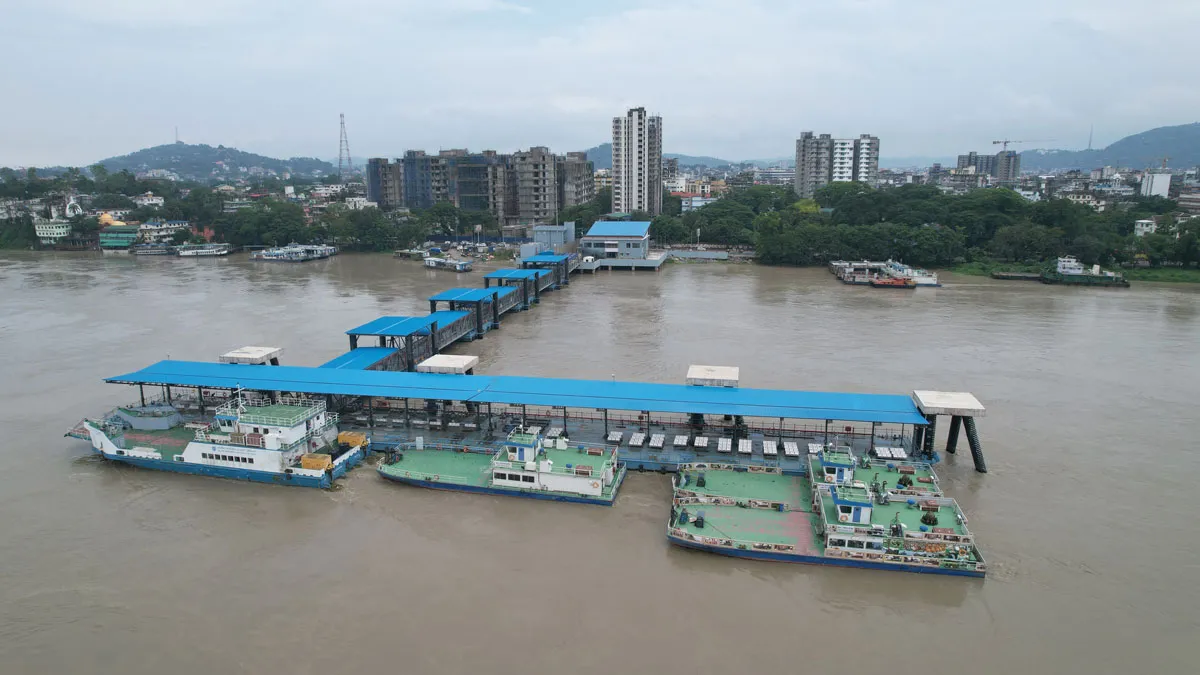
The Brahmaputra does not behave like an ordinary river. It shifts, swells and retreats with extraordinary force, carrying immense sediment loads from the Himalayas while constantly reshaping its own channel. In Guwahati, seasonal water levels can swing by nearly 10-11 m, transforming calm winter waters into a roaring monsoon current.Building permanent infrastructure in such conditions is notoriously difficult. Conventional river terminals – fixed jetties anchored to the riverbed – struggle to survive in an environment where currents intensify, sediment accumulates rapidly and the river’s morphology constantly evolves. Yet, along the banks of the Brahmaputra today stands the Gateway of Guwahati, a floating river terminal designed precisely for these conditions. Instead of resisting the river, the project embraces it, creating infrastructure that rises, falls and adjusts with the water itself.A project built between a river and a cityThe Gateway of Guwahati posed both river engineering and urban construction challenges. Located beside the busy MG Road, the site offered barely 15 m of working width, forcing heavy equipment mobilisation at night owing to traffic restrictions. Meanwhile, the Brahmaputra’s heavy sediment load and shifting riverbed complicated marine logistics. A jack-up barge transported via the Indo-Bangladesh Protocol Route, expected in two months, took nearly seven months due to sedimentation and sudden channel shifts. As conditions evolved, teams repeatedly shifted between marine and land-based construction strategies to keep progress on track.Engineering against a moving riverFrom an engineering standpoint, the project demanded infrastructure capable of surviving extreme hydraulic conditions. “The Brahmaputra River is characterised by dramatic seasonal changes in water levels, with variations of nearly 11 m between dry and peak monsoon periods,” says Sanjeev Gupta, VP and Business Head – Ports and Highways, AECOM. “This posed a fundamental challenge for passenger access and vessel berthing, both of which needed to remain functional year-round.”The solution was to abandon conventional fixed-terminal thinking. Instead, the project introduced a floating terminal architecture built on modular steel pontoons. These pontoons allow the terminal to move vertically with changing river levels, ensuring safe passenger access regardless of whether the river is in dry-season retreat or monsoon flood. Passenger movement between the floating terminal and the riverbank is maintained through articulated link spans and telescopic gangways, which automatically adjust to water-level fluctuations. “Emphasis was placed on adaptive infrastructure capable of accommodating wide water-level fluctuations, resilient structural detailing suited to high-flow and debris conditions, and operational systems designed for uninterrupted year-round service,” Gupta explains.The terminal building itself is anchored by 61 BCIS piles driven to depths of approximately 47 m, providing stable foundations despite the constantly shifting riverbed.Building in one of India’s most difficult riversExecuting structural works in the Brahmaputra demanded constant engineering improvisation. Three link spans were erected in floating mode while 60-m steel pontoons were fabricated locally and launched during flood conditions – a first for Northeast India – eliminating the need to transport them from Kolkata. Construction strategies shifted from offshore marine operations to land-based methods using temporary load-out jetties and navigation channels to move heavy piles safely. Productivity improved when conventional guide frames were replaced with modular systems and annular pile casings, reducing installation time from six days per pile to two piles per day. Environmental safeguards were equally critical, with recyclable drilling fluids used to protect the endangered Gangetic dolphin habitat.Engineering for extreme conditionsDuring the monsoon, river discharge can exceed 60,000 cu m per second, generating powerful currents that create serious berthing risks. “These conditions placed significant stress on berthing structures and increased the risk of vessel drift and impact,” shares Gupta. To manage these forces, the terminal incorporates high-capacity mooring systems with redundant lines and quick-release mechanisms capable of stabilising vessels even under heavy hydraulic loads.Reimagining the Brahmaputra as urban infrastructureFor Aditya Vikram Yadav, IAS, Managing Director, Assam Inland Waterways Company (AIWCL), the Gateway of Guwahati is far more than a ferry terminal – it represents a structural shift in how Guwahati views its river. “The Gateway of Guwahati Terminal marks the beginning of a transformative phase in Guwahati’s riverfront and multimodal connectivity landscape,” he avers. “The terminal is not merely a transport node but a strategic anchor for integrating the river into the city’s mainstream mobility, commerce and public life.” The facility includes passenger amenities such as waiting lounges, an observatory deck, food courts, accessible ramps, surveillance systems and an integrated command centre designed to ensure safety and operational efficiency. “By providing safer, faster and more comfortable ferry services, the terminal will enhance daily connectivity and rebuild public confidence in water transport,” he adds. “By improving passenger experience and streamlining operations, it is expected to encourage a modal shift from road to river.” But the vision extends far beyond ferry services. “In the coming years, the Brahmaputra can evolve into a shared public resource – a place for mobility, recreation, culture and economic activity,” Yadav notes. AIWCL is already exploring plans for water metro systems, cruise tourism, leisure vessels, water sports events and organised ferry networks, potentially transforming the Brahmaputra into a vibrant public corridor.In conclusionMore than 4,000 vessels operate across the Brahmaputra and Barak Valley waterways, reflecting the region’s reliance on inland transport. Engineered for 10-11 m seasonal water swings, the Gateway of Guwahati transforms a restless river into a reliable mobility corridor, turning the Brahmaputra from a barrier into a backbone of everyday connectivity.
FACT FILE
Project: Gateway of Guwahati Floating River Terminal
Completion/inauguration: 2025
Cost: Rs 305 Crore
Implementing authority: Government of Assam
Project programme: Assam Inland Water Transport Project
Operating agency: Assam Inland Waterways Company
PMC: AECOM
Terminal development/civil works: Larsen & Toubro design & engineering/technical support: Tractebel
Floating infrastructure & marine works: Modular pontoon and link-span systems executed under AIWTP river terminal package
Funding support: World Bank (Assam Inland Water Transport Project)