
DB Schenker Uses Remote-Controlled Forklifts
Equipment

DB Schenker Uses Remote-Controlled Forklifts

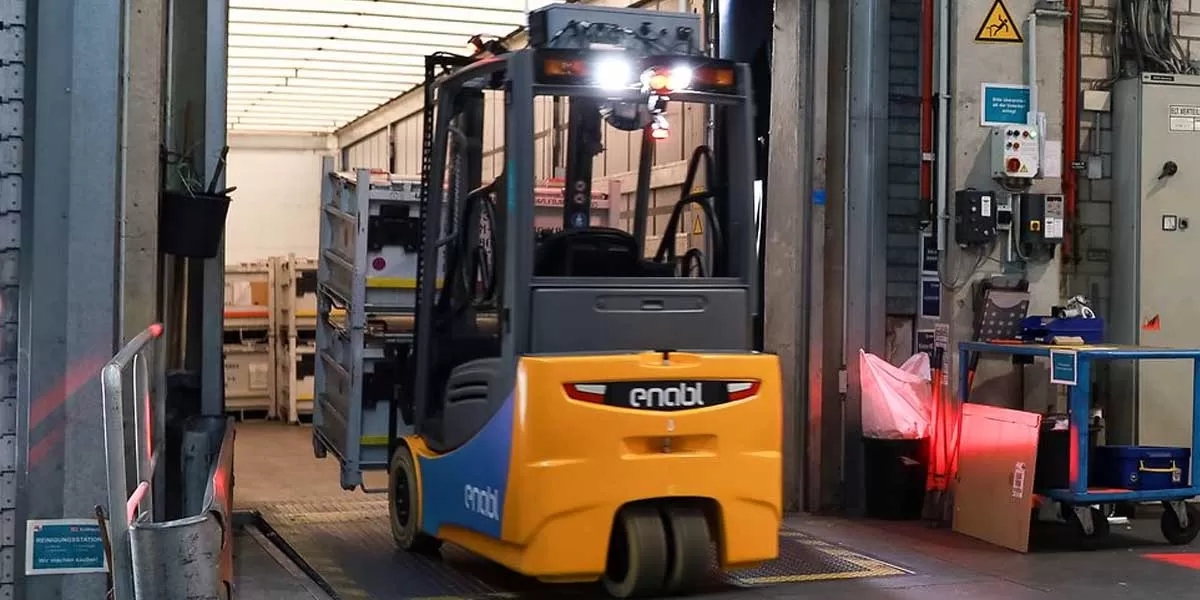
Forklifts are now being operated remotely at DB Schenker’s Contract Logistics site in Kassel, Germany. The drivers control the vehicles from a distance. With a remote driving setup, drivers are connected to several different vehicles at different locations via the enabl platform.

Lucas Mömken, Vice President Global Engineering & Innovation in Contract Logistics, DB Schenker: “The collaboration with enabl allows us to react flexibly to fluctuations in demand and automate our processes to increase productivity. We see this partnership as a valuable addition to our CL digitalization strategy, which will help us to secure our competitiveness in the long term.”

Julian Wadephul, CEO enabl Technologies: “Our solution has been in continuous use at DB Schenker for nine months and has shown that our product meets the needs of our customers and market trends. This collaboration is a big step for us on the way to becoming a global leader in warehouse automation. We are pleased that our safety concept makes it possible to dispense with a support driver with immediate effect.”

Remote-controlled driving has the potential to increase efficiency and eliminate staff shortages by separating the driver from the forklift. DB Schenker is continuing its collaboration with the German technology startup to increase the automation of its logistics processes. A Letter of Intent describing the long-term collaboration to scale enabl’s advanced remote control and automation technology for forklifts at several DB Schenker international locations was recently signed.

With around 72,700 employees at more than 1,850 locations in over 130 countries, DB Schenker is one of the world’s leading logistics service providers. The company operates land, air, and ocean transportation services, and it also offers comprehensive logistics and global supply chain management solutions from a single source. Aiming for a sustainable future of the logistics industry, DB Schenker continuously invests in innovative transport solutions, renewable energies, and low-emission products for its customers.

Forklifts are now being operated remotely at DB Schenker’s Contract Logistics site in Kassel, Germany. The drivers control the vehicles from a distance. With a remote driving setup, drivers are connected to several different vehicles at different locations via the enabl platform.Lucas Mömken, Vice President Global Engineering & Innovation in Contract Logistics, DB Schenker: “The collaboration with enabl allows us to react flexibly to fluctuations in demand and automate our processes to increase productivity. We see this partnership as a valuable addition to our CL digitalization strategy, which will help us to secure our competitiveness in the long term.”Julian Wadephul, CEO enabl Technologies: “Our solution has been in continuous use at DB Schenker for nine months and has shown that our product meets the needs of our customers and market trends. This collaboration is a big step for us on the way to becoming a global leader in warehouse automation. We are pleased that our safety concept makes it possible to dispense with a support driver with immediate effect.”Remote-controlled driving has the potential to increase efficiency and eliminate staff shortages by separating the driver from the forklift. DB Schenker is continuing its collaboration with the German technology startup to increase the automation of its logistics processes. A Letter of Intent describing the long-term collaboration to scale enabl’s advanced remote control and automation technology for forklifts at several DB Schenker international locations was recently signed.With around 72,700 employees at more than 1,850 locations in over 130 countries, DB Schenker is one of the world’s leading logistics service providers. The company operates land, air, and ocean transportation services, and it also offers comprehensive logistics and global supply chain management solutions from a single source. Aiming for a sustainable future of the logistics industry, DB Schenker continuously invests in innovative transport solutions, renewable energies, and low-emission products for its customers.

Next Story
Infrastructure Transport

Large Format Store Planned At M G Road Metro Station

M G Road station in Bengaluru is set to host the city’s first large-format commercial and experience space, with planning led by Bangalore Metro Rail Corporation Limited. BMRCL has invited proposals to develop and operate a central business district destination at the Purple?Pink Line interchange. The plan positions the station as a commercial hub designed to serve a broad commuter base across the city. The proposal is part of a broader effort to activate transit nodes commercially. Tender documents set a minimum monthly rental of Rs 0.944 million (mn), inclusive of GST, for the large-format..

Next Story
Infrastructure Energy

Government Cancels Auction Of Eleven Critical Mineral Blocks

The government has cancelled the auction of 11 critical and strategic mineral blocks after receiving a poor investor response and failing to attract a sufficient number of qualified bidders. The decision represents a setback to plans to ramp up domestic exploration and production of critical minerals amid global supply chain disruptions and rising demand for materials used in clean energy and advanced technologies. The mines ministry issued an annulment notice setting out the reasons for the cancellations. The annulment notice indicated that the auction process for five mineral blocks was canc..

Next Story
Infrastructure Energy

Gujarat Pushes Biogas Growth With 193 Operational Units

Gujarat has operationalised 193 biogas plants across the state and is planning to add 60 more units as part of a broader push to scale up clean and sustainable energy solutions. The existing plants, established under various government-supported schemes, process organic waste including cattle dung and agricultural residue to produce biogas and a nutrient-rich slurry. The output is mainly used for cooking and other energy needs in rural and semi-urban communities, while also improving local waste management practices. The Gujarat Energy Development Agency (GEDA) is leading the initiative and is..

Advertisement

Subscribe to Our Newsletter

Get daily newsletters around different themes from Construction world.

STAY CONNECTED

Advertisement

Advertisement

Advertisement