

Gurugram Overtakes Mumbai As Top Luxury Housing Market
Real Estate

Gurugram Overtakes Mumbai As Top Luxury Housing Market

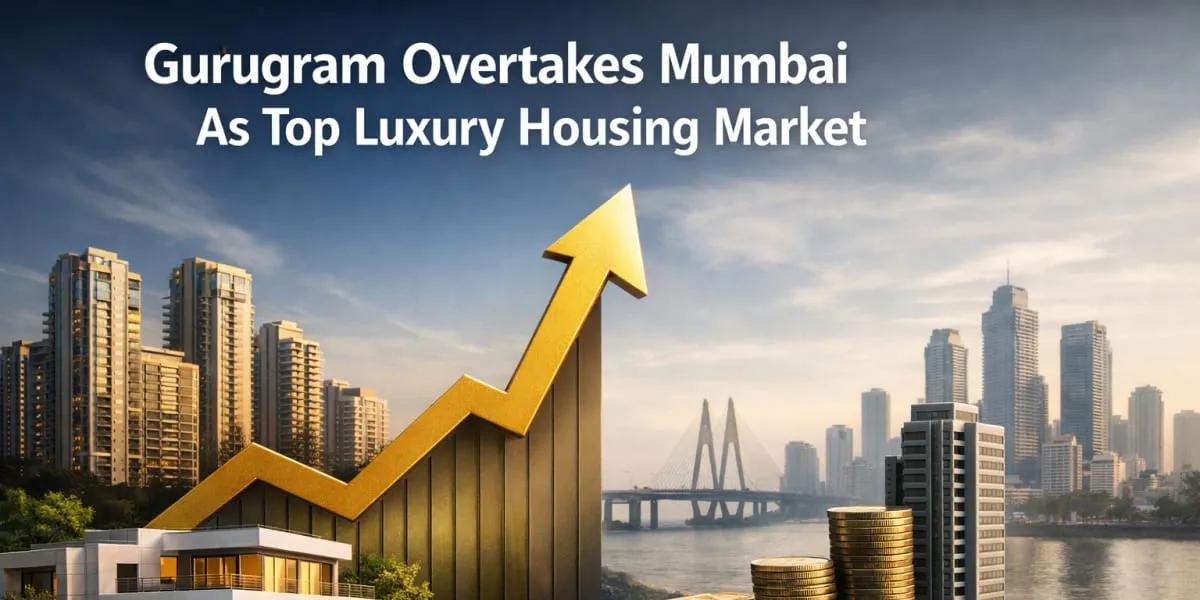
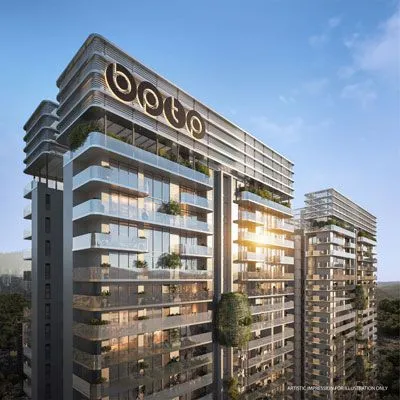
Gurugram has overtaken Mumbai to become India’s largest market for luxury homes, according to a joint report by India Sotheby’s International Realty and CRE Matrix. The city recorded transactions worth Rs 241,200 million (mn) for homes priced at Rs 100 mn and above in 2025, representing an 80 per cent rise over Rs 133,840 mn in 2024. The surge illustrates a marked reallocation of high net worth capital towards Gurugram’s luxury segment.

Mumbai’s high-end market was comparatively stagnant, with transactions of Rs 219,020 mn in 2025 against Rs 204,150 mn in 2024, and unit sales of 967 compared with 924. Industry executives said Mumbai had not stagnated but that Gurugram outperformed due to the emergence of new micro markets and recent infrastructure upgrades. Several high profile project launches helped the shift, including DLF’s Dahlias and Camellias priced in the Rs 700 mn–Rs 1,020 mn range and branded residences by the Trump Organisation and Elie Saab.

The report identified the Dwarka Expressway, Golf Course Road and Golf Course Extension Road as primary drivers of expansion, supported by new supply and enhanced connectivity. The Dwarka Expressway saw a 2,079 per cent jump in transaction value, rising from Rs 3,830 mn in 2024 to Rs 83,470 mn in 2025, while Golf Course Extension Road recorded a 379 per cent increase from Rs 6,930 mn to Rs 33,190 mn. Sales of 1,494 homes in the Rs 100 mn plus segment represented the highest annual total on record for the city.

Demand was concentrated in larger units, with the 4,000–6,000 square foot category accounting for 1,029 of the 1,494 luxury homes and 54 per cent of transaction share. Units larger than 8,000 square feet contributed nearly 22 per cent of total value, and ultra-luxury housing made up 24 per cent of Gurugram’s residential market value with an average ticket size of about Rs 160 mn. Executives attributed the boom to broader capital formation and record IPO proceeds of $19.54 billion (bn) in 2025 creating a new cohort of buyers.

Gurugram has overtaken Mumbai to become India’s largest market for luxury homes, according to a joint report by India Sotheby’s International Realty and CRE Matrix. The city recorded transactions worth Rs 241,200 million (mn) for homes priced at Rs 100 mn and above in 2025, representing an 80 per cent rise over Rs 133,840 mn in 2024. The surge illustrates a marked reallocation of high net worth capital towards Gurugram’s luxury segment. Mumbai’s high-end market was comparatively stagnant, with transactions of Rs 219,020 mn in 2025 against Rs 204,150 mn in 2024, and unit sales of 967 compared with 924. Industry executives said Mumbai had not stagnated but that Gurugram outperformed due to the emergence of new micro markets and recent infrastructure upgrades. Several high profile project launches helped the shift, including DLF’s Dahlias and Camellias priced in the Rs 700 mn–Rs 1,020 mn range and branded residences by the Trump Organisation and Elie Saab. The report identified the Dwarka Expressway, Golf Course Road and Golf Course Extension Road as primary drivers of expansion, supported by new supply and enhanced connectivity. The Dwarka Expressway saw a 2,079 per cent jump in transaction value, rising from Rs 3,830 mn in 2024 to Rs 83,470 mn in 2025, while Golf Course Extension Road recorded a 379 per cent increase from Rs 6,930 mn to Rs 33,190 mn. Sales of 1,494 homes in the Rs 100 mn plus segment represented the highest annual total on record for the city. Demand was concentrated in larger units, with the 4,000–6,000 square foot category accounting for 1,029 of the 1,494 luxury homes and 54 per cent of transaction share. Units larger than 8,000 square feet contributed nearly 22 per cent of total value, and ultra-luxury housing made up 24 per cent of Gurugram’s residential market value with an average ticket size of about Rs 160 mn. Executives attributed the boom to broader capital formation and record IPO proceeds of $19.54 billion (bn) in 2025 creating a new cohort of buyers.

Next Story
Infrastructure Transport

Sector 51-52 Metro skywalk in Noida remains shut despite being ready for over a year

Thousands of commuters travelling between Delhi Metro Rail Corporation’s (DMRC) Sector 52 station and Noida Metro Rail Corporation’s (NMRC) Sector 51 station continue to face daily inconvenience as the 300-metre air-conditioned skywalk connecting the two stations remains closed, despite being completed over a year ago, according to a report.The Noida Metro Rail Corporation built the foot overbridge to enable a seamless interchange between the Delhi Metro and Noida Metro networks. However, pending finishing work and a structural obstruction have delayed its opening.Krishna Karunesh, Chief E..

Next Story
Infrastructure Transport

Maharashtra clears Metro Line 5A, expansion of Mumbai Metro Line 5

The Maharashtra government has approved the expansion of Mumbai Metro Line 5 along with a new integrated corridor, Metro Line 5A, forming a combined 34.2-km metro network across the Thane-Bhiwandi-Kalyan-Ulhasnagar belt. The integrated project has been cleared at an estimated cost of ₹18,130.55 crore, according to a government resolution (GR).Metro Line 5 was originally approved in October 2017 as a 24.9-km fully elevated corridor with 17 stations connecting Thane, Bhiwandi and Kalyan, with an initial project cost of ₹8,416.51 crore. The corridor is being developed in two phases.The first ..

Next Story
Infrastructure Transport

Bengaluru Metro expansion seen driving office demand

Bengaluru’s expanding metro network is expected to emerge as a major catalyst for real estate growth, with the Yellow and Pink Lines likely to boost both office demand and residential prices across key micro-markets, according to a report by Colliers India.The report estimates that over the next two years, Bengaluru could witness an additional 5–7 million sq ft of Grade A office space demand across the Central Business District (CBD), Secondary Business District (SBD) and Electronic City. Improved metro connectivity and reduced commute times are expected to drive higher occupier interest a..

Advertisement

Subscribe to Our Newsletter

Get daily newsletters around different themes from Construction world.

STAY CONNECTED

Advertisement

Advertisement

Advertisement