+
India Must Embrace New Technology as AI Could Save Rs 200 billion
Technology

India Must Embrace New Technology as AI Could Save Rs 200 billion

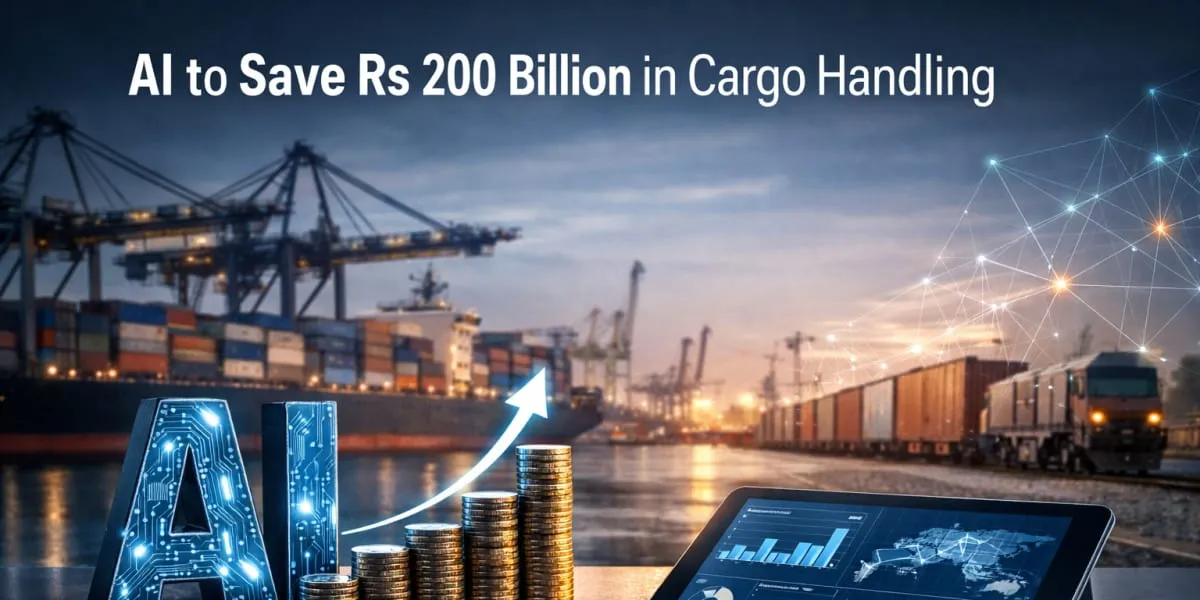
An Economic Advisory Council to the Prime Minister (EAC-PM) member has urged India to embrace new technology and said artificial intelligence could save Rs 200 billion (bn) in cargo handling nationwide. The member outlined that adoption of digital systems and advanced analytics in ports, terminals and freight corridors can reduce inefficiencies and operating costs. The intervention stressed that timely policy support would be necessary to unlock such gains. The assessment quantified potential savings across ports, road and rail segments.

The EAC-PM member identified automation of terminal operations, predictive maintenance of equipment and optimisation of cargo routing as key areas where AI can deliver savings. Digitisation of documentation and improved data sharing across stakeholders were said to reduce dwell times and transaction costs. Investment in interoperable platforms and real time visibility across supply chains was described as essential. Early pilots were cited as instructive for scaling interventions.

To realise benefits, the member recommended stronger public private partnerships, focused capital expenditure and targeted skilling programmes to prepare the workforce for technology adoption. Regulatory clarity, standards for data governance and incentives for pilot projects were proposed to accelerate deployment. The member indicated that collaboration with global technology providers and domestic start ups could fast track solutions. Funding mechanisms were noted as critical to support transition costs.

The assessment suggested that, beyond direct cost savings, wider adoption of AI could enhance competitiveness of Indian logistics, lower end consumer prices and support export growth. The member urged coordinated action by central and state agencies alongside industry to translate proposals into measurable outcomes. Implementation, the member added, would require sustained monitoring and iterative policy adjustments. The member recommended a phased implementation with measurable milestones and periodic reviews.

An Economic Advisory Council to the Prime Minister (EAC-PM) member has urged India to embrace new technology and said artificial intelligence could save Rs 200 billion (bn) in cargo handling nationwide. The member outlined that adoption of digital systems and advanced analytics in ports, terminals and freight corridors can reduce inefficiencies and operating costs. The intervention stressed that timely policy support would be necessary to unlock such gains. The assessment quantified potential savings across ports, road and rail segments. The EAC-PM member identified automation of terminal operations, predictive maintenance of equipment and optimisation of cargo routing as key areas where AI can deliver savings. Digitisation of documentation and improved data sharing across stakeholders were said to reduce dwell times and transaction costs. Investment in interoperable platforms and real time visibility across supply chains was described as essential. Early pilots were cited as instructive for scaling interventions. To realise benefits, the member recommended stronger public private partnerships, focused capital expenditure and targeted skilling programmes to prepare the workforce for technology adoption. Regulatory clarity, standards for data governance and incentives for pilot projects were proposed to accelerate deployment. The member indicated that collaboration with global technology providers and domestic start ups could fast track solutions. Funding mechanisms were noted as critical to support transition costs. The assessment suggested that, beyond direct cost savings, wider adoption of AI could enhance competitiveness of Indian logistics, lower end consumer prices and support export growth. The member urged coordinated action by central and state agencies alongside industry to translate proposals into measurable outcomes. Implementation, the member added, would require sustained monitoring and iterative policy adjustments. The member recommended a phased implementation with measurable milestones and periodic reviews.

Next Story
Infrastructure Urban

Modi Meets Finnish Prime Minister On Margins Of AI Summit

Prime Minister Shri Narendra Modi met with His Excellency Mr Petteri Orpo, Prime Minister of the Republic of Finland (the Finnish Prime Minister), in New Delhi on 18 February 2026 on the margins of the artificial intelligence (AI) Impact Summit. The meeting brought together leaders to discuss bilateral cooperation across technology and sustainability. The two leaders reviewed recent developments in India-European Union relations and bilateral ties. Both leaders welcomed the recent conclusion of the India-European Union Free Trade Agreement (India-EU FTA) at the 16th India-European Union Summit..

Next Story
Infrastructure Urban

Prime Minister to Inaugurate India AI Impact Summit 2026

Prime Minister Narendra Modi will inaugurate the India AI Impact Summit 2026 on 19 February at Bharat Mandapam in New Delhi, having welcomed participating world leaders at the venue on the evening of 18 February and scheduled bilateral meetings on the sidelines. The opening ceremony is scheduled for around 9:40 am and will feature addresses from the President of France, the Secretary-General of the United Nations and senior industry leaders. The programme aims to set the tone for national and international collaboration on artificial intelligence. At around 11 am the Prime Minister will visit ..

Next Story
Infrastructure Urban

India And Germany Reaffirm Telecom And Digital Cooperation

India and Germany reaffirmed cooperation in telecommunications and digital transformation after a bilateral meeting on 18 February 2026 at Sanchar Bhawan in New Delhi between the Union Minister of Communications and Development of the North Eastern Region and the German Federal Minister for Digital Transformation and Government Modernization. The meeting followed the signing of a Joint Declaration of Intent on 10 January 2026 during the India?Germany Summit and was presented as a non?binding framework for structured collaboration. The Indian minister outlined India’s digital transformation, ..

Advertisement

Subscribe to Our Newsletter

Get daily newsletters around different themes from Construction world.

STAY CONNECTED

Advertisement

Advertisement

Advertisement

Open In App