+
Tata Technologies WATTSync Supports Battery Aadhaar Identity
Technology

Tata Technologies WATTSync Supports Battery Aadhaar Identity

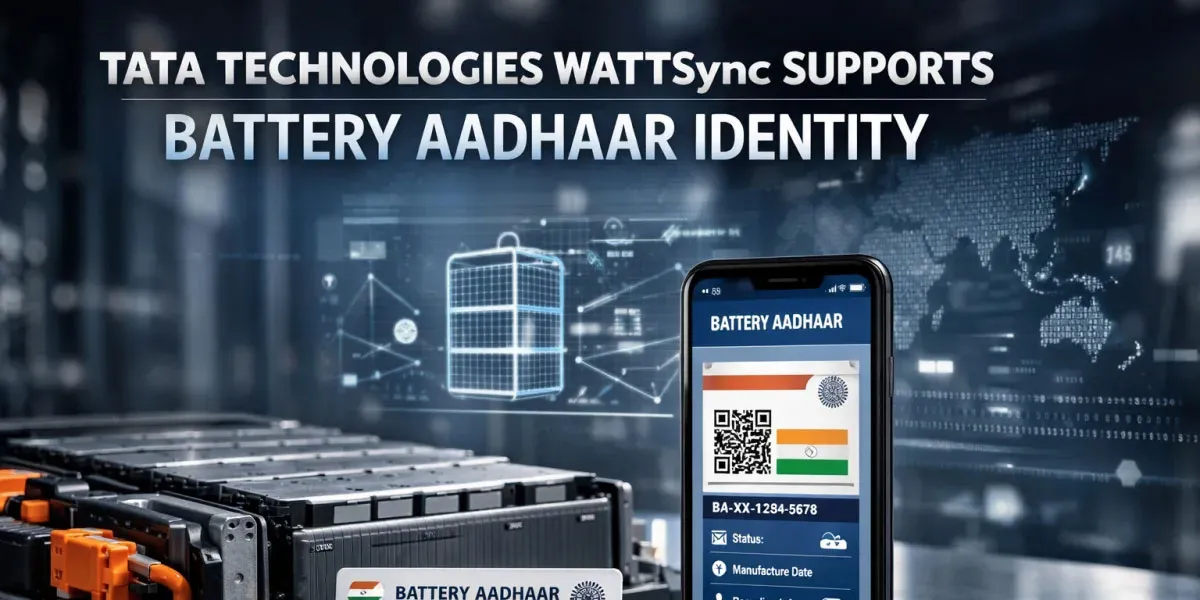
Tata Technologies has announced that its WATTSync platform now supports India's Battery Aadhaar digital identity initiative. The company presented WATTSync as a cloud native solution that enables unique identification and life cycle tracking of battery cells, modules and packs across manufacturing, transport and end use. The platform is designed to collect provenance, test and certification data at manufacture and every subsequent service event to establish an auditable chain of custody for battery assets.

WATTSync is said to link with manufacturing execution systems and enterprise resource planning suites to capture batch information and serial level data. It also supports integration with laboratory information management systems to record test results and safety certifications. The architecture is reported to use secure digital signatures and tamper evident records to maintain data integrity, and to provide interoperable application programming interfaces for third party tools and analytics platforms.

The firm indicated that the move is intended to assist original equipment manufacturers, battery assemblers and vehicle fleet operators in meeting regulatory and consumer expectations for safety and transparency. By enabling traceability from cell to pack and through service life it is expected to reduce counterfeit components, streamline warranty claims and support more efficient end of life recovery and recycling. Data gathered through the platform is presented as useful for predictive maintenance programmes and for informing design improvements.

Company representatives reported that WATTSync aligns with policy frameworks that seek standardised identifiers for batteries and with industry efforts to create secure supply chains. The platform is positioned as enabling compliance reporting and as a tool for manufacturers and regulators to monitor safety incidents and environmental obligations. Deployment is expected to proceed through phased pilots with manufacturing partners and testing agencies, and the company indicated it will continue to expand integrations and certification coverage as the Battery Aadhaar initiative evolves.

Tata Technologies has announced that its WATTSync platform now supports India's Battery Aadhaar digital identity initiative. The company presented WATTSync as a cloud native solution that enables unique identification and life cycle tracking of battery cells, modules and packs across manufacturing, transport and end use. The platform is designed to collect provenance, test and certification data at manufacture and every subsequent service event to establish an auditable chain of custody for battery assets. WATTSync is said to link with manufacturing execution systems and enterprise resource planning suites to capture batch information and serial level data. It also supports integration with laboratory information management systems to record test results and safety certifications. The architecture is reported to use secure digital signatures and tamper evident records to maintain data integrity, and to provide interoperable application programming interfaces for third party tools and analytics platforms. The firm indicated that the move is intended to assist original equipment manufacturers, battery assemblers and vehicle fleet operators in meeting regulatory and consumer expectations for safety and transparency. By enabling traceability from cell to pack and through service life it is expected to reduce counterfeit components, streamline warranty claims and support more efficient end of life recovery and recycling. Data gathered through the platform is presented as useful for predictive maintenance programmes and for informing design improvements. Company representatives reported that WATTSync aligns with policy frameworks that seek standardised identifiers for batteries and with industry efforts to create secure supply chains. The platform is positioned as enabling compliance reporting and as a tool for manufacturers and regulators to monitor safety incidents and environmental obligations. Deployment is expected to proceed through phased pilots with manufacturing partners and testing agencies, and the company indicated it will continue to expand integrations and certification coverage as the Battery Aadhaar initiative evolves.

Next Story
Infrastructure Urban

Implementation Status of Jal Jeevan Mission

Since August 2019 the Government has implemented Jal Jeevan Mission to provide assured potable water through household tap connections in rural India. At the start of the mission only 32.3 million (mn) rural households, representing 16.7 per cent, were reported to have tap water connections. States and union territories have reported that 125.8 mn additional rural households have since been provided with tap connections. As a result, of about 193.6 mn rural households roughly 158.2 mn, or 81.71 per cent, are reported to have tap water supply at home.\n\nThe State, district and village level st..

Next Story
Infrastructure Urban

Jal Jeevan Mission Reaches Eighty One Per Cent Rural Coverage

The Government reported substantial progress under the Jal Jeevan Mission, launched in August 2019 to provide tap water to every rural household. At launch only 32.3 million (mn) rural households had tap connections and states and Union territories reported provision of 125.8 mn additional households by March 2026. Consequently, out of about 193.6 mn rural households around 158.2 mn, or 81.71 per cent, are reported to have tap water at home. The Finance Minister announced extension of the mission until 2028 in the 2025-26 budget speech. The Swachh Bharat Mission Grameen, launched in October 20..

Next Story
Infrastructure Urban

Empowering Local Governance for Sustainable Rural Water Supply

The Ministry of Jal Shakti has aligned the Jal Jeevan Mission (JJM) with the 73rd Amendment to strengthen village level planning and community ownership of water supply. Gram Panchayats, village water and sanitation committees and Pani Samitis are to plan, implement, manage and maintain piped water systems, with gram sabha processes formalising handover and oversight. Implementation support agencies including non government organisations, community based organisations and self help groups have been empanelled to train local committees and promote women participation. Under JJM, the department ..

Advertisement

Subscribe to Our Newsletter

Get daily newsletters around different themes from Construction world.

STAY CONNECTED

Advertisement

Advertisement

Advertisement