AP Government Approves Phase II Land Acquisition for Three Ports
ECONOMY & POLICY

AP Government Approves Phase II Land Acquisition for Three Ports

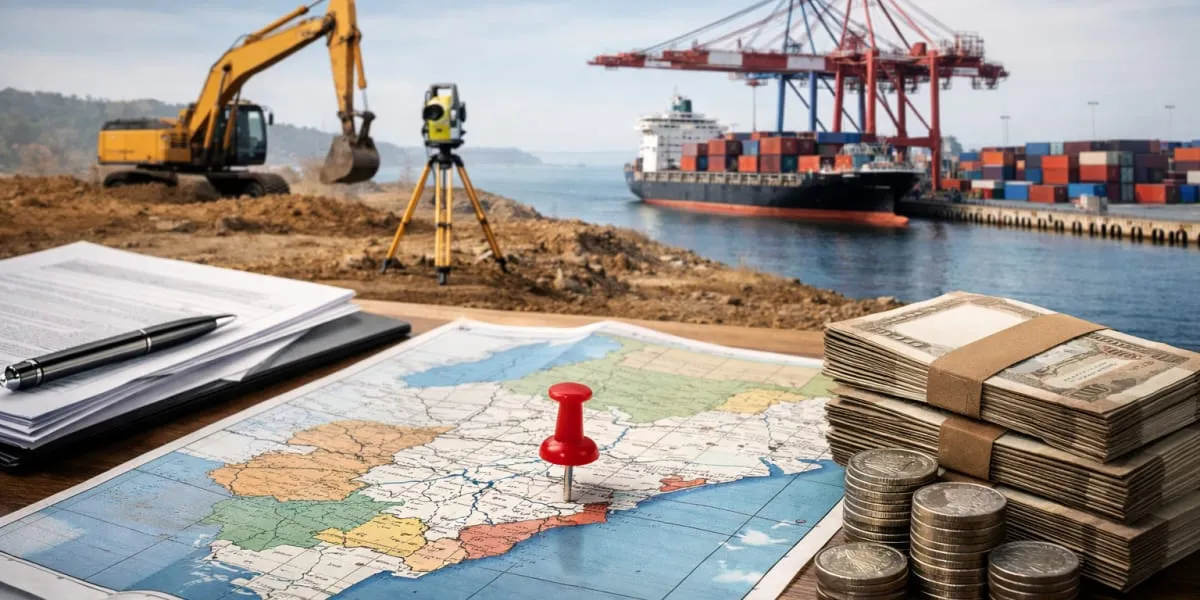
The Andhra Pradesh government has approved Phase II land acquisition of 6,248 acres at a cost of Rs 16,380 mn for the development of three ports in the state, covering Mulapeta, Machilipatnam and Ramayapatnam. The decision was formalised in a government order that accorded administrative sanction for the second phase of acquisitions. MT Krishna Babu, special chief secretary in the Infrastructure and Investment Department, said the expenditure would be met from the internal resources of the Andhra Pradesh Maritime Board (APMB).

Under the Phase II plan, 1,903 acres will be acquired for Mulapeta Port at a cost of Rs 4,400 mn, with provision for resettlement and rehabilitation included in the estimate. Machilipatnam Port is to receive 1,421 acres at a cost of Rs 3,470 mn. Ramayapatnam Port will require 2,924 acres and carry a projected expenditure of Rs 8,510 mn.

The combined allocations for the three projects total Rs 16,380 mn, matching the figure cited in the government order. The allocations and land transfers form a part of the state government’s broader strategy to expand maritime infrastructure and increase cargo handling capacity. Officials indicated the Phase II acquisitions are intended to secure sufficient land for port terminals, associated logistics and auxiliary facilities.

The Andhra Pradesh Maritime Board will manage the funding and oversee implementation, drawing on its internal resources to meet acquisition costs. Authorities are expected to proceed with statutory processes required for land transfer and resettlement planning before construction commences. The announcement is likely to be viewed as a significant step in the state’s efforts to bolster its maritime economy.

The projects are expected to create employment opportunities during construction and operation phases and to strengthen regional trade links, supporting ancillary industries and logistics. The state anticipates improved connectivity will help attract private investment and expand export capacity over time.

The Andhra Pradesh government has approved Phase II land acquisition of 6,248 acres at a cost of Rs 16,380 mn for the development of three ports in the state, covering Mulapeta, Machilipatnam and Ramayapatnam. The decision was formalised in a government order that accorded administrative sanction for the second phase of acquisitions. MT Krishna Babu, special chief secretary in the Infrastructure and Investment Department, said the expenditure would be met from the internal resources of the Andhra Pradesh Maritime Board (APMB). Under the Phase II plan, 1,903 acres will be acquired for Mulapeta Port at a cost of Rs 4,400 mn, with provision for resettlement and rehabilitation included in the estimate. Machilipatnam Port is to receive 1,421 acres at a cost of Rs 3,470 mn. Ramayapatnam Port will require 2,924 acres and carry a projected expenditure of Rs 8,510 mn. The combined allocations for the three projects total Rs 16,380 mn, matching the figure cited in the government order. The allocations and land transfers form a part of the state government’s broader strategy to expand maritime infrastructure and increase cargo handling capacity. Officials indicated the Phase II acquisitions are intended to secure sufficient land for port terminals, associated logistics and auxiliary facilities. The Andhra Pradesh Maritime Board will manage the funding and oversee implementation, drawing on its internal resources to meet acquisition costs. Authorities are expected to proceed with statutory processes required for land transfer and resettlement planning before construction commences. The announcement is likely to be viewed as a significant step in the state’s efforts to bolster its maritime economy. The projects are expected to create employment opportunities during construction and operation phases and to strengthen regional trade links, supporting ancillary industries and logistics. The state anticipates improved connectivity will help attract private investment and expand export capacity over time.

Related Stories

Gold Stories

Next Story
Infrastructure Urban

KONE Opens India's First Digital Experience Centre in Pune

KONE, a global elevator and escalator manufacturer, has inaugurated its first Digital Experience Centre (DEC) in India, located in Pune. The facility aims to showcase how artificial intelligence (AI), connectivity and data-driven technologies can enhance customer experiences and improve building operations.The centre was inaugurated by Jussi Herlin, Executive Vice Chair, KONE Corporation; Philippe Delorme, President and CEO, KONE; and Nandan Nilekani, Co-founder and Chairman of the Board, Infosys.Designed as an interactive customer environment, the facility demonstrates digital solutions cover..

Next Story
Infrastructure Urban

CII GreenCo Launches Circularity Guidelines for Indian Industry

The Confederation of Indian Industry (CII) GreenCo Council has launched the CII GreenCo Circularity Guidelines – Pilot Version at the 17th CII GreenCo Waste & Resource Management Summit 2026 in Chennai. The initiative aims to strengthen resource efficiency, waste reduction and circular economy practices across Indian manufacturing and process industries.The guidelines introduce a structured framework with circularity indices covering raw materials, consumables, packaging and other resource inputs. These indicators will help industries assess existing practices, identify opportunities to ..

Next Story
Infrastructure Energy

Global Electronics Association Launches IPC-1783-CO2E Standard

The Global Electronics Association has introduced IPC-1783-CO2E, a new international standard aimed at improving consistency, transparency and comparability in product carbon footprint reporting across the electronics manufacturing industry.The standard, titled International Standard for Data Collection and Reporting of CO2 Equivalent (CO2e) Emissions for the Electronics Manufacturing Supply Chain, provides industry-specific guidance for collecting, estimating and reporting carbon emissions data.With increasing regulatory requirements and customer expectations, electronics manufacturers face c..

Advertisement

Subscribe to Our Newsletter

Get daily newsletters around different themes from Construction world.

STAY CONNECTED

Advertisement

SPECIAL OFFER
QR Code