Bajaj Auto to Raise Monthly Electric 2W Capacity to 80,000 by March
ECONOMY & POLICY

Bajaj Auto to Raise Monthly Electric 2W Capacity to 80,000 by March

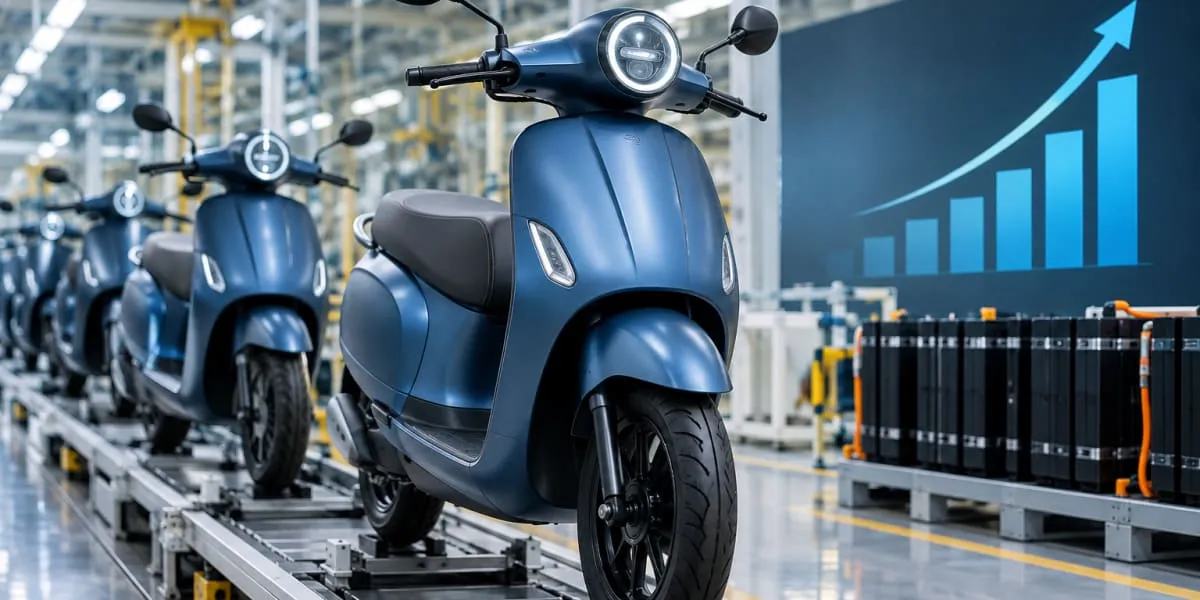
Bajaj Auto plans to raise monthly production capacity for electric two-wheelers to around 80,000 units by the end of March, as demand for its Chetak electric scooter continues to exceed available output. The company currently has capacity for around 60,000 electric two-wheelers a month.

Joint Managing Director Rakesh Sharma said production had returned to the existing full capacity after a supply chain disruption affected output. The issue had reduced recent production to around 40,000 units, resulting in a shortfall of 20,000 vehicles despite strong demand.

The company expects to remove production bottlenecks during the January-March quarter and bring monthly capacity closer to current requirements. Chetak volumes more than doubled during the July-September quarter, while revenue from the segment crossed Rs. 20 bn.

Sharma said electric vehicles (EVs) had become margin accretive for Bajaj Auto rather than reducing margins. Chetak had moved from losses to double-digit profitability, while the company’s three-wheeler business continued to report double-digit profitability and had improved its performance.

Bajaj Auto is also evaluating several locations for a new manufacturing facility that would support EV and internal combustion engine (ICE) production. The company is discussing potential sites with a few state governments as it considers its sixth plant, with capacity also being assessed for premium products and high-end motorcycles.

The automaker has previously indicated that it aims to increase annual manufacturing capacity by more than 25 per cent in the medium term. Capacity is expected to rise from around 7 mn units to more than 9 mn units to meet demand for EVs, premium motorcycles and exports.

Bajaj Auto plans to raise monthly production capacity for electric two-wheelers to around 80,000 units by the end of March, as demand for its Chetak electric scooter continues to exceed available output. The company currently has capacity for around 60,000 electric two-wheelers a month. Joint Managing Director Rakesh Sharma said production had returned to the existing full capacity after a supply chain disruption affected output. The issue had reduced recent production to around 40,000 units, resulting in a shortfall of 20,000 vehicles despite strong demand. The company expects to remove production bottlenecks during the January-March quarter and bring monthly capacity closer to current requirements. Chetak volumes more than doubled during the July-September quarter, while revenue from the segment crossed Rs. 20 bn. Sharma said electric vehicles (EVs) had become margin accretive for Bajaj Auto rather than reducing margins. Chetak had moved from losses to double-digit profitability, while the company’s three-wheeler business continued to report double-digit profitability and had improved its performance. Bajaj Auto is also evaluating several locations for a new manufacturing facility that would support EV and internal combustion engine (ICE) production. The company is discussing potential sites with a few state governments as it considers its sixth plant, with capacity also being assessed for premium products and high-end motorcycles. The automaker has previously indicated that it aims to increase annual manufacturing capacity by more than 25 per cent in the medium term. Capacity is expected to rise from around 7 mn units to more than 9 mn units to meet demand for EVs, premium motorcycles and exports.

Related Stories

Gold Stories

Next Story
Building Material

PureSil Paints Develops Mineral Coatings from Industrial Waste

PureSil Paints, a brand of Relic Coatings LLP, has developed an indigenous mineral-based coating technology aimed at reducing dependence on petrochemical-derived raw materials in the paints and coatings industry. Its proprietary Silicification Technology uses agricultural and industrial by-products to manufacture architectural coatings as an alternative to conventional acrylic paints.Developed in-house by Dr Nikhil Dhote, Founder and Chief Technologist, Relic Coatings LLP, the technology uses silicate binders derived from upcycled rice husk ash and industrial coal fly ash. The formulation is d..
Next Story
Infrastructure Energy

Vedanta Eyes AI to Accelerate Mineral Exploration

Vedanta Group is exploring the use of artificial intelligence (AI) to significantly improve efficiency in mineral exploration, geological analysis and resource modelling. The company aims to reduce exploration processes that traditionally take three to four months to just six to seven days through AI-driven technologies.The proposed approach involves AI-led geological analysis and mineral block modelling to accelerate mineral resource assessment and support faster, more cost-efficient development of domestic mineral reserves. The initiative aligns with India's growing focus on critical mineral..

Next Story
Technology

NXP Launches Unified Robotics Platform for Physical AI

NXP Semiconductors has launched a unified robotics platform designed to accelerate the development and deployment of trusted physical artificial intelligence (AI) systems. Built on the company's neural axis architecture, the platform integrates AI processing, connectivity, motor control, security and energy management within a common hardware and software ecosystem.The platform combines an open-source, modular software development kit (SDK) with pre-validated reference designs, enabling developers to build robotic systems more efficiently. It supports development ranging from individual subsys..

Advertisement

Subscribe to Our Newsletter

Get daily newsletters around different themes from Construction world.

STAY CONNECTED

Advertisement

SPECIAL OFFER
QR Code