Cabinet Approves Varanasi Elevated Corridors to Cut Travel Time
ECONOMY & POLICY

Cabinet Approves Varanasi Elevated Corridors to Cut Travel Time

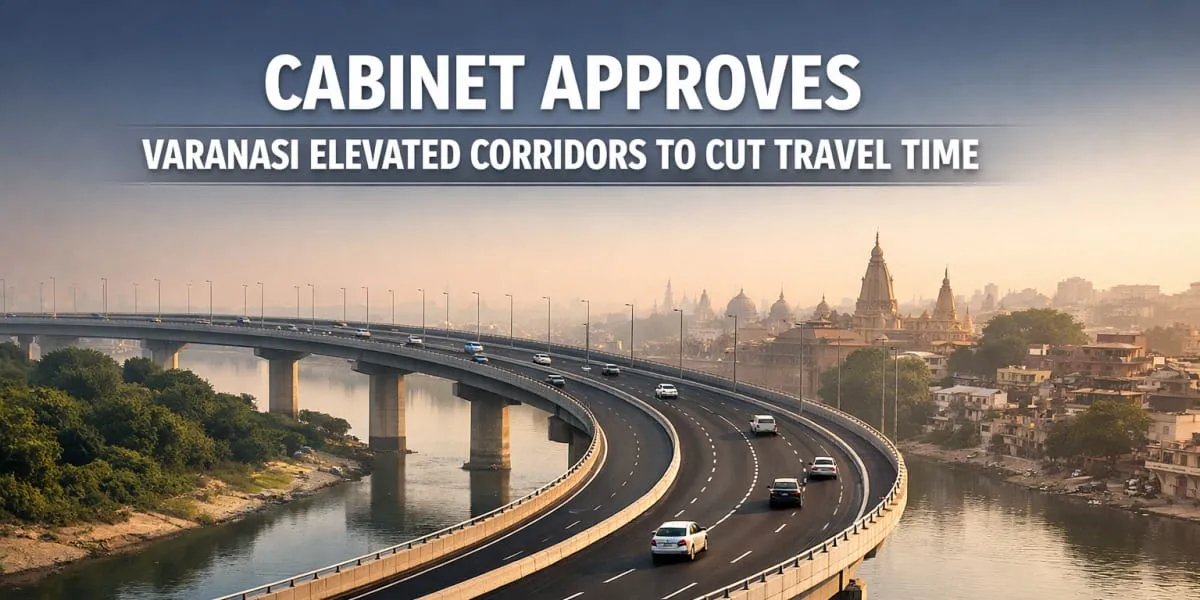
The Central Government's Cabinet approved two major road projects in Varanasi worth Rs 254.46 billion (bn), under which two elevated corridors totalling 89.26 kilometre will be constructed as part of a city de-congestion plan. The programme is intended to reduce traffic congestion and shorten journey times, improving links to religious, educational and industrial areas.

The first corridor comprises a 43.218 kilometre six/four-lane elevated road along the Varuna River to be developed on the Hybrid Annuity Model (HAM) at an estimated cost of Rs 109.98 billion (bn). It will provide direct connectivity between NH-31 and Kashi Railway Station and is expected to cut a journey that currently takes about 40 minutes to roughly 20 minutes. The scheme will also improve access to the Chandauli Social Economic Zone and six major logistics hubs, which should stimulate regional economic activity.

The second project is a 46.039 kilometre six-lane greenfield elevated corridor linking NH-19 to the Varanasi Ring Road at an estimated Rs 144.48 billion (bn). Authorities anticipate that the corridor will relieve pressure on the existing urban road network and make traffic movement smoother, reducing average travel time from 60 minutes to around 20 minutes. Improved access to Kashi Vishwanath Dham, significant ghats, academic institutions and cultural sites is a key objective.

Overall, the projects are expected to alter the traffic system in Varanasi, strengthening connections between inner and outer areas and benefitting devotees, tourists, students and traders. Observers suggested that the measures could reinforce Varanasi's position as a religious, cultural and economic centre in Purvanchal.

The Ganga Elevated Corridor described by officials will run parallel to the Ganga as a six-lane structure of approximately 46 kilometre, connecting NH-19 to the Ring Road. Designs are said to protect the river's natural form and the ghats, and will include a cable-stayed bridge, viewpoints and three pedestrian suspension bridges for improved river crossings and visitor experience.

The Central Government's Cabinet approved two major road projects in Varanasi worth Rs 254.46 billion (bn), under which two elevated corridors totalling 89.26 kilometre will be constructed as part of a city de-congestion plan. The programme is intended to reduce traffic congestion and shorten journey times, improving links to religious, educational and industrial areas. The first corridor comprises a 43.218 kilometre six/four-lane elevated road along the Varuna River to be developed on the Hybrid Annuity Model (HAM) at an estimated cost of Rs 109.98 billion (bn). It will provide direct connectivity between NH-31 and Kashi Railway Station and is expected to cut a journey that currently takes about 40 minutes to roughly 20 minutes. The scheme will also improve access to the Chandauli Social Economic Zone and six major logistics hubs, which should stimulate regional economic activity. The second project is a 46.039 kilometre six-lane greenfield elevated corridor linking NH-19 to the Varanasi Ring Road at an estimated Rs 144.48 billion (bn). Authorities anticipate that the corridor will relieve pressure on the existing urban road network and make traffic movement smoother, reducing average travel time from 60 minutes to around 20 minutes. Improved access to Kashi Vishwanath Dham, significant ghats, academic institutions and cultural sites is a key objective. Overall, the projects are expected to alter the traffic system in Varanasi, strengthening connections between inner and outer areas and benefitting devotees, tourists, students and traders. Observers suggested that the measures could reinforce Varanasi's position as a religious, cultural and economic centre in Purvanchal. The Ganga Elevated Corridor described by officials will run parallel to the Ganga as a six-lane structure of approximately 46 kilometre, connecting NH-19 to the Ring Road. Designs are said to protect the river's natural form and the ghats, and will include a cable-stayed bridge, viewpoints and three pedestrian suspension bridges for improved river crossings and visitor experience.

Related Stories

Gold Stories

Next Story
Infrastructure Urban

KONE Opens India's First Digital Experience Centre in Pune

KONE, a global elevator and escalator manufacturer, has inaugurated its first Digital Experience Centre (DEC) in India, located in Pune. The facility aims to showcase how artificial intelligence (AI), connectivity and data-driven technologies can enhance customer experiences and improve building operations.The centre was inaugurated by Jussi Herlin, Executive Vice Chair, KONE Corporation; Philippe Delorme, President and CEO, KONE; and Nandan Nilekani, Co-founder and Chairman of the Board, Infosys.Designed as an interactive customer environment, the facility demonstrates digital solutions cover..

Next Story
Infrastructure Urban

CII GreenCo Launches Circularity Guidelines for Indian Industry

The Confederation of Indian Industry (CII) GreenCo Council has launched the CII GreenCo Circularity Guidelines – Pilot Version at the 17th CII GreenCo Waste & Resource Management Summit 2026 in Chennai. The initiative aims to strengthen resource efficiency, waste reduction and circular economy practices across Indian manufacturing and process industries.The guidelines introduce a structured framework with circularity indices covering raw materials, consumables, packaging and other resource inputs. These indicators will help industries assess existing practices, identify opportunities to ..

Next Story
Infrastructure Energy

Global Electronics Association Launches IPC-1783-CO2E Standard

The Global Electronics Association has introduced IPC-1783-CO2E, a new international standard aimed at improving consistency, transparency and comparability in product carbon footprint reporting across the electronics manufacturing industry.The standard, titled International Standard for Data Collection and Reporting of CO2 Equivalent (CO2e) Emissions for the Electronics Manufacturing Supply Chain, provides industry-specific guidance for collecting, estimating and reporting carbon emissions data.With increasing regulatory requirements and customer expectations, electronics manufacturers face c..

Advertisement

Subscribe to Our Newsletter

Get daily newsletters around different themes from Construction world.

STAY CONNECTED

Advertisement

SPECIAL OFFER
QR Code