CBIC Introduces Deferred Customs Duty For Eligible Manufacturer Importers
ECONOMY & POLICY

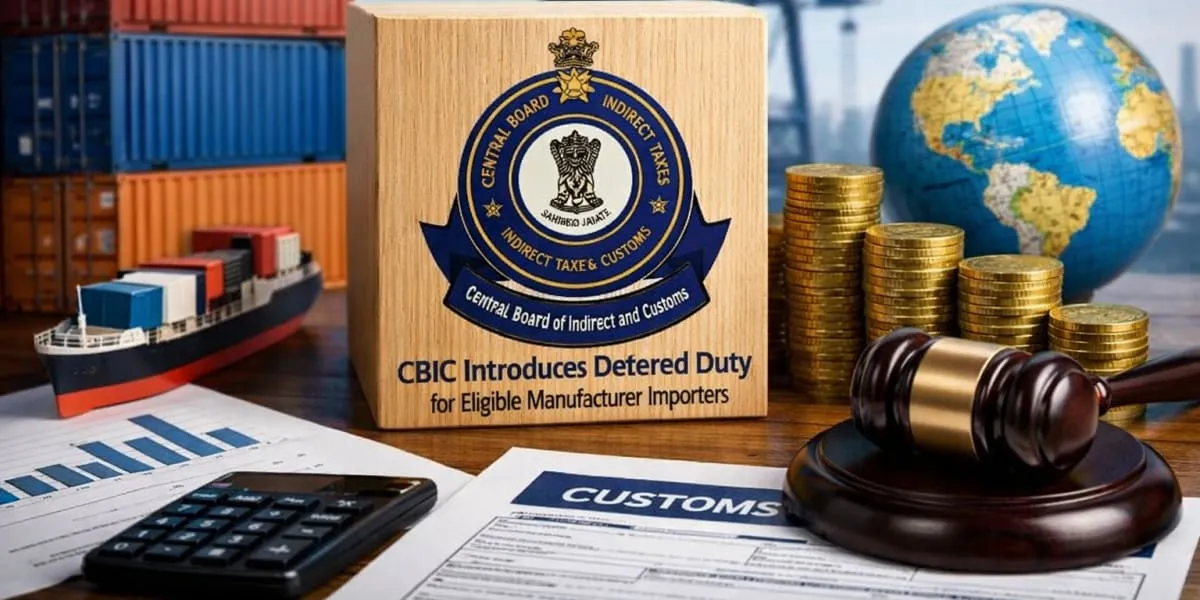
CBIC Introduces Deferred Customs Duty For Eligible Manufacturer Importers

The Central Board of Indirect Taxes and Customs (CBIC) has introduced a deferred Customs duty payment facility for a new category of importers designated as Eligible Manufacturer Importers (EMIs) following the Union Budget 2026–27 announcement. CBIC issued detailed eligibility conditions, the application process and operational guidelines through Circular No. 08/2026-Customs dated 28 February 2026. The scheme is presented as a trust-based facilitation measure to support compliant manufacturers, improve cash flow and promote higher levels of compliance.

Under the initiative EMIs will be able to clear imported goods without paying Customs duty at the time of clearance and the applicable duty may be paid on a monthly basis as prescribed under the Deferred Payment of Import Duty Rules, 2016. The deferred arrangement is intended to help manufacturers better manage working capital and business continuity. The facility is expected to reduce liquidity pressure and streamline import operations for eligible entities.

The deferred payment facility will be available from first April 2026 and will remain in force until 31 March 2028, subject to fulfilment of prescribed criteria relating to Customs and Goods and Services Tax compliance, turnover, financial standing and past track record. Existing Authorised Economic Operator (AEO) T1 entities, including micro, small and medium enterprises, that meet the eligibility conditions may participate. Approved EMIs are expected to progress to AEO T2 or AEO T3 status during the validity period to access enhanced facilitation and priority treatment.

Applications under the EMI scheme can be submitted online from first March 2026 on the Authorised Economic Operator portal at www.aeoindia.gov.in under the tab Eligible Manufacturer Importer and applicants are required to follow the procedures laid down in the circular. The reform is expected to improve ease of doing business, bolster domestic manufacturing and encourage wider participation in the AEO programme. The measure reflects CBIC's continued commitment to creating a predictable and facilitative Customs environment to support India’s manufacturing-led and export-oriented growth.

The Central Board of Indirect Taxes and Customs (CBIC) has introduced a deferred Customs duty payment facility for a new category of importers designated as Eligible Manufacturer Importers (EMIs) following the Union Budget 2026–27 announcement. CBIC issued detailed eligibility conditions, the application process and operational guidelines through Circular No. 08/2026-Customs dated 28 February 2026. The scheme is presented as a trust-based facilitation measure to support compliant manufacturers, improve cash flow and promote higher levels of compliance. Under the initiative EMIs will be able to clear imported goods without paying Customs duty at the time of clearance and the applicable duty may be paid on a monthly basis as prescribed under the Deferred Payment of Import Duty Rules, 2016. The deferred arrangement is intended to help manufacturers better manage working capital and business continuity. The facility is expected to reduce liquidity pressure and streamline import operations for eligible entities. The deferred payment facility will be available from first April 2026 and will remain in force until 31 March 2028, subject to fulfilment of prescribed criteria relating to Customs and Goods and Services Tax compliance, turnover, financial standing and past track record. Existing Authorised Economic Operator (AEO) T1 entities, including micro, small and medium enterprises, that meet the eligibility conditions may participate. Approved EMIs are expected to progress to AEO T2 or AEO T3 status during the validity period to access enhanced facilitation and priority treatment. Applications under the EMI scheme can be submitted online from first March 2026 on the Authorised Economic Operator portal at www.aeoindia.gov.in under the tab Eligible Manufacturer Importer and applicants are required to follow the procedures laid down in the circular. The reform is expected to improve ease of doing business, bolster domestic manufacturing and encourage wider participation in the AEO programme. The measure reflects CBIC's continued commitment to creating a predictable and facilitative Customs environment to support India’s manufacturing-led and export-oriented growth.

Next Story
Real Estate

Housing Sales Dip 7 per cent QoQ Across Top Cities

India’s housing market saw a 7 per cent quarter-on-quarter decline in sales across the top seven cities in Q1 2026, with approximately 1,01,675 units sold compared to 1,08,970 units in Q4 2025, according to ANAROCK Group. However, on a yearly basis, sales rose 9 per cent, indicating continued underlying demand.The total sales value stood at around Rs 1.51 trillion, reflecting a 5 per cent quarterly drop but a 6 per cent annual increase. Mumbai Metropolitan Region and Bengaluru together accounted for nearly 48 per cent of total sales, while Chennai recorded the highest quarterly decline at 18..

Next Story
Real Estate

Birla Estates Enters Mumbai Redevelopment

Birla Estates has announced its entry into Mumbai’s redevelopment segment with a luxury residential project in Khar West, developed in partnership with Parinee Real Estate Builders. The project will redevelop Anmol Co-operative Housing Society and Bhartiya Bhavan Co-operative Housing Society, marking the company’s first redevelopment initiative in the Mumbai Metropolitan Region.Spread across 1.3 acres, the development will offer a saleable area of 2.9 lakh sq ft with an estimated revenue potential of Rs 17 billion. Positioned in one of Mumbai’s prime residential micro-markets, the projec..

Next Story
Infrastructure Urban

Hitachi, MUFG Expand EV Financing Model

Hitachi and MUFG Bank have expanded their NextGen business co-creation model to accelerate decarbonised mobility by financing electric vehicles and charging infrastructure. The renewed collaboration aims to address key barriers to electrification, including limited access to capital and the need for integrated energy solutions.Building on earlier partnerships, the expanded model extends beyond battery-focused solutions to include electric mobility assets, charging systems and energy management infrastructure across global markets. The initiative will leverage structured financing through speci..

Advertisement

Subscribe to Our Newsletter

Get daily newsletters around different themes from Construction world.

STAY CONNECTED

Advertisement

Advertisement

Advertisement