+
CSIR-NIScPR Workshop on Strengthening India's Semiconductor Ecosystem
ECONOMY & POLICY

CSIR-NIScPR Workshop on Strengthening India's Semiconductor Ecosystem

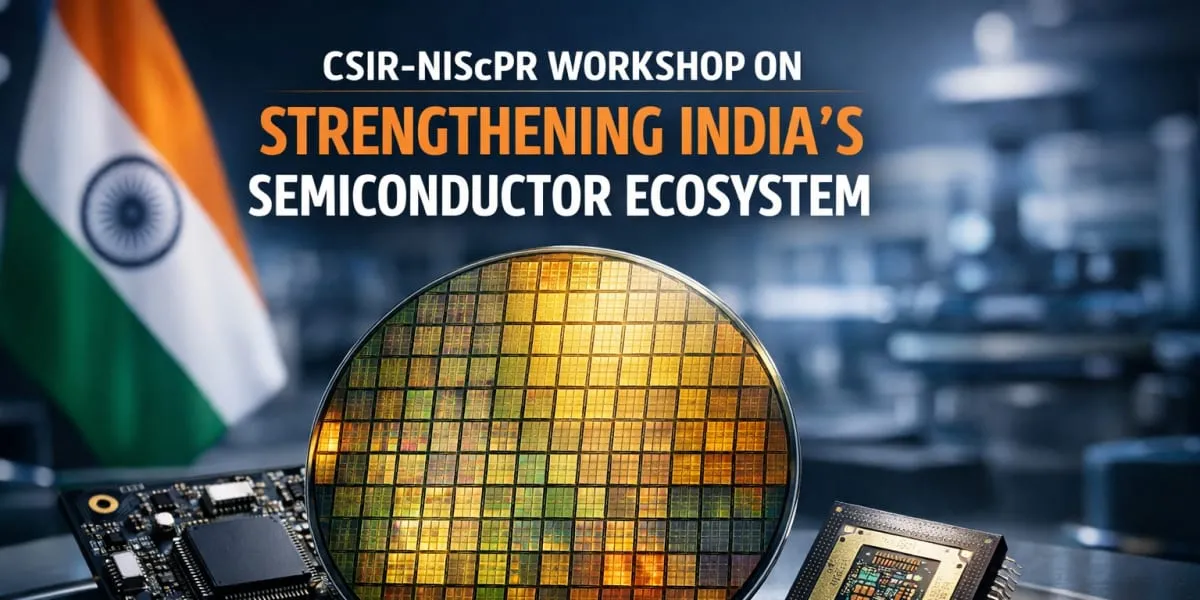
CSIR-NIScPR organised a day-long workshop on strengthening India's semiconductor ecosystem at Vivekananda Hall, Pusa Campus, New Delhi on 27 February 2026. The event brought together experts from research and development institutions, government, academia and industry to review findings of a comparative study on global semiconductor policies and India's landscape. Representatives from central agencies, universities, laboratories and private firms participated and proceedings were streamed live to widen stakeholder engagement. The convening aimed to identify challenges, explore collaboration opportunities and inform policy recommendations.

Speakers noted that India exhibits strong global design leadership while remaining heavily import dependent, with 95 per cent of key components sourced externally. CSIR-NIScPR highlighted evidence-based policy reforms and an innovation push under ISM 2.0 as central to strategic self-reliance by 2030. Panelists recommended mission-mode programmes, expansion of indigenous technology initiatives and support for deep-tech startups to bridge the valley of death between prototypes and manufacturing. There was emphasis on scaling prototyping facilities and R&D hubs to advance technology readiness levels.

Technical sessions addressed research and innovation, design and manufacturing ecosystems, skills development, and policy and governance frameworks. Participants urged pilot fabs, niche defence semiconductors, indigenous materials and equipment development, and design-led research with focus on photonics and artificial intelligence applications. The skills session called for CMOS-focused academic programmes, structured skilling initiatives and industry collaboration to build a specialised workforce. Policy discussions compared global models and recommended unified governance structures, a national research centre and measures to improve supply chain resilience.

Concluding discussions stressed coordinated action across R&D, design, manufacturing, skills and policy to strengthen India's position in the global value chain. Experts identified opportunities in indigenous analog, sensor and application-specific products and emerging areas such as chip-to-chip-less architectures and quantum-integrated semiconductor systems. CSIR-NIScPR reaffirmed its commitment to provide evidence-based policy inputs and to facilitate multi-stakeholder dialogue for implementation of recommendations. The workshop outcomes were presented as a roadmap to guide focused execution, innovation and scaling over the coming years.

CSIR-NIScPR organised a day-long workshop on strengthening India's semiconductor ecosystem at Vivekananda Hall, Pusa Campus, New Delhi on 27 February 2026. The event brought together experts from research and development institutions, government, academia and industry to review findings of a comparative study on global semiconductor policies and India's landscape. Representatives from central agencies, universities, laboratories and private firms participated and proceedings were streamed live to widen stakeholder engagement. The convening aimed to identify challenges, explore collaboration opportunities and inform policy recommendations. Speakers noted that India exhibits strong global design leadership while remaining heavily import dependent, with 95 per cent of key components sourced externally. CSIR-NIScPR highlighted evidence-based policy reforms and an innovation push under ISM 2.0 as central to strategic self-reliance by 2030. Panelists recommended mission-mode programmes, expansion of indigenous technology initiatives and support for deep-tech startups to bridge the valley of death between prototypes and manufacturing. There was emphasis on scaling prototyping facilities and R&D hubs to advance technology readiness levels. Technical sessions addressed research and innovation, design and manufacturing ecosystems, skills development, and policy and governance frameworks. Participants urged pilot fabs, niche defence semiconductors, indigenous materials and equipment development, and design-led research with focus on photonics and artificial intelligence applications. The skills session called for CMOS-focused academic programmes, structured skilling initiatives and industry collaboration to build a specialised workforce. Policy discussions compared global models and recommended unified governance structures, a national research centre and measures to improve supply chain resilience. Concluding discussions stressed coordinated action across R&D, design, manufacturing, skills and policy to strengthen India's position in the global value chain. Experts identified opportunities in indigenous analog, sensor and application-specific products and emerging areas such as chip-to-chip-less architectures and quantum-integrated semiconductor systems. CSIR-NIScPR reaffirmed its commitment to provide evidence-based policy inputs and to facilitate multi-stakeholder dialogue for implementation of recommendations. The workshop outcomes were presented as a roadmap to guide focused execution, innovation and scaling over the coming years.

Next Story
Infrastructure Energy

Jyoti Structures Commissions 400 kV Line In Karnataka

Jyoti Structures (JSL) has completed and commissioned the 400 kV Gadag–II transmission line project for ReNew Power in Karnataka. The project includes 100 circuit kilometres of twin HTLS transmission lines connecting Gadag Power Station and Koppal Power Station. The transmission line passes through Gadag and Koppal districts, where the project team addressed challenging terrain, right-of-way constraints and difficult soil conditions, including stretches of black cotton soil. The project forms part of the Interstate Transmission System developed to evacuate renewable energy from the Koppal ..

Next Story
Resources

Mindspace EcoRun 2.0 Draws 4,000 Runners

Over 4,000 participants took part in the Mindspace EcoRun 2.0 at Mindspace Airoli East, Navi Mumbai, combining fitness with sustainability awareness. Organised by Mindspace REIT in association with Mirchi, the second edition attracted runners, families, corporate teams and amateur athletes from across the city. The event featured 5 km, 10 km and 21 km race categories. The half marathon and 10 km races were open to participants aged 18 and above, while the 5 km run included runners aged eight years and above. Actress Daisy Shah flagged off the 10 km run, while actors Medha Shankr and Avinash T..

Next Story
Technology

Powerplay Expands Software Linked Credit To Hyderabad

Construction management platform Powerplay has expanded its software-enabled, procurement-linked credit solution to Hyderabad, integrating financing into the daily workflows of builders and contractors as construction activity in the city accelerates. The expansion comes amid strong growth in Telangana’s construction sector, which recorded nearly 12 per cent growth in 2025 and contributed around Rs 800 billion to the regional economy, according to industry estimates. Powerplay currently supports more than 2,000 construction projects in and around Hyderabad through its platform. These proje..

Advertisement

Subscribe to Our Newsletter

Get daily newsletters around different themes from Construction world.

STAY CONNECTED

Advertisement

Advertisement

Advertisement

Open In App