




+
Delhi-NCR To Expand Air Quality Monitoring Network
ECONOMY & POLICY

Delhi-NCR To Expand Air Quality Monitoring Network

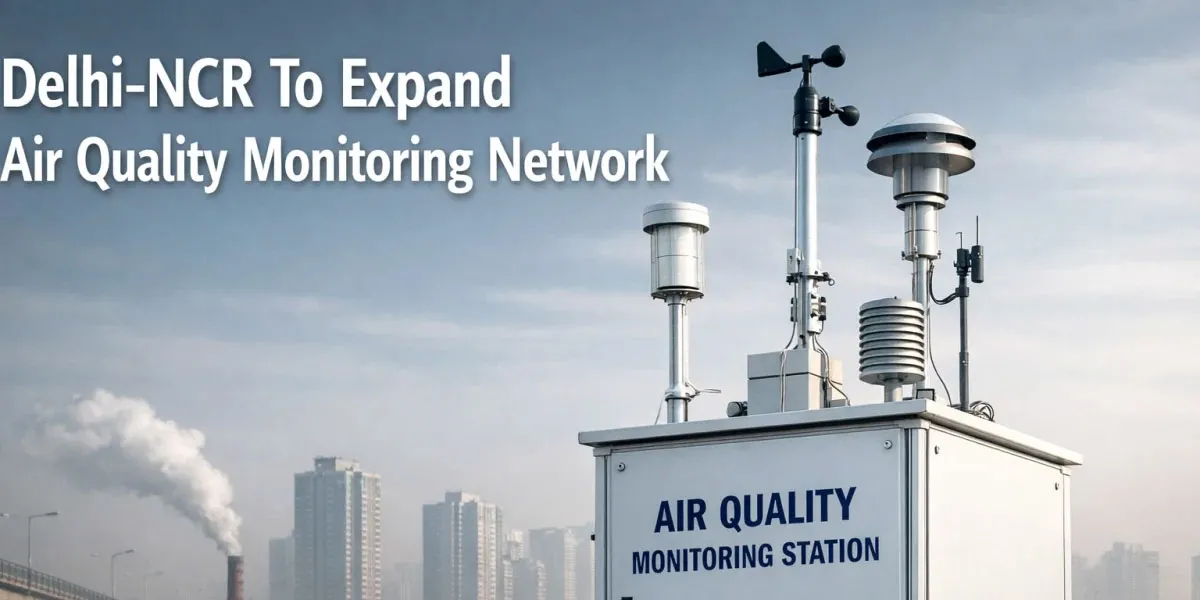
The Delhi-NCR air quality monitoring framework is being strengthened by augmenting the Continuous Ambient Air Quality Monitoring Stations (CAAQMS) network to improve spatial coverage and data reliability. The initiative will enhance real-time surveillance and support policy for pollution abatement. The Commission for Air Quality Management in NCR and Adjoining Areas has reviewed the planned addition of 27 new CAAQMS above the existing 84 stations.

Six of the new stations have been installed in Delhi, while seven in Haryana, four in Rajasthan and 10 in Uttar Pradesh are being installed. The existing network includes 40 stations in Delhi, 22 in Haryana-NCR, four in Rajasthan-NCR and 18 in Uttar Pradesh-NCR. Staged installation will maintain continuity and allow validation of data streams.

Deliberations set scientific criteria to ensure monitoring density reflects population distribution and land use, including residential, traffic, industrial and background areas. Urban contiguity and rapid peri-urban expansion were considered, with a shift towards grid-based spatial coverage to provide even representation. Background and border stations were identified as necessary to understand pollutant transport and baseline conditions affecting Delhi-NCR.

Norms have been framed for Delhi and contiguous cities such as Ghaziabad, Noida, Greater Noida, Faridabad and Sonepat, targeting approximately one station per 25 sq. km grid, defined as a five km by five km area, while other district headquarters will have one station per 50 sq. km. Coverage in peri-urban and suburban areas is critical for assessing inflow and outflow of pollution and the impact of urban sprawl on regional air quality. The grid approach is intended to balance population based needs with land use and deployment considerations.

On this basis, 46 additional stations, including 14 in Delhi, 16 in Haryana, one in Rajasthan and 15 in Uttar Pradesh, shall be installed to strengthen the monitoring infrastructure and ensure uniform coverage across Delhi-NCR. The total number of CAAQMS would rise to 157, comprising 60 in Delhi, 45 in Haryana, nine in Rajasthan and 43 in Uttar Pradesh. The Commission concluded that a dense and robust monitoring network is vital for identifying pollution sources, tracking trends and enabling timely policy action to mitigate air pollution in the region.

The Delhi-NCR air quality monitoring framework is being strengthened by augmenting the Continuous Ambient Air Quality Monitoring Stations (CAAQMS) network to improve spatial coverage and data reliability. The initiative will enhance real-time surveillance and support policy for pollution abatement. The Commission for Air Quality Management in NCR and Adjoining Areas has reviewed the planned addition of 27 new CAAQMS above the existing 84 stations. Six of the new stations have been installed in Delhi, while seven in Haryana, four in Rajasthan and 10 in Uttar Pradesh are being installed. The existing network includes 40 stations in Delhi, 22 in Haryana-NCR, four in Rajasthan-NCR and 18 in Uttar Pradesh-NCR. Staged installation will maintain continuity and allow validation of data streams. Deliberations set scientific criteria to ensure monitoring density reflects population distribution and land use, including residential, traffic, industrial and background areas. Urban contiguity and rapid peri-urban expansion were considered, with a shift towards grid-based spatial coverage to provide even representation. Background and border stations were identified as necessary to understand pollutant transport and baseline conditions affecting Delhi-NCR. Norms have been framed for Delhi and contiguous cities such as Ghaziabad, Noida, Greater Noida, Faridabad and Sonepat, targeting approximately one station per 25 sq. km grid, defined as a five km by five km area, while other district headquarters will have one station per 50 sq. km. Coverage in peri-urban and suburban areas is critical for assessing inflow and outflow of pollution and the impact of urban sprawl on regional air quality. The grid approach is intended to balance population based needs with land use and deployment considerations. On this basis, 46 additional stations, including 14 in Delhi, 16 in Haryana, one in Rajasthan and 15 in Uttar Pradesh, shall be installed to strengthen the monitoring infrastructure and ensure uniform coverage across Delhi-NCR. The total number of CAAQMS would rise to 157, comprising 60 in Delhi, 45 in Haryana, nine in Rajasthan and 43 in Uttar Pradesh. The Commission concluded that a dense and robust monitoring network is vital for identifying pollution sources, tracking trends and enabling timely policy action to mitigate air pollution in the region.

Next Story
Real Estate

Casagrand Launches Keystone In Tiruppur

Casagrand has launched Casagrand Keystone, a gated residential development at Rakkiyapalayam, off Avinashi Road, in Tiruppur. Spread across 2.2 acres, the B+G+5 structure comprises 142 units of 2 and 3 BHK homes, supported by 48 indoor and outdoor amenities. The project is introduced at a starting price of Rs 5,199 per sq. ft. The development allocates 1.3 acres to open space, including a central park of about 24,500 sq. ft. A 6,800 sq. ft. clubhouse includes a multipurpose hall, mini theatre and indoor recreation facilities. Other amenities include a 5,100 sq. ft. swimming pool, poolside par..

Next Story
Real Estate

Premium homes account for half of India’s housing sales in 2025

Knight Frank India, in its latest report on India’s office and residential property market, has highlighted a significant shift in housing demand, with homes priced above Rs 10 million accounting for 50 per cent of total residential sales across the top eight cities in 2025. The findings underscore the growing dominance of premium housing in the country’s real estate landscape.Out of 348,247 residential units sold during the year, approximately 175,091 units were in the Rs 10 million-plus category, marking a 14 per cent year-on-year increase. The data reflects changing buyer preferences, w..

Next Story
Infrastructure Energy

Xbattery launches XB-5K energy storage system for homes, offices

Xbattery, a Hyderabad-based deep-tech company specialising in next-generation energy storage and battery management technologies, has introduced its flagship XB-5K, a scalable 5kWh energy storage system designed for homes and offices in India.The XB-5K is built on the company’s indigenously developed BharatBMS platform, described as India’s first universal high-voltage battery management system architecture aimed at reducing import dependence and improving after-sales service capabilities. The launch comes as India seeks to strengthen domestic manufacturing and address reliance on imported..

Advertisement

Subscribe to Our Newsletter

Get daily newsletters around different themes from Construction world.

STAY CONNECTED

Advertisement

Advertisement

Advertisement

Open In App