+
ESR Commits Rs Nine Billion To Navi Mumbai Data Centre
ECONOMY & POLICY

ESR Commits Rs Nine Billion To Navi Mumbai Data Centre

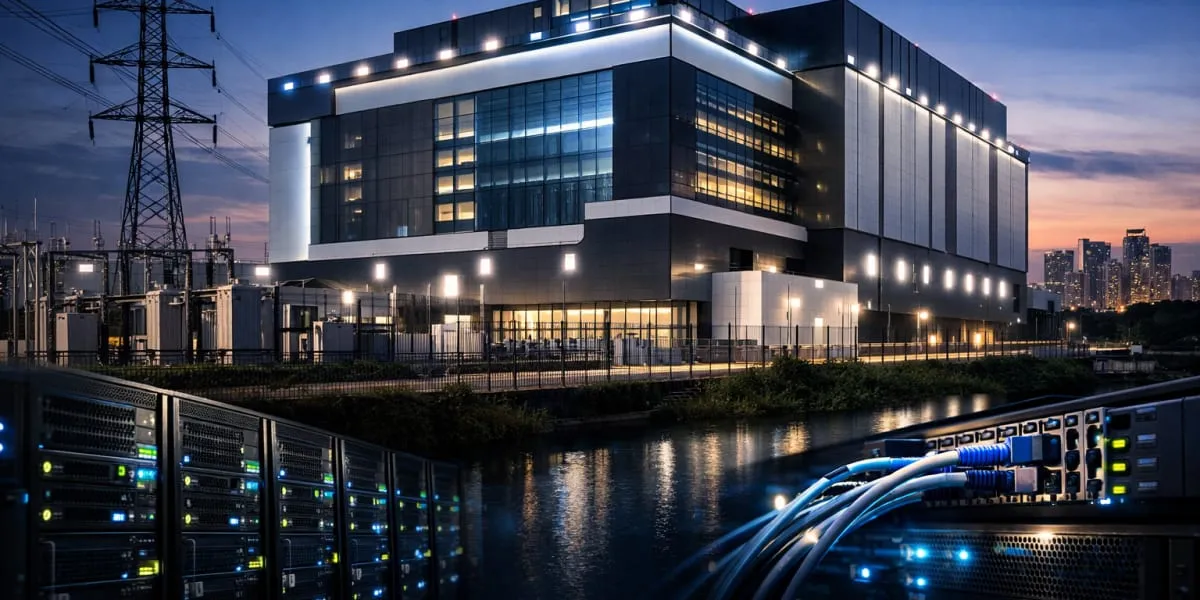
Asia-Pacific real asset manager ESR Group has entered India’s data centre market with an investment of Rs nine billion (Rs 9 bn) to develop a hyperscale facility in the Rabale area of Navi Mumbai. The project marks the company’s first data centre development in the country and signals growing investor confidence in India’s digital infrastructure sector. The commitment reflects a strategic bet on long-term demand for compute and storage capacity across enterprise and cloud segments.

The facility is planned as a multi-storey, high-capacity centre intended to meet rapidly rising needs for cloud services, artificial intelligence workloads and enterprise data hosting. Industry observers said the investment underlines expanding opportunities in India’s data centre ecosystem driven by accelerating digital adoption, regulatory emphasis on local data processing and rising demand from technology and cloud service providers. Developers are positioning scalable solutions to address emerging use cases and future-ready network architectures.

The Navi Mumbai centre will be engineered to support significant power and network requirements, a central consideration in a market where connectivity and computational workloads are increasing sharply. The development is expected to strengthen regional capacity at a moment when India’s overall data centre footprint is set to expand substantially and key hubs such as Navi Mumbai account for a large share of new infrastructure. Planners will need to integrate resilient power solutions and diverse fibre pathways to meet operator demands.

Despite the favourable outlook, challenges persist around securing reliable power supplies, high-speed connectivity and land for large-format sites, and both established players and new entrants must navigate competitive pressures as capacity expands. ESR’s entry is part of a broader trend of institutional capital flowing into digital infrastructure, reinforcing the sector’s strategic importance to India’s technology-enabled growth narrative. Stakeholders said collaboration between developers, utilities and regulators will be essential to translate investment into resilient, scalable capacity.

Asia-Pacific real asset manager ESR Group has entered India’s data centre market with an investment of Rs nine billion (Rs 9 bn) to develop a hyperscale facility in the Rabale area of Navi Mumbai. The project marks the company’s first data centre development in the country and signals growing investor confidence in India’s digital infrastructure sector. The commitment reflects a strategic bet on long-term demand for compute and storage capacity across enterprise and cloud segments. The facility is planned as a multi-storey, high-capacity centre intended to meet rapidly rising needs for cloud services, artificial intelligence workloads and enterprise data hosting. Industry observers said the investment underlines expanding opportunities in India’s data centre ecosystem driven by accelerating digital adoption, regulatory emphasis on local data processing and rising demand from technology and cloud service providers. Developers are positioning scalable solutions to address emerging use cases and future-ready network architectures. The Navi Mumbai centre will be engineered to support significant power and network requirements, a central consideration in a market where connectivity and computational workloads are increasing sharply. The development is expected to strengthen regional capacity at a moment when India’s overall data centre footprint is set to expand substantially and key hubs such as Navi Mumbai account for a large share of new infrastructure. Planners will need to integrate resilient power solutions and diverse fibre pathways to meet operator demands. Despite the favourable outlook, challenges persist around securing reliable power supplies, high-speed connectivity and land for large-format sites, and both established players and new entrants must navigate competitive pressures as capacity expands. ESR’s entry is part of a broader trend of institutional capital flowing into digital infrastructure, reinforcing the sector’s strategic importance to India’s technology-enabled growth narrative. Stakeholders said collaboration between developers, utilities and regulators will be essential to translate investment into resilient, scalable capacity.

Next Story
Infrastructure Urban

Implementation Status of Jal Jeevan Mission

Since August 2019 the Government has implemented Jal Jeevan Mission to provide assured potable water through household tap connections in rural India. At the start of the mission only 32.3 million (mn) rural households, representing 16.7 per cent, were reported to have tap water connections. States and union territories have reported that 125.8 mn additional rural households have since been provided with tap connections. As a result, of about 193.6 mn rural households roughly 158.2 mn, or 81.71 per cent, are reported to have tap water supply at home.\n\nThe State, district and village level st..

Next Story
Infrastructure Urban

Jal Jeevan Mission Reaches Eighty One Per Cent Rural Coverage

The Government reported substantial progress under the Jal Jeevan Mission, launched in August 2019 to provide tap water to every rural household. At launch only 32.3 million (mn) rural households had tap connections and states and Union territories reported provision of 125.8 mn additional households by March 2026. Consequently, out of about 193.6 mn rural households around 158.2 mn, or 81.71 per cent, are reported to have tap water at home. The Finance Minister announced extension of the mission until 2028 in the 2025-26 budget speech. The Swachh Bharat Mission Grameen, launched in October 20..

Next Story
Infrastructure Urban

Empowering Local Governance for Sustainable Rural Water Supply

The Ministry of Jal Shakti has aligned the Jal Jeevan Mission (JJM) with the 73rd Amendment to strengthen village level planning and community ownership of water supply. Gram Panchayats, village water and sanitation committees and Pani Samitis are to plan, implement, manage and maintain piped water systems, with gram sabha processes formalising handover and oversight. Implementation support agencies including non government organisations, community based organisations and self help groups have been empanelled to train local committees and promote women participation. Under JJM, the department ..

Advertisement

Subscribe to Our Newsletter

Get daily newsletters around different themes from Construction world.

STAY CONNECTED

Advertisement

Advertisement

Advertisement