Government Details Reforms Boosting FDI And Investment Climate
ECONOMY & POLICY

Government Details Reforms Boosting FDI And Investment Climate

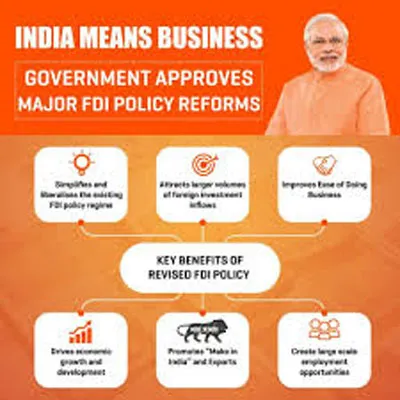
The Government of India has reiterated that while Foreign Direct Investment (FDI) policies are reviewed and liberalised on an ongoing basis to keep India attractive for global investors, no fixed targets are set for FDI inflows, as these depend largely on private business decisions. FDI levels are influenced by factors such as natural resources, market size, infrastructure, political stability and investor sentiment.

To attract greater investment, the Government has prioritised removing regulatory barriers, streamlining procedures, improving logistics and enhancing infrastructure, alongside sustained efforts to strengthen the Ease of Doing Business (EoDB). Several nationwide initiatives have been launched to improve business efficiency and competitiveness. The Business Reforms Action Plan (BRAP) 2024 rankings and the Logistics Ease Across Different States (LEADS) 2024 report highlight state-level progress and provide investors with insights into regional business environments. The Regulatory Compliance Burden (RCB) initiative has already led to more than 42,000 compliance reductions across 670 Acts. The Jan Vishwas (Amendment of Provisions) Act, 2023 decriminalised 183 provisions across 42 Central Acts, promoting a more investment-friendly regulatory framework.

Between 2014 and 2019, the Government liberalised FDI norms across Defence, Insurance, Pensions, Construction, Civil Aviation and Single Brand Retail. From 2019 to 2024, reforms included permitting 100 per cent FDI under the automatic route in coal mining, contract manufacturing and insurance intermediaries. Additional liberalisation has followed in sectors such as Pension, Other Financial Services, Asset Reconstruction Companies, Broadcasting, Pharmaceuticals, Construction and Development, Power Exchanges, e-commerce, Digital Media and Civil Aviation. Recent reforms have targeted Defence, Insurance, Petroleum and Natural Gas, Telecom and Space.

Invest India, the national investment promotion agency, has been tasked with enhancing investor facilitation through greater coordination between government and industry. Tax measures have also been updated: the abolition of angel tax and reduced income tax rates for foreign companies under the 2024 amendments to the Income Tax Act have simplified compliance for start-ups and overseas investors.

GST reforms introduced in September 2025 mark a major restructuring of India’s indirect tax system, lowering rates and rationalising slabs to boost entrepreneurship, job creation and affordability. Youth-intensive sectors—including education, automobiles, technology, handicrafts, footwear, healthcare, food processing and textiles—received priority. Reduced GST rates on leather, footwear, paper, textiles, toys, packaging and logistics are expected to ease compliance, support start-ups and improve competitiveness.

The Government has also leveraged Free Trade Agreements (FTAs) to diversify exports and attract investment. India currently has 15 FTAs and six Preferential Trade Agreements (PTAs). The Trade and Economic Partnership Agreement with the European Free Trade Association (EFTA), signed on 10 March 2024, includes an unprecedented unilateral commitment of USD 100 billion in investment and one million direct jobs over 15 years from Switzerland, Norway, Liechtenstein and Iceland. Negotiations continue with partners including the EU, Peru, Chile, New Zealand and Oman. The Government is also working closely with exporters, industry bodies and state governments to optimise the benefits of existing FTAs.

India follows a negative-list approach to FDI, allowing up to 100 per cent investment under the automatic route in most sectors, subject to applicable regulations and security conditions. FDI continues to play a transformative role by bringing non-debt capital, promoting technology transfer and generating employment.

FDI inflow in FY 2024–25 reached USD 80.62 billion—the highest in three years. During the first half of FY 2025–26, provisional inflows stood at USD 50.36 billion, a 16 per cent rise over USD 43.37 billion in the first half of FY 2024–25, marking the highest-ever inflow for the first half of any financial year.

Sectoral caps have been liberalised: Defence now permits up to 74 per cent FDI under the automatic route, Telecom allows 100 per cent, and Insurance has increased its automatic route cap from 49 per cent to 74 per cent. Since their respective liberalisation years, FDI inflows up to FY 2024–25 reached USD 11.59 million in Defence, USD 8,788.59 million in Insurance and USD 1,740.81 million in Telecommunications. In FY 2024–25, these sectors recorded strong growth compared with their initial liberalisation years—196.83 per cent in Defence, 199.20 per cent in Insurance and 11.68 per cent in Telecommunications.

The information was provided by Minister of State for Commerce and Industry, Jitin Prasada, in a written reply in the Lok Sabha.

The Government of India has reiterated that while Foreign Direct Investment (FDI) policies are reviewed and liberalised on an ongoing basis to keep India attractive for global investors, no fixed targets are set for FDI inflows, as these depend largely on private business decisions. FDI levels are influenced by factors such as natural resources, market size, infrastructure, political stability and investor sentiment. To attract greater investment, the Government has prioritised removing regulatory barriers, streamlining procedures, improving logistics and enhancing infrastructure, alongside sustained efforts to strengthen the Ease of Doing Business (EoDB). Several nationwide initiatives have been launched to improve business efficiency and competitiveness. The Business Reforms Action Plan (BRAP) 2024 rankings and the Logistics Ease Across Different States (LEADS) 2024 report highlight state-level progress and provide investors with insights into regional business environments. The Regulatory Compliance Burden (RCB) initiative has already led to more than 42,000 compliance reductions across 670 Acts. The Jan Vishwas (Amendment of Provisions) Act, 2023 decriminalised 183 provisions across 42 Central Acts, promoting a more investment-friendly regulatory framework. Between 2014 and 2019, the Government liberalised FDI norms across Defence, Insurance, Pensions, Construction, Civil Aviation and Single Brand Retail. From 2019 to 2024, reforms included permitting 100 per cent FDI under the automatic route in coal mining, contract manufacturing and insurance intermediaries. Additional liberalisation has followed in sectors such as Pension, Other Financial Services, Asset Reconstruction Companies, Broadcasting, Pharmaceuticals, Construction and Development, Power Exchanges, e-commerce, Digital Media and Civil Aviation. Recent reforms have targeted Defence, Insurance, Petroleum and Natural Gas, Telecom and Space. Invest India, the national investment promotion agency, has been tasked with enhancing investor facilitation through greater coordination between government and industry. Tax measures have also been updated: the abolition of angel tax and reduced income tax rates for foreign companies under the 2024 amendments to the Income Tax Act have simplified compliance for start-ups and overseas investors. GST reforms introduced in September 2025 mark a major restructuring of India’s indirect tax system, lowering rates and rationalising slabs to boost entrepreneurship, job creation and affordability. Youth-intensive sectors—including education, automobiles, technology, handicrafts, footwear, healthcare, food processing and textiles—received priority. Reduced GST rates on leather, footwear, paper, textiles, toys, packaging and logistics are expected to ease compliance, support start-ups and improve competitiveness. The Government has also leveraged Free Trade Agreements (FTAs) to diversify exports and attract investment. India currently has 15 FTAs and six Preferential Trade Agreements (PTAs). The Trade and Economic Partnership Agreement with the European Free Trade Association (EFTA), signed on 10 March 2024, includes an unprecedented unilateral commitment of USD 100 billion in investment and one million direct jobs over 15 years from Switzerland, Norway, Liechtenstein and Iceland. Negotiations continue with partners including the EU, Peru, Chile, New Zealand and Oman. The Government is also working closely with exporters, industry bodies and state governments to optimise the benefits of existing FTAs. India follows a negative-list approach to FDI, allowing up to 100 per cent investment under the automatic route in most sectors, subject to applicable regulations and security conditions. FDI continues to play a transformative role by bringing non-debt capital, promoting technology transfer and generating employment. FDI inflow in FY 2024–25 reached USD 80.62 billion—the highest in three years. During the first half of FY 2025–26, provisional inflows stood at USD 50.36 billion, a 16 per cent rise over USD 43.37 billion in the first half of FY 2024–25, marking the highest-ever inflow for the first half of any financial year. Sectoral caps have been liberalised: Defence now permits up to 74 per cent FDI under the automatic route, Telecom allows 100 per cent, and Insurance has increased its automatic route cap from 49 per cent to 74 per cent. Since their respective liberalisation years, FDI inflows up to FY 2024–25 reached USD 11.59 million in Defence, USD 8,788.59 million in Insurance and USD 1,740.81 million in Telecommunications. In FY 2024–25, these sectors recorded strong growth compared with their initial liberalisation years—196.83 per cent in Defence, 199.20 per cent in Insurance and 11.68 per cent in Telecommunications. The information was provided by Minister of State for Commerce and Industry, Jitin Prasada, in a written reply in the Lok Sabha.

Next Story
Products

Kuche7 Launches Ruby Vanity for Sculpted, High-Performance Bathrooms

Kuche7, India’s leading maker of premium stainless-steel kitchens, has unveiled the Ruby Vanity, a bathroom system engineered for long-term performance with a warm, sculpted aesthetic. Built on a 304-grade stainless-steel framework, the vanity offers corrosion resistance, structural strength and high durability suited to humid environments.Precision metal-forming enables the seamless curved façade, finished in a matte beige PU coat and paired with a marble countertop for depth and texture. Stainless-steel internal carcasses ensure efficient, moisture-resistant storage for everyday use. The ..

Next Story
Resources

Knauf India Doubles Capacity with New Metal Line at Khushkhera Plant

Knauf India, the world’s leading drywall and ceiling solutions company, has inaugurated a new Metal Line at its Khushkhera plant, doubling the facility’s overall production capacity. The expansion strengthens Knauf’s local manufacturing footprint and supports the growing domestic demand for advanced building materials.The launch was held during Knauf’s Dealer Engagement Day, which brought together dealers, partners and team members from across the country for a full-day programme combining technical demonstrations and engagement activities. The event began with a guided plant tour show..

Next Story
Products

Valueline Launches Tiberio by Ceramica Cielo in India

Valueline, a premium home solutions brand established in 2002, has announced the launch of Tiberio by Ceramica Cielo, an Italian bathroom collection that pairs traditional ceramic craftsmanship with contemporary design. The series is positioned to bring refined elegance and architectural depth to modern interiors.Designed by Andrea Parisio and Giuseppe Pezzano, Tiberio emphasises balanced proportions and a harmonious integration of ceramic and wood. The collection offers both modular and freestanding formats, enabling application across varied settings including high-end residences, boutique h..

Advertisement

Subscribe to Our Newsletter

Get daily newsletters around different themes from Construction world.

STAY CONNECTED

Advertisement

Advertisement

Advertisement

Advertisement

Get CW App