Government Projects 26 GW Data Centre Demand By FY32
ECONOMY & POLICY

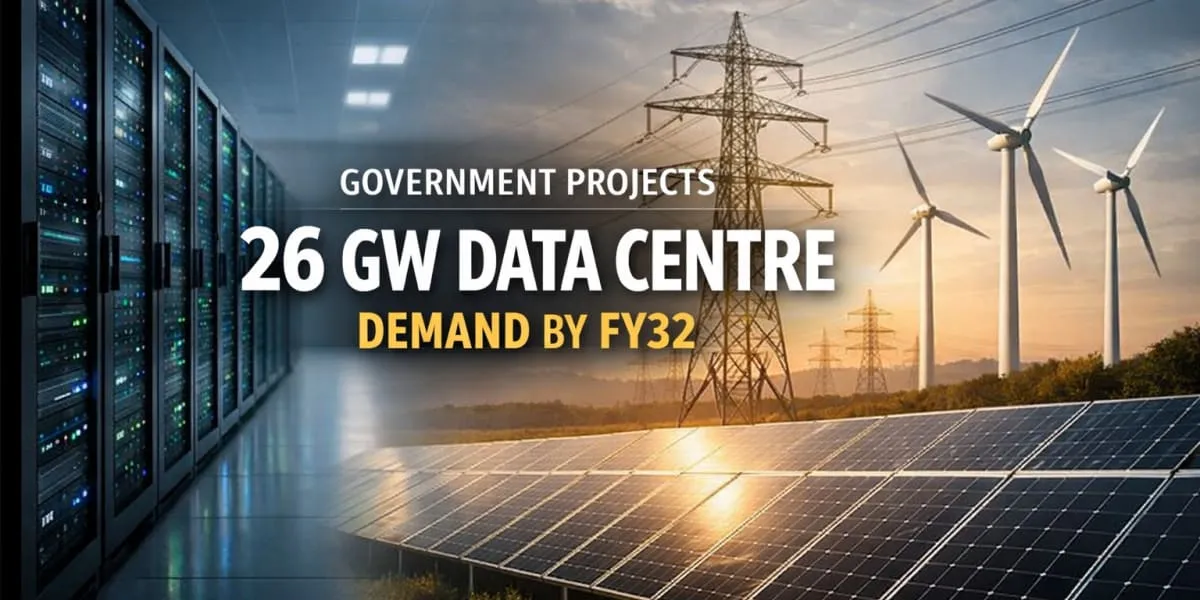
Government Projects 26 GW Data Centre Demand By FY32

Union minister of state for power Shripad Yesso Naik told the Rajya Sabha in a written reply that data centres are projected to consume 26.3 GW of power by 2031-32. He said demand from data centres will be met by renewable energy sources and will be integrated into the grid. The projection covers additional load from artificial intelligence data centres and reflects planning for anticipated large compute deployments.

India's peak demand has reached 270.8 GW and is projected to reach 272 GW this year and 300 GW in the next fiscal, the minister noted. Union power minister Manohar Lal also indicated that the nation's peak demand may touch 300 GW next year, prompting calls for utilities to prepare for record demand. Officials have therefore emphasised the need to align generation and distribution planning with evolving consumption patterns.

The ministry said development of transmission infrastructure is being undertaken in a phased manner to match growing electricity demand and planned generation capacity addition, including renewable energy. The National Electricity Plan (NEP) envisages developing the transmission system with an estimated investment of about Rs 9.16 tn by FY32. Grid modernisation measures under consideration include static synchronous compensator (STATCOM), battery energy storage systems (BESS) and synchronous condensers to enhance reliability and facilitate renewable integration. These measures aim to improve flexibility and grid support as variable renewable output rises.

The Central Electricity Authority (CEA) has returned to the drawing board to reassess demand mapping amid concerns that concentration of data centres in a few states could skew consumption and affect grid stability. The CEA will ask states and distribution companies to incorporate data centre demand projections into resource adequacy plans and is assessing emerging loads under the 21st Electric Power Survey Exercise. The increase in demand will be considered in the NEP for FY28 to FY37, which the ministry expects to release by March 2027. Policymakers and operators are therefore urged to coordinate planning to accommodate AI-driven growth without compromising system security.

Union minister of state for power Shripad Yesso Naik told the Rajya Sabha in a written reply that data centres are projected to consume 26.3 GW of power by 2031-32. He said demand from data centres will be met by renewable energy sources and will be integrated into the grid. The projection covers additional load from artificial intelligence data centres and reflects planning for anticipated large compute deployments. India's peak demand has reached 270.8 GW and is projected to reach 272 GW this year and 300 GW in the next fiscal, the minister noted. Union power minister Manohar Lal also indicated that the nation's peak demand may touch 300 GW next year, prompting calls for utilities to prepare for record demand. Officials have therefore emphasised the need to align generation and distribution planning with evolving consumption patterns. The ministry said development of transmission infrastructure is being undertaken in a phased manner to match growing electricity demand and planned generation capacity addition, including renewable energy. The National Electricity Plan (NEP) envisages developing the transmission system with an estimated investment of about Rs 9.16 tn by FY32. Grid modernisation measures under consideration include static synchronous compensator (STATCOM), battery energy storage systems (BESS) and synchronous condensers to enhance reliability and facilitate renewable integration. These measures aim to improve flexibility and grid support as variable renewable output rises. The Central Electricity Authority (CEA) has returned to the drawing board to reassess demand mapping amid concerns that concentration of data centres in a few states could skew consumption and affect grid stability. The CEA will ask states and distribution companies to incorporate data centre demand projections into resource adequacy plans and is assessing emerging loads under the 21st Electric Power Survey Exercise. The increase in demand will be considered in the NEP for FY28 to FY37, which the ministry expects to release by March 2027. Policymakers and operators are therefore urged to coordinate planning to accommodate AI-driven growth without compromising system security.

Next Story
Infrastructure Urban

SCLR Extension Nears Completion Linking BKC With Signal-Free Route

The Santacruz-Chembur Link Road (SCLR) extension towards Bandra-Kurla Complex (BKC) via the Mumbai University campus has entered its final stage, bringing motorists closer to a direct, signal-free connection between the Western Express Highway and the city’s commercial district. The elevated connector is being built as an arm from the SCLR alignment and will link the western suburbs with BKC without surface signals. The link is designed to reduce journey times for commuters travelling from the western suburbs to BKC and to improve access to eastern Mumbai. By carrying through traffic above s..

Next Story
Infrastructure Transport

Raiganj MP Seeks Bengal Only Highway Link To Siliguri

Raiganj Member of Parliament Kartik Chandra Paul met Union Minister for Road Transport and Highways Nitin Gadkari in New Delhi to press for a new stretch of national highway in North Dinajpur district. He urged approval for a Bengal-to-Bengal link that would connect National Highways 12 and 27 to allow vehicles bound for Siliguri to avoid the current route through Kishanganj in neighbouring Bihar. He also submitted a proposed alignment of the new road to the ministry for consideration. At present vehicles from Raiganj travel along NH-12 and join NH-27 at Purnia More in Dalkhola, a route that p..

Next Story
Infrastructure Transport

Airport Kilambakkam Metro Line To Be Extended To Chengalpattu

Chennai Metro Rail (CMRL) has invited tenders for two detailed project reports that would extend its rail network to Chengalpattu in the south and extend Corridor-5 to Wimco Nagar in the north as part of a second wave of expansion beyond the operator's corridors under construction. The move signals an acceleration of planning for suburban links and interchange nodes. The larger of the two studies covers a roughly 27km extension from the planned Kilambakkam metro station to Chengalpattu under Corridor-1, Phase I. CMRL floated the tender at an estimated cost of Rs 21.6 mn. The proposed line woul..

Advertisement

Subscribe to Our Newsletter

Get daily newsletters around different themes from Construction world.

STAY CONNECTED

Advertisement

Advertisement

Advertisement