Haryana Grants 100 Per Cent MV Tax Exemption For Clean Fleet
ECONOMY & POLICY

Haryana Grants 100 Per Cent MV Tax Exemption For Clean Fleet

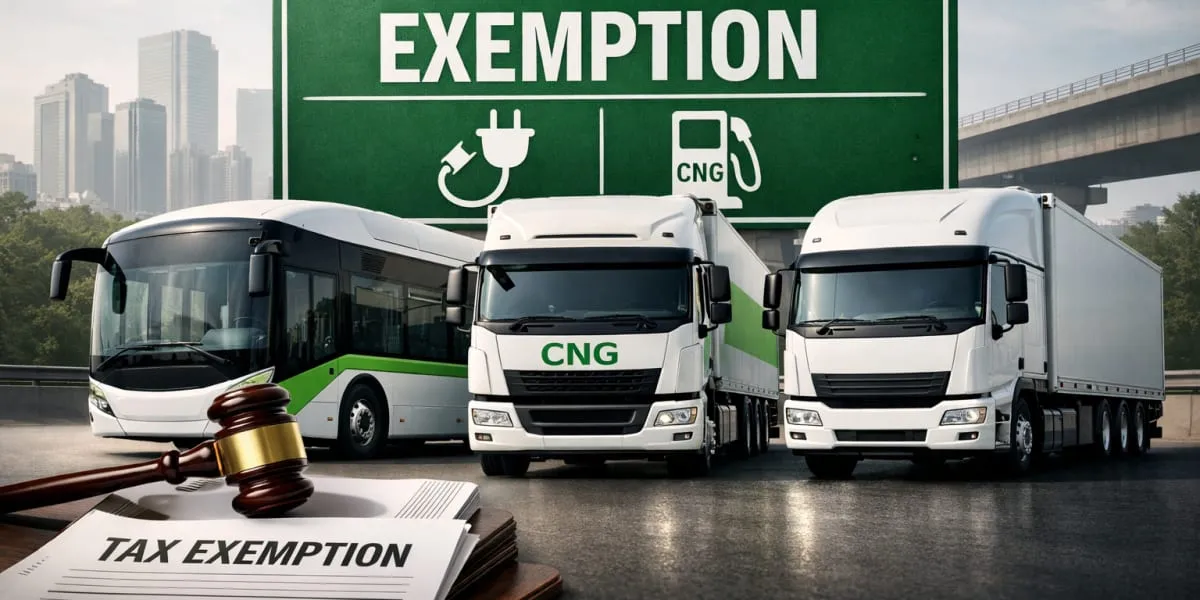
The Haryana government has announced a Motor Vehicle tax (MV tax) exemption for environment-friendly trucks and buses in the National Capital Region (NCR) districts. An official notification by the Transport Department on June 24 stated that a 100 per cent exemption will apply to the purchase of new BS-VI compliant vehicles, including electric and CNG models. The measure targets commercial fleets registered in Haryana's NCR districts to stimulate transition to cleaner mobility.

The notification provides a 50 per cent MV tax exemption for used vehicles that meet the same emission norms. The exemption will remain valid for 10 years from the date of first registration, offering long-term relief for fleet operators. To qualify, applicants must own a transport truck or bus registered within Haryana's NCR districts and replace a vehicle that complies with BS-IV or older emission standards.

The policy mandates proper scrapping or disposal of older vehicles and distinguishes by emission category. BS-III and older trucks and buses must be scrapped at a Registered Vehicle Scrapping Facility (RVSF) in the state, while BS-IV vehicles may be scrapped at an RVSF or sold outside the NCR in areas not covered under the National Clean Air Programme (NCAP). The replacement vehicle, new or pre-owned, must be purchased and registered within Haryana's NCR districts and comply with BS-VI, electric, CNG, or higher emission standards.

The notification also waives outstanding MV tax liabilities pending for more than one year for BS-IV or older trucks and buses registered in the NCR districts, extending relief to owners. The initiative is expected to accelerate the phase-out of older high-emission commercial vehicles and promote their replacement with cleaner alternatives, contributing to improved air quality in the NCR and aligning with the state's environmental objectives. Authorities presented the measures as part of efforts to incentivise cleaner transport and reduce vehicular emissions.

"Join industry leaders at RAHSTA Expo, India's premier platform for roads, highways and traffic infrastructure. Register now to explore innovations, network with experts and shape the future of mobility."

The Haryana government has announced a Motor Vehicle tax (MV tax) exemption for environment-friendly trucks and buses in the National Capital Region (NCR) districts. An official notification by the Transport Department on June 24 stated that a 100 per cent exemption will apply to the purchase of new BS-VI compliant vehicles, including electric and CNG models. The measure targets commercial fleets registered in Haryana's NCR districts to stimulate transition to cleaner mobility. The notification provides a 50 per cent MV tax exemption for used vehicles that meet the same emission norms. The exemption will remain valid for 10 years from the date of first registration, offering long-term relief for fleet operators. To qualify, applicants must own a transport truck or bus registered within Haryana's NCR districts and replace a vehicle that complies with BS-IV or older emission standards. The policy mandates proper scrapping or disposal of older vehicles and distinguishes by emission category. BS-III and older trucks and buses must be scrapped at a Registered Vehicle Scrapping Facility (RVSF) in the state, while BS-IV vehicles may be scrapped at an RVSF or sold outside the NCR in areas not covered under the National Clean Air Programme (NCAP). The replacement vehicle, new or pre-owned, must be purchased and registered within Haryana's NCR districts and comply with BS-VI, electric, CNG, or higher emission standards. The notification also waives outstanding MV tax liabilities pending for more than one year for BS-IV or older trucks and buses registered in the NCR districts, extending relief to owners. The initiative is expected to accelerate the phase-out of older high-emission commercial vehicles and promote their replacement with cleaner alternatives, contributing to improved air quality in the NCR and aligning with the state's environmental objectives. Authorities presented the measures as part of efforts to incentivise cleaner transport and reduce vehicular emissions.

Next Story
Infrastructure Transport

Second TBM begins Mumbai bullet train undersea tunnel

The second tunnel boring machine (TBM) has begun excavation of the 7-km undersea tunnel beneath Thane Creek for the Mumbai–Ahmedabad Bullet Train Project, marking another milestone in the construction of India's first undersea rail tunnel.The TBM commenced its drive from Sawli (Ghansoli) towards Vikhroli as part of the project's 21-km underground section. Of this, 16 km between Sawli and Bandra Kurla Complex (BKC) will be excavated using TBMs, while the remaining 5 km has already been completed using the New Austrian Tunnelling Method (NATM). The first TBM began tunnelling from Vikhroli towa..

Next Story
Infrastructure Energy

Joint Solar eyes growth as India's power demand rises

Joint Solar expects rising electricity demand in India to create new growth opportunities for the solar sector, particularly across the residential, commercial and industrial markets.The company said government estimates indicating that the country's peak power demand could reach 300 GW next year are likely to accelerate the adoption of renewable energy as additional generation capacity is required to meet rising consumption.According to Joint Solar, increasing economic activity, urbanisation and higher electricity usage are driving demand for clean energy solutions. The company expects growin..

Next Story
Infrastructure Transport

Matrix Geo wins Central Railway survey contract

Matrix Geo Solutions has secured a Rs 12.4 million contract from Central Railway to conduct precision track geometry surveys covering more than 300 km of railway lines using advanced geospatial technology.The company received a Letter of Acceptance (LoA) for the project, which will be executed over 18 months. The surveys are intended to assess track alignment, identify irregularities and support corrective measures to improve railway safety, operational efficiency and maintenance planning.According to the company, the technology enables highly accurate measurement of track geometry, helping en..

Advertisement

Subscribe to Our Newsletter

Get daily newsletters around different themes from Construction world.

STAY CONNECTED

Advertisement

Advertisement

Advertisement