India, Cyprus Agree on Strategic Road Map, Security Ties
ECONOMY & POLICY

India, Cyprus Agree on Strategic Road Map, Security Ties

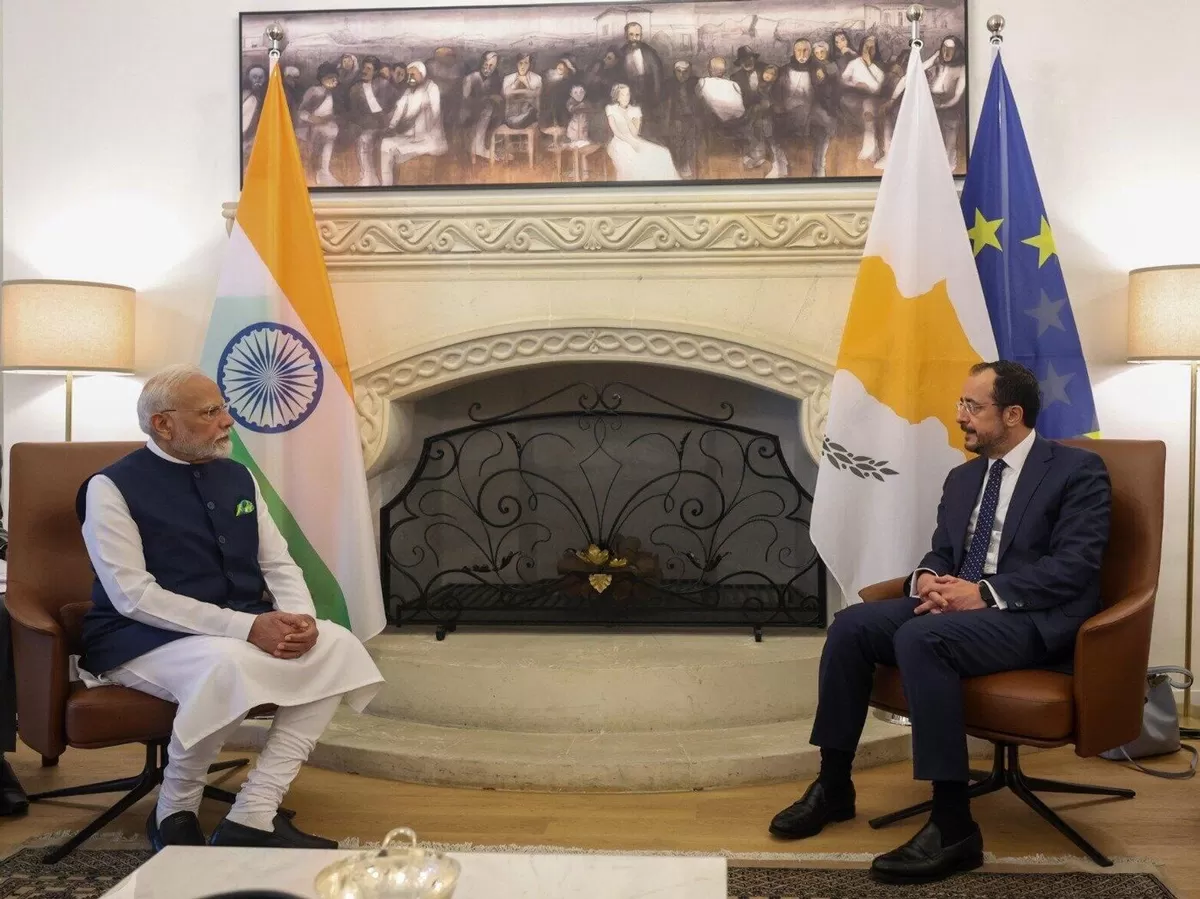
Prime Minister Narendra Modi held formal talks with the President of the Republic of Cyprus, Nikos Christodoulides, at the Presidential Palace in Nicosia. President Christodoulides personally welcomed Prime Minister Modi at the airport a day earlier, highlighting the deep mutual respect and enduring friendship between the two nations.

During the meeting, the leaders reaffirmed their shared democratic values and mutual respect for sovereignty and territorial integrity. Prime Minister Modi expressed gratitude to Cyprus for its strong condemnation of the April 2025 terrorist attack in Pahalgam and for its continued support to India’s anti-terrorism efforts. He reiterated India’s firm support for Cyprus’s unity and a peaceful resolution of the Cyprus issue in accordance with UN Security Council resolutions, international law, and the EU Acquis.

The two sides reviewed ongoing cooperation in trade, investment, science, research, culture, and people-to-people exchanges. They agreed to expand collaboration into emerging sectors such as fintech, start-ups, defence manufacturing, digitalisation, artificial intelligence, mobility, and connectivity.

A significant outcome was the agreement to establish a five-year road map to enhance cooperation in key strategic areas. New dialogues on cyber and maritime security were announced, along with mechanisms for real-time information sharing on terrorism, drug trafficking, and arms smuggling.

The leaders welcomed the Bilateral Defence Cooperation Programme signed in January 2025, which is expected to give tangible shape to defence ties. They also endorsed the creation of the India-Greece-Cyprus (IGC) Business and Investment Council aimed at fostering stronger economic engagement. Enhancing air connectivity was discussed to promote business, tourism, and innovation exchanges.

Prime Minister Modi highlighted the India-Middle East-Europe Economic Corridor (IMEC) as a transformative initiative for regional peace and development.

On global issues, both leaders stressed their commitment to multilateralism and reform of international institutions, including the UN Security Council. Prime Minister Modi appreciated Cyprus’s consistent support for India’s bid for permanent membership in a reformed UNSC.

President Christodoulides was invited to visit India. The visit also saw the signing of a Memorandum of Understanding to establish an ICCR India Studies Chair at the University of Nicosia. A Joint Declaration on the India-Cyprus Partnership was released, outlining the shared vision for deepened ties.

Image source:https://sputniknews.in/

Prime Minister Narendra Modi held formal talks with the President of the Republic of Cyprus, Nikos Christodoulides, at the Presidential Palace in Nicosia. President Christodoulides personally welcomed Prime Minister Modi at the airport a day earlier, highlighting the deep mutual respect and enduring friendship between the two nations.During the meeting, the leaders reaffirmed their shared democratic values and mutual respect for sovereignty and territorial integrity. Prime Minister Modi expressed gratitude to Cyprus for its strong condemnation of the April 2025 terrorist attack in Pahalgam and for its continued support to India’s anti-terrorism efforts. He reiterated India’s firm support for Cyprus’s unity and a peaceful resolution of the Cyprus issue in accordance with UN Security Council resolutions, international law, and the EU Acquis.The two sides reviewed ongoing cooperation in trade, investment, science, research, culture, and people-to-people exchanges. They agreed to expand collaboration into emerging sectors such as fintech, start-ups, defence manufacturing, digitalisation, artificial intelligence, mobility, and connectivity.A significant outcome was the agreement to establish a five-year road map to enhance cooperation in key strategic areas. New dialogues on cyber and maritime security were announced, along with mechanisms for real-time information sharing on terrorism, drug trafficking, and arms smuggling.The leaders welcomed the Bilateral Defence Cooperation Programme signed in January 2025, which is expected to give tangible shape to defence ties. They also endorsed the creation of the India-Greece-Cyprus (IGC) Business and Investment Council aimed at fostering stronger economic engagement. Enhancing air connectivity was discussed to promote business, tourism, and innovation exchanges.Prime Minister Modi highlighted the India-Middle East-Europe Economic Corridor (IMEC) as a transformative initiative for regional peace and development.On global issues, both leaders stressed their commitment to multilateralism and reform of international institutions, including the UN Security Council. Prime Minister Modi appreciated Cyprus’s consistent support for India’s bid for permanent membership in a reformed UNSC.President Christodoulides was invited to visit India. The visit also saw the signing of a Memorandum of Understanding to establish an ICCR India Studies Chair at the University of Nicosia. A Joint Declaration on the India-Cyprus Partnership was released, outlining the shared vision for deepened ties.Image source:https://sputniknews.in/

Next Story
Technology

AI-Enabled Workflows Lift Profitability and Productivity

Organisations modernising frontline workflows with artificial intelligence, automation and real-time data are reporting stronger financial performance, higher productivity and improved employee engagement, according to a global study by Zebra Technologies and Oxford Economics.The research covered 1,000 senior leaders across retail, manufacturing, transportation and logistics in the US, Mexico, the UK, Germany, India, Japan, Australia and New Zealand.In transportation and logistics, 54 per cent of companies that improved picking and packing operations reported faster operational performance, wh..

Next Story
Real Estate

India Leads Global AI Readiness but Implementation Lags

Indian companies lead global averages across all eight artificial intelligence readiness indicators tracked by JLL, but only 19 per cent have started making changes to their workplaces, according to the JLL 2026 Future of Work Survey.The study found that 77 per cent of Indian business leaders expect AI to change their office requirements, creating a 58-percentage-point gap between awareness and implementation. The survey covered more than 2,200 CEOs, CFOs and real estate leaders across 21 countries during the first quarter of 2026.Despite concerns over automation, 58 per cent of Indian leaders..

Next Story
Equipment

Three WOLFF Cranes Build Riyadh Cable-Stayed Bridges

Three WOLFF 180 B luffing jib cranes are supporting the construction of two cable-stayed bridges alongside the existing Wadi Laban Bridge in Riyadh, Saudi Arabia. The project is being developed for the Royal Commission for Riyadh City and executed by the ICRC joint venture comprising IC Ictas and Al Rashid Trading & Contracting Company.The cranes are handling lifting operations including formwork, reinforcement, concrete placement, work platforms, surveying equipment and other construction materials. Each crane is fitted with a 40 m jib, reaches a hook height of 157 m and offers a maximum ..

Advertisement

Subscribe to Our Newsletter

Get daily newsletters around different themes from Construction world.

STAY CONNECTED

Advertisement

Advertisement

Advertisement