+
India and GCC Sign Joint Statement to Start FTA Talks
ECONOMY & POLICY

India and GCC Sign Joint Statement to Start FTA Talks

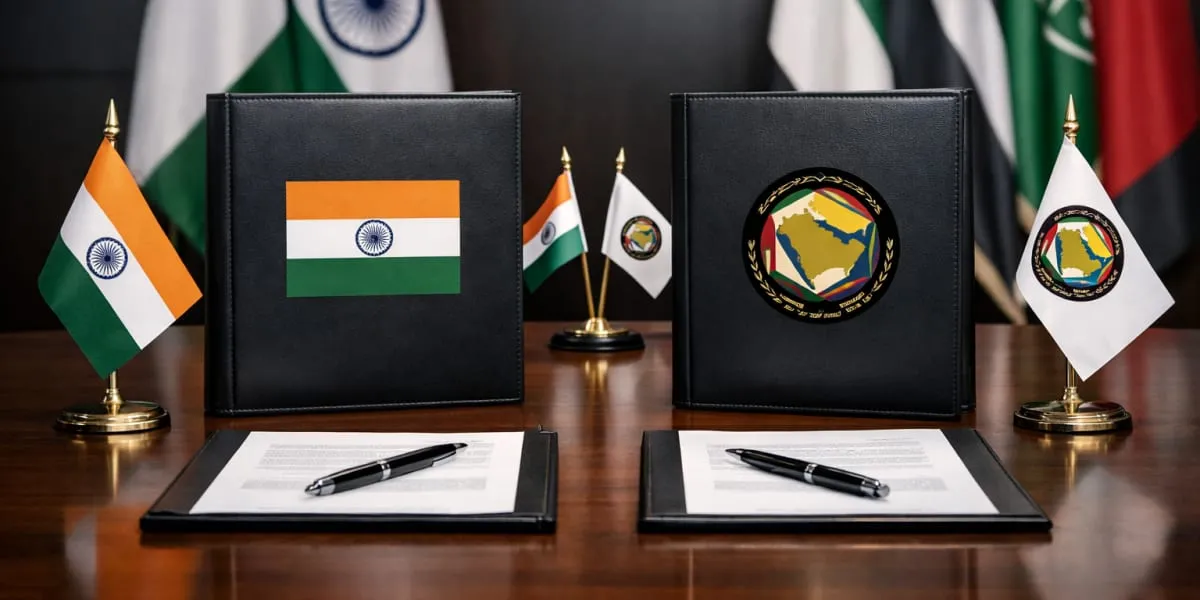
Senior ministers of India and the Gulf Cooperation Council signed a joint statement launching negotiations on a comprehensive free trade agreement in New Delhi on 24 February 2026. The document was endorsed by the Union Minister of Commerce and Industry and the Secretary General of the Gulf Cooperation Council in the presence of delegations from both sides. The signing formally initiated talks intended to build a broad based and mutually beneficial trading arrangement.

Officials noted that the statement follows the earlier signing of the terms of reference on 5 February 2026 and represents a significant milestone in bilateral relations. They said the agreement seeks to harness historical linkages and complementarities and to provide predictability and certainty for businesses. The process was described as timely given global uncertainties and the need to bolster trade and investment ties.

Data supplied by officials indicates that the GCC is India’s largest trading partner bloc, with bilateral trade reaching US$ 178.56 billion (bn) in FY 2024-25, of which exports stood at US$ 56.87 billion and imports at US$ 121.68 billion, accounting for 15.42 per cent of India’s global trade. Trade with the bloc has expanded at an annual average growth rate of 15.3 per cent over the last five years. The GCC region is also a major source of foreign direct investment into India, with cumulative investments exceeding US$ 31.14 bn as of September 2025.

Key Indian exports to the GCC include engineering goods, rice, textiles, machinery and gems and jewellery while imports are dominated by crude oil, LNG, petrochemicals and precious metals such as gold. Collectively the GCC represents a market of 61.5 million (mn) people and an economy of US$ 2.3 trillion (tn) at current prices, ranking ninth globally. The region hosts around 10 mn members of the Indian community and a significant presence of Indian companies, factors that are expected to reinforce the impact of a successful free trade agreement.

Senior ministers of India and the Gulf Cooperation Council signed a joint statement launching negotiations on a comprehensive free trade agreement in New Delhi on 24 February 2026. The document was endorsed by the Union Minister of Commerce and Industry and the Secretary General of the Gulf Cooperation Council in the presence of delegations from both sides. The signing formally initiated talks intended to build a broad based and mutually beneficial trading arrangement. Officials noted that the statement follows the earlier signing of the terms of reference on 5 February 2026 and represents a significant milestone in bilateral relations. They said the agreement seeks to harness historical linkages and complementarities and to provide predictability and certainty for businesses. The process was described as timely given global uncertainties and the need to bolster trade and investment ties. Data supplied by officials indicates that the GCC is India’s largest trading partner bloc, with bilateral trade reaching US$ 178.56 billion (bn) in FY 2024-25, of which exports stood at US$ 56.87 billion and imports at US$ 121.68 billion, accounting for 15.42 per cent of India’s global trade. Trade with the bloc has expanded at an annual average growth rate of 15.3 per cent over the last five years. The GCC region is also a major source of foreign direct investment into India, with cumulative investments exceeding US$ 31.14 bn as of September 2025. Key Indian exports to the GCC include engineering goods, rice, textiles, machinery and gems and jewellery while imports are dominated by crude oil, LNG, petrochemicals and precious metals such as gold. Collectively the GCC represents a market of 61.5 million (mn) people and an economy of US$ 2.3 trillion (tn) at current prices, ranking ninth globally. The region hosts around 10 mn members of the Indian community and a significant presence of Indian companies, factors that are expected to reinforce the impact of a successful free trade agreement.

Next Story
Infrastructure Urban

Implementation Status of Jal Jeevan Mission

Since August 2019 the Government has implemented Jal Jeevan Mission to provide assured potable water through household tap connections in rural India. At the start of the mission only 32.3 million (mn) rural households, representing 16.7 per cent, were reported to have tap water connections. States and union territories have reported that 125.8 mn additional rural households have since been provided with tap connections. As a result, of about 193.6 mn rural households roughly 158.2 mn, or 81.71 per cent, are reported to have tap water supply at home.\n\nThe State, district and village level st..

Next Story
Infrastructure Urban

Jal Jeevan Mission Reaches Eighty One Per Cent Rural Coverage

The Government reported substantial progress under the Jal Jeevan Mission, launched in August 2019 to provide tap water to every rural household. At launch only 32.3 million (mn) rural households had tap connections and states and Union territories reported provision of 125.8 mn additional households by March 2026. Consequently, out of about 193.6 mn rural households around 158.2 mn, or 81.71 per cent, are reported to have tap water at home. The Finance Minister announced extension of the mission until 2028 in the 2025-26 budget speech. The Swachh Bharat Mission Grameen, launched in October 20..

Next Story
Infrastructure Urban

Empowering Local Governance for Sustainable Rural Water Supply

The Ministry of Jal Shakti has aligned the Jal Jeevan Mission (JJM) with the 73rd Amendment to strengthen village level planning and community ownership of water supply. Gram Panchayats, village water and sanitation committees and Pani Samitis are to plan, implement, manage and maintain piped water systems, with gram sabha processes formalising handover and oversight. Implementation support agencies including non government organisations, community based organisations and self help groups have been empanelled to train local committees and promote women participation. Under JJM, the department ..

Advertisement

Subscribe to Our Newsletter

Get daily newsletters around different themes from Construction world.

STAY CONNECTED

Advertisement

Advertisement

Advertisement