+
India And Israel Begin Free Trade Agreement Negotiations
ECONOMY & POLICY

India And Israel Begin Free Trade Agreement Negotiations

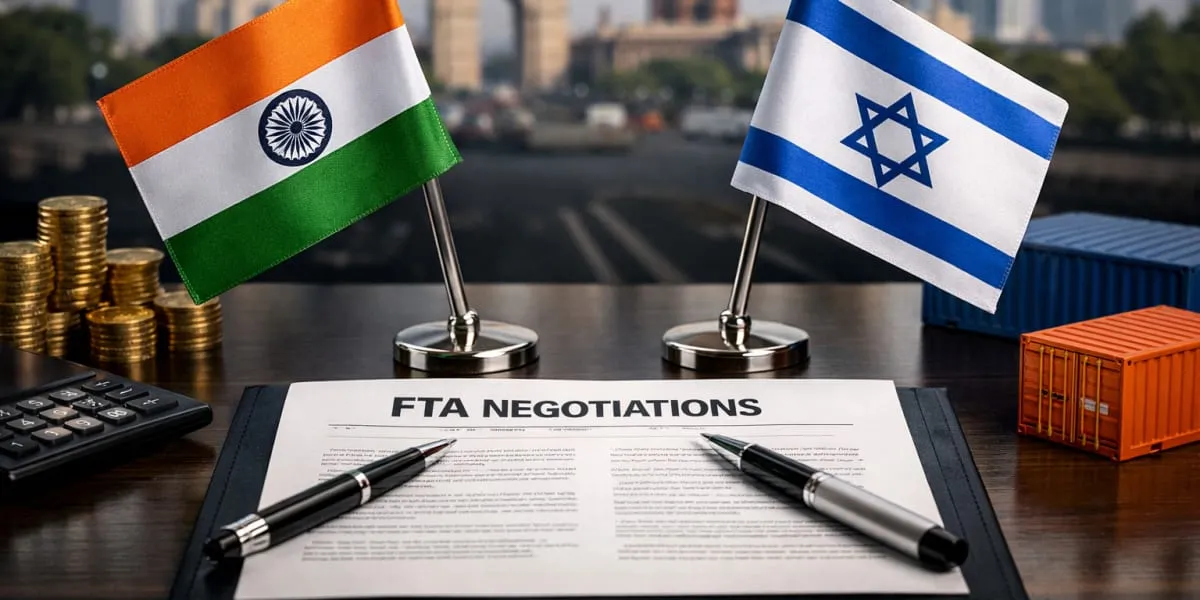
The first round of negotiations for a Free Trade Agreement between India and Israel commenced on 23 February 2026 in New Delhi and will continue until 26 February 2026.

The Terms of Reference signed in November 2025 established a structured framework for discussions on identified areas to enhance trade and economic cooperation and officials from both sides described the timing as opportune given high level engagement between the two governments.

Total merchandise trade between the two countries amounted to USD 3.62 billion in fiscal year 2024-2025 and the proposed agreement is expected to provide greater certainty and predictability for businesses, including micro, small and medium enterprises.

Negotiators noted complementarities across sectors and the potential for the agreement to act as a catalyst for deeper commercial ties and attention will focus on measures to facilitate market access and strengthen supply chains.

During the round, technical experts from India and Israel will examine trade in goods, trade in services, rules of origin, sanitary and phytosanitary measures and technical barriers to trade and sessions will also cover customs procedure and trade facilitation, intellectual property rights and other regulatory issues that affect cross border commerce.

Senior Indian officials underlined opportunities in innovation, science and technology, artificial intelligence, cybersecurity, high tech manufacturing, agriculture and services and urged negotiators to seek a balanced outcome while both sides reiterated the aim of concluding a mutually beneficial agreement that strengthens economic partnerships and opens new markets.

The first round of negotiations for a Free Trade Agreement between India and Israel commenced on 23 February 2026 in New Delhi and will continue until 26 February 2026. The Terms of Reference signed in November 2025 established a structured framework for discussions on identified areas to enhance trade and economic cooperation and officials from both sides described the timing as opportune given high level engagement between the two governments. Total merchandise trade between the two countries amounted to USD 3.62 billion in fiscal year 2024-2025 and the proposed agreement is expected to provide greater certainty and predictability for businesses, including micro, small and medium enterprises. Negotiators noted complementarities across sectors and the potential for the agreement to act as a catalyst for deeper commercial ties and attention will focus on measures to facilitate market access and strengthen supply chains. During the round, technical experts from India and Israel will examine trade in goods, trade in services, rules of origin, sanitary and phytosanitary measures and technical barriers to trade and sessions will also cover customs procedure and trade facilitation, intellectual property rights and other regulatory issues that affect cross border commerce. Senior Indian officials underlined opportunities in innovation, science and technology, artificial intelligence, cybersecurity, high tech manufacturing, agriculture and services and urged negotiators to seek a balanced outcome while both sides reiterated the aim of concluding a mutually beneficial agreement that strengthens economic partnerships and opens new markets.

Next Story
Infrastructure Urban

We’ve cut 50,000 tonnes of carbon emmissions since 2019

MatchLog is challenging a decades-old logistics norm and empty container miles by directly matching import flows with export demand. Indeed, the platform is unlocking measurable cost savings, cutting emissions and driving structural change in landside operations. Dhruv Taneja, Founder and Global CEO, outlines the quantified impact, adoption  journey and the evolving future of container reuse in an exclusive interview with Construction World. MatchLog has partnered with carriers such as Maersk, ONE and HMM in India. Could you share quantified outcomes from one specific corri..

Next Story
Infrastructure Transport

Airports: Capacity is Key

A lotus-inspired terminal design in Navi Mumbai International Airport. A terminal in a garden in Bengaluru’s Kempegowda International Airport. A peacock-inspired canopy in Chhatrapati Shivaji Maharaj International Airport. A nature-inspired terminal in Guwahati’s Lokpriya Gopinath Bordoloi International Airport.Truly, “India’s airports are no longer constrained by architectural ambition,” avers Ravikanth Mididhodi, Chief Technical Officer, J&F, a German-based engineering firm with over 25 years of global legacy in delivering advanced engineering and BIM services for air..

Next Story
Real Estate

In 2025, Amaravati attracted ₹ 28,075 crore in investments

In an exclusive interview with Construction World, Kanna Babu, IAS, Commissioner, Andhra Pradesh Capital Region Development Authority (APCRDA), reveals how Amaravati is entering a decisive new phase of capital city development. With 36 MoUs worth ₹ 45,589 crore, a ₹ 58,000 crore tender pipeline, and rising institutional investments, he explains the strategic execution, infrastructure rollout, and governance framework driving Amaravati’s emergence as a structured, investment-ready, and future-focused capital.APCRDA has recently secured major financial tie-ups, including loans from NA..

Advertisement

Subscribe to Our Newsletter

Get daily newsletters around different themes from Construction world.

STAY CONNECTED

Advertisement

Advertisement

Advertisement

Open In App