India and United Kingdom Advance Green Hydrogen Safety Standards
ECONOMY & POLICY

India and United Kingdom Advance Green Hydrogen Safety Standards

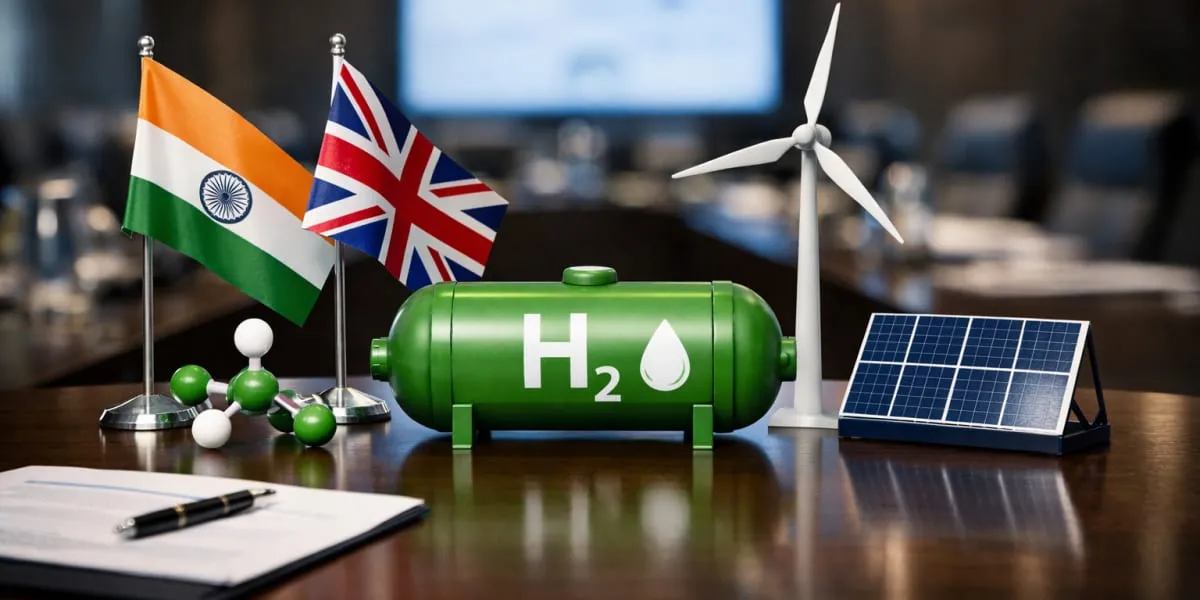
The India–UK conference on green hydrogen standards and safety protocols convened on 27 February 2026 in New Delhi, bringing together representatives from India and the United Kingdom across government, industry, academia, standards bodies and regulatory agencies to advance safe deployment under the National Green Hydrogen Mission. The event was organised by the National Centre for Hydrogen Safety, established under the Ministry of New and Renewable Energy, in collaboration with the British High Commission in India and WRI India. The National Centre for Hydrogen Safety will be referred to as NCHS and the Ministry of New and Renewable Energy as MNRE.

The inaugural session included context setting remarks by the Director General of the National Institute of Solar Energy and addresses from senior officials, while the keynote speaker from the Office of the Principal Scientific Adviser underlined the importance of robust safety frameworks, standards development and international cooperation to enable large scale deployment of green hydrogen technologies. Discussions emphasised regulatory frameworks and safety protocols across production, storage, transportation and end use sectors.

National regulators such as the Petroleum and Explosives Safety Organisation and the Bureau of Indian Standards presented perspectives on safety compliance, risk assessment, hazard management and efforts to align Indian standards with international best practice. Technical sessions brought together experts from industry, academia and research institutions to examine safety practices, safe design and operation of production, storage and transportation systems, risk assessment methodologies and incident case studies. Delegates also examined emerging innovations including advanced sensor technologies and artificial intelligence enabled monitoring for hydrogen safety.

The conference concluded with a shared commitment by India and the United Kingdom to strengthen collaboration on standards development, regulatory capacity building and safety frameworks to support reliable large scale deployment of green hydrogen. The deliberations are expected to contribute to the National Green Hydrogen Mission by helping to build a comprehensive safety ecosystem and to facilitate the growth of a globally competitive green hydrogen sector in India.

The India–UK conference on green hydrogen standards and safety protocols convened on 27 February 2026 in New Delhi, bringing together representatives from India and the United Kingdom across government, industry, academia, standards bodies and regulatory agencies to advance safe deployment under the National Green Hydrogen Mission. The event was organised by the National Centre for Hydrogen Safety, established under the Ministry of New and Renewable Energy, in collaboration with the British High Commission in India and WRI India. The National Centre for Hydrogen Safety will be referred to as NCHS and the Ministry of New and Renewable Energy as MNRE. The inaugural session included context setting remarks by the Director General of the National Institute of Solar Energy and addresses from senior officials, while the keynote speaker from the Office of the Principal Scientific Adviser underlined the importance of robust safety frameworks, standards development and international cooperation to enable large scale deployment of green hydrogen technologies. Discussions emphasised regulatory frameworks and safety protocols across production, storage, transportation and end use sectors. National regulators such as the Petroleum and Explosives Safety Organisation and the Bureau of Indian Standards presented perspectives on safety compliance, risk assessment, hazard management and efforts to align Indian standards with international best practice. Technical sessions brought together experts from industry, academia and research institutions to examine safety practices, safe design and operation of production, storage and transportation systems, risk assessment methodologies and incident case studies. Delegates also examined emerging innovations including advanced sensor technologies and artificial intelligence enabled monitoring for hydrogen safety. The conference concluded with a shared commitment by India and the United Kingdom to strengthen collaboration on standards development, regulatory capacity building and safety frameworks to support reliable large scale deployment of green hydrogen. The deliberations are expected to contribute to the National Green Hydrogen Mission by helping to build a comprehensive safety ecosystem and to facilitate the growth of a globally competitive green hydrogen sector in India.

Next Story
Infrastructure Transport

Sector 51-52 Metro skywalk in Noida remains shut despite being ready for over a year

Thousands of commuters travelling between Delhi Metro Rail Corporation’s (DMRC) Sector 52 station and Noida Metro Rail Corporation’s (NMRC) Sector 51 station continue to face daily inconvenience as the 300-metre air-conditioned skywalk connecting the two stations remains closed, despite being completed over a year ago, according to a report.The Noida Metro Rail Corporation built the foot overbridge to enable a seamless interchange between the Delhi Metro and Noida Metro networks. However, pending finishing work and a structural obstruction have delayed its opening.Krishna Karunesh, Chief E..

Next Story
Infrastructure Transport

Maharashtra clears Metro Line 5A, expansion of Mumbai Metro Line 5

The Maharashtra government has approved the expansion of Mumbai Metro Line 5 along with a new integrated corridor, Metro Line 5A, forming a combined 34.2-km metro network across the Thane-Bhiwandi-Kalyan-Ulhasnagar belt. The integrated project has been cleared at an estimated cost of ₹18,130.55 crore, according to a government resolution (GR).Metro Line 5 was originally approved in October 2017 as a 24.9-km fully elevated corridor with 17 stations connecting Thane, Bhiwandi and Kalyan, with an initial project cost of ₹8,416.51 crore. The corridor is being developed in two phases.The first ..

Next Story
Infrastructure Transport

Bengaluru Metro expansion seen driving office demand

Bengaluru’s expanding metro network is expected to emerge as a major catalyst for real estate growth, with the Yellow and Pink Lines likely to boost both office demand and residential prices across key micro-markets, according to a report by Colliers India.The report estimates that over the next two years, Bengaluru could witness an additional 5–7 million sq ft of Grade A office space demand across the Central Business District (CBD), Secondary Business District (SBD) and Electronic City. Improved metro connectivity and reduced commute times are expected to drive higher occupier interest a..

Advertisement

Subscribe to Our Newsletter

Get daily newsletters around different themes from Construction world.

STAY CONNECTED

Advertisement

Advertisement

Advertisement