





India Emerges As Second Largest Mobile Manufacturer
ECONOMY & POLICY

India Emerges As Second Largest Mobile Manufacturer

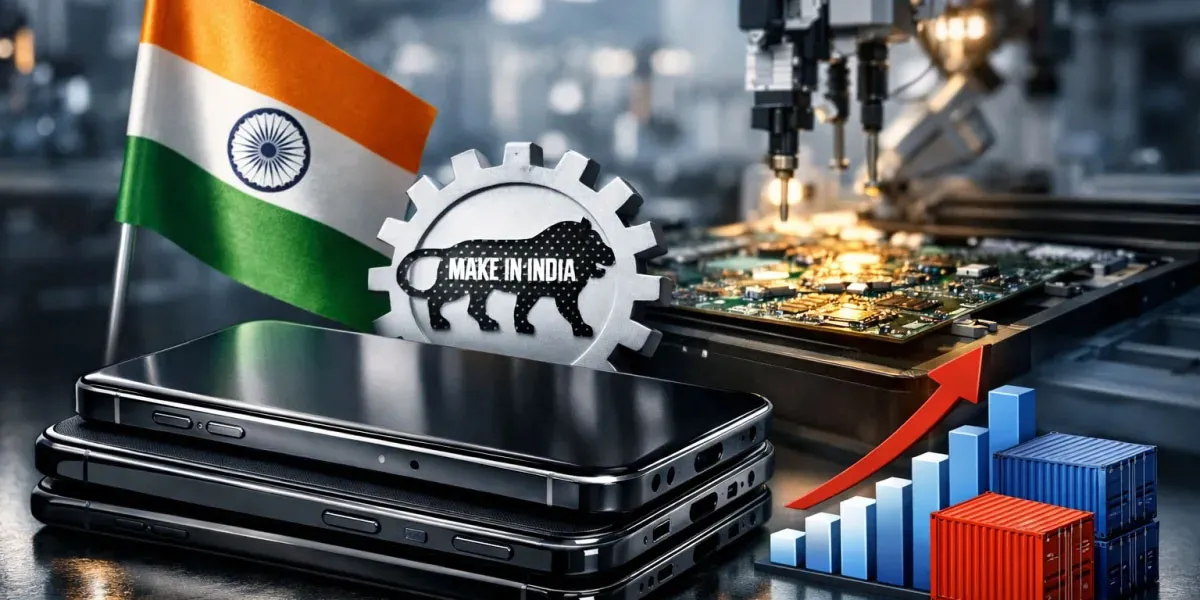
India has seen substantial expansion in electronics manufacturing over the past 11 years as a result of government initiatives under Make in India and Atmanirbhar Bharat. Production of electronics goods rose from Rs one point nine trillion (tn) in 2014-15 to Rs 11.3 trillion (tn) in 2024-25, an increase of six times, while exports grew from Rs zero point three eight trillion (tn) to Rs three point three trillion (tn).

Mobile phone production grew markedly to Rs five point five trillion (tn) in 2024-25 and mobile exports reached Rs two trillion (tn). The Production Linked Incentive scheme for Large Scale Electronics Manufacturing, launched in 2020, is credited with stimulating domestic mobile manufacturing and supporting a move from net importer to net exporter.

Till December 2025 the PLI scheme had attracted Rs 151.72 billion (bn) in investment and generated 171,448 additional jobs. PLI 2.0 for IT hardware, launched in 2023, contributed cumulative production of Rs 165.31 billion (bn), cumulative investment of Rs 8,566.4 million (mn) and direct employment of 4,776. Cumulative production under the PLI schemes reached Rs 10.39 trillion (tn) by 31 December 2025.

The government has complemented the PLI measures with initiatives for electronic components and semiconductors, electronics manufacturing clusters and the Semicon India Programme, along with procurement preferences and tax reforms. Policy adjustments have allowed one hundred per cent foreign direct investment in electronics manufacturing, subject to applicable laws and regulations. These measures aim to reduce import dependence, deepen the domestic ecosystem and position India as a trusted global supply chain hub.

India has seen substantial expansion in electronics manufacturing over the past 11 years as a result of government initiatives under Make in India and Atmanirbhar Bharat. Production of electronics goods rose from Rs one point nine trillion (tn) in 2014-15 to Rs 11.3 trillion (tn) in 2024-25, an increase of six times, while exports grew from Rs zero point three eight trillion (tn) to Rs three point three trillion (tn). Mobile phone production grew markedly to Rs five point five trillion (tn) in 2024-25 and mobile exports reached Rs two trillion (tn). The Production Linked Incentive scheme for Large Scale Electronics Manufacturing, launched in 2020, is credited with stimulating domestic mobile manufacturing and supporting a move from net importer to net exporter. Till December 2025 the PLI scheme had attracted Rs 151.72 billion (bn) in investment and generated 171,448 additional jobs. PLI 2.0 for IT hardware, launched in 2023, contributed cumulative production of Rs 165.31 billion (bn), cumulative investment of Rs 8,566.4 million (mn) and direct employment of 4,776. Cumulative production under the PLI schemes reached Rs 10.39 trillion (tn) by 31 December 2025. The government has complemented the PLI measures with initiatives for electronic components and semiconductors, electronics manufacturing clusters and the Semicon India Programme, along with procurement preferences and tax reforms. Policy adjustments have allowed one hundred per cent foreign direct investment in electronics manufacturing, subject to applicable laws and regulations. These measures aim to reduce import dependence, deepen the domestic ecosystem and position India as a trusted global supply chain hub.

Next Story
Technology

Powerplay Launches AI Workforce for Construction

Powerplay has launched an AI Workforce platform for the construction sector, introducing five domain-trained AI agents to automate workflows across estimation, procurement, finance and project management. The platform is designed to improve operational efficiency, with early deployments showing a reduction in estimation timelines from weeks to minutes and productivity gains of 50–60 per cent across key processes. Built on data from over 85,000 construction projects executed using Powerplay’s software, the system leverages insights from bills of quantities, procurement cycles, billing wor..

Next Story
Infrastructure Urban

Infrastructure Opportunity Outlook by IMPACCT.Info

India’s infrastructure pipeline is witnessing dynamic activity across stages — from immediate bidding to future planning. IMPACCT segments these into three categories: Immediate, 3–6 Month, and Future Opportunities, enabling businesses to identify, prepare, and participate in high-value tenders and projects across sectors. To read the full story Click Here..

Next Story
Real Estate

Birla Estates Enters Mumbai Redevelopment Segment

Birla Estates has announced its entry into Mumbai’s redevelopment segment with a luxury residential project in Khar West. The project will be developed in a joint venture with Parinee Real Estate Builders. The redevelopment covers Anmol Co-operative Housing Society and Bhartiya Bhavan Co-operative Housing Society, spanning approximately 1.3 acres with a saleable area of 2.9 lakh sq ft. The project has an estimated revenue potential of Rs 17 billion. The development will comprise luxury residences aimed at urban homebuyers, reinforcing Birla Estates’ presence in Mumbai’s premium housing..

Advertisement

Subscribe to Our Newsletter

Get daily newsletters around different themes from Construction world.

STAY CONNECTED

Advertisement

Advertisement

Advertisement














