+
India, Germany Sign 19 MoUs As Strategic Ties Deepen
ECONOMY & POLICY

India, Germany Sign 19 MoUs As Strategic Ties Deepen

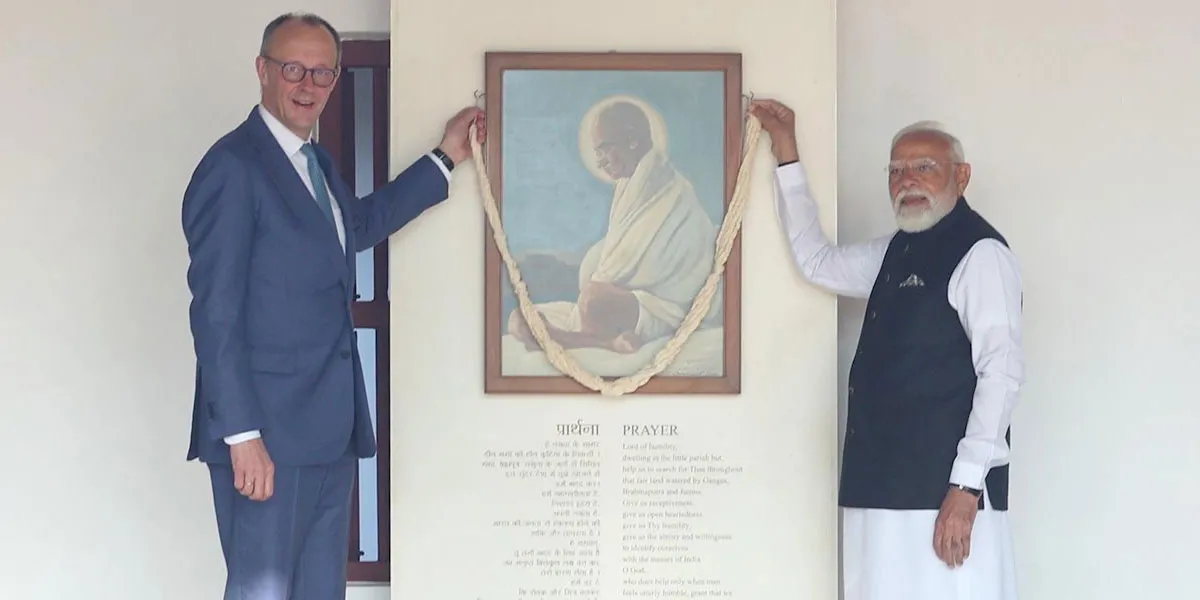
India and Germany on Friday deepened their strategic partnership following high-level delegation talks between Prime Minister Narendra Modi and German Chancellor Friedrich Merz in Gandhinagar, marking the 25th anniversary of the bilateral strategic partnership.

The visit resulted in the exchange of 19 memoranda of understanding and eight key announcements covering defence, advanced technology, clean energy and skills cooperation. Both leaders reiterated support for concluding the India–European Union Free Trade Agreement, with the German side indicating that negotiations could be wrapped up by the end of the month, ahead of the upcoming EU–India Summit.

Several joint declarations of intent were signed across sectors including semiconductors, critical minerals, telecommunications and a Defence Industrial Cooperation Roadmap focused on co-development and co-production of military hardware. Talent mobility and skills cooperation featured prominently, with a major highlight being the announcement of a visa-free transit facility for Indian passport holders transiting through Germany.

On the economic front, the two sides welcomed the establishment of a CEO Forum to strengthen bilateral trade and investment. In the area of sustainability, Germany announced a fresh funding commitment of €1.24 billion under the Green and Sustainable Development Partnership, supporting initiatives such as the PM e-Bus Sewa programme and green hydrogen projects.

The leaders also announced the setting up of an India–Germany Centre of Excellence to deepen collaboration in green technologies, innovation and climate action. They welcomed the signing of one of the largest offtake agreements under India’s National Green Hydrogen Mission, involving the supply of green ammonia from AM Green to Uniper Global Commodities.

Cultural cooperation was also strengthened with an agreement for the development of the National Maritime Heritage Complex at Lothal in collaboration with the German Maritime Museum. In addition, a comprehensive roadmap on higher education was exchanged to deepen institutional ties between universities and research bodies in both countries.

The visit concluded with an emphasis on sports and youth engagement, including a new agreement aimed at promoting youth hockey development.

India and Germany on Friday deepened their strategic partnership following high-level delegation talks between Prime Minister Narendra Modi and German Chancellor Friedrich Merz in Gandhinagar, marking the 25th anniversary of the bilateral strategic partnership. The visit resulted in the exchange of 19 memoranda of understanding and eight key announcements covering defence, advanced technology, clean energy and skills cooperation. Both leaders reiterated support for concluding the India–European Union Free Trade Agreement, with the German side indicating that negotiations could be wrapped up by the end of the month, ahead of the upcoming EU–India Summit. Several joint declarations of intent were signed across sectors including semiconductors, critical minerals, telecommunications and a Defence Industrial Cooperation Roadmap focused on co-development and co-production of military hardware. Talent mobility and skills cooperation featured prominently, with a major highlight being the announcement of a visa-free transit facility for Indian passport holders transiting through Germany. On the economic front, the two sides welcomed the establishment of a CEO Forum to strengthen bilateral trade and investment. In the area of sustainability, Germany announced a fresh funding commitment of €1.24 billion under the Green and Sustainable Development Partnership, supporting initiatives such as the PM e-Bus Sewa programme and green hydrogen projects. The leaders also announced the setting up of an India–Germany Centre of Excellence to deepen collaboration in green technologies, innovation and climate action. They welcomed the signing of one of the largest offtake agreements under India’s National Green Hydrogen Mission, involving the supply of green ammonia from AM Green to Uniper Global Commodities. Cultural cooperation was also strengthened with an agreement for the development of the National Maritime Heritage Complex at Lothal in collaboration with the German Maritime Museum. In addition, a comprehensive roadmap on higher education was exchanged to deepen institutional ties between universities and research bodies in both countries. The visit concluded with an emphasis on sports and youth engagement, including a new agreement aimed at promoting youth hockey development.

Next Story
Infrastructure Transport

Second Mountain Tunnel Breakthrough in Palghar Advances High Speed Rail

The Mumbai-Ahmedabad high speed rail (MAHSR) project reached a milestone with the breakthrough of a mountain tunnel in Palghar, Maharashtra. Mountain tunnel MT-six measures 454 metres long and 14.4 metres wide and will accommodate up and down tracks. The breakthrough follows MT-five near Saphale on second January 2026 and the MT-six excavation was completed from both ends using the New Austrian Tunnelling Method. The ministry reported that the tunnelling was completed within 12 months. The New Austrian Tunnelling Method is favoured for its flexibility in complex geology and irregular tunnel s..

Next Story
Infrastructure Transport

Modi Government Pushes Atmanirbhar Container Drive With BCSL MoU

The Union Government advanced a plan to create an integrated, domestically anchored container ecosystem with the signing of a Memorandum of Understanding to establish the Bharat Container Shipping Line (BCSL). The MoU was signed by key agencies including the Shipping Corporation of India and Container Corporation of India alongside major port authorities and Sagarmala Finance Corporation Limited under the Ministry of Ports, Shipping and Waterways, in the presence of senior ministers. The initiative aligns with the Container Manufacturing Assistance Scheme announced in the Union Budget 2026–2..

Next Story
Infrastructure Urban

Ministry Reports Gains In Mobility For Marginalised Communities

The Ministry of Social Justice and Empowerment is implementing skill development, education and rehabilitation schemes to promote socio-economic mobility and sustainable livelihoods for marginalised and disadvantaged communities across the country. Programmes target Scheduled Castes, Other Backward Classes, Economically Weaker Sections, De-notified Tribes and Safai Karamcharis through specialised implementing corporations and empanelled training institutes. Pradhan Mantri Dakshata Aur Kushalta Sampann Hitgrahi Yojana, or PM-DAKSH, provided skill training and placement support through the Nati..

Advertisement

Subscribe to Our Newsletter

Get daily newsletters around different themes from Construction world.

STAY CONNECTED

Advertisement

Advertisement

Advertisement

Open In App