India Launches Automotive Mission Plan 2047 for Global Leadership
ECONOMY & POLICY

India Launches Automotive Mission Plan 2047 for Global Leadership

The government has initiated the formulation of the Automotive Mission Plan 2047 (AMP 2047), a strategic roadmap aligned with the ‘Viksit Bharat @2047’ vision to establish India as a global leader in the automotive sector, focusing on innovation and sustainability, the Ministry of Heavy Industries announced on Thursday.
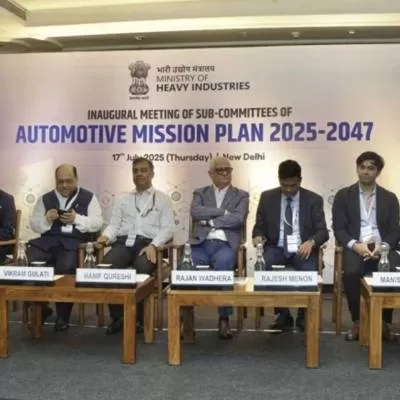
Seven sub-committees, comprising experts from government, industry, and academia, have convened to outline objectives, framework, and targets for sectoral growth, exports, and industrial advancement, aiming to increase India’s share in global automotive trade.
“The vision for 2047 is not merely aspirational but a strategic roadmap backed by concrete targets for sector growth, exports, and industry advancement. We must think beyond specific technologies or companies and focus on India’s global standing in 2047, aiming to boost our share in global automotive trade through innovation and quality,” said Hanif Qureshi, Additional Secretary in the Ministry of Heavy Industries.
The initiative involves various ministries, industry bodies including the Society of Indian Automobile Manufacturers (SIAM), Automotive Component Manufacturers Association of India (ACMA), Confederation of Indian Industry (CII), as well as academic institutions and testing agencies in an industry-led effort.
An official statement added, “Under the visionary leadership of Prime Minister Narendra Modi and guidance of Minister for Heavy Industries and Steel H D Kumaraswamy, the Ministry of Heavy Industries has commenced the formulation of AMP 2047. The inaugural meeting of the AMP 2047 sub-committees was held to outline its objectives and framework.”
AMP 2047 seeks to integrate the collective vision of stakeholders—original equipment manufacturers (OEMs), auto component makers, policy-makers, academia and end users—to address challenges such as technological advancements and charging infrastructure.
Representatives from the Ministries of Power, Road Transport and Highways, Commerce, Petroleum and Natural Gas, Department for Promotion of Industry and Internal Trade (DPIIT), Environment, Forest and Climate Change, along with industry bodies and academic institutions, attended the meeting.
The current AMP 2016–26 aims to position the Indian automotive industry among the world’s top three in engineering, manufacturing, and exports of vehicles and components, targeting growth to over 12 per cent of India’s GDP and generating an additional 65 million jobs. 

The government has initiated the formulation of the Automotive Mission Plan 2047 (AMP 2047), a strategic roadmap aligned with the ‘Viksit Bharat @2047’ vision to establish India as a global leader in the automotive sector, focusing on innovation and sustainability, the Ministry of Heavy Industries announced on Thursday.Seven sub-committees, comprising experts from government, industry, and academia, have convened to outline objectives, framework, and targets for sectoral growth, exports, and industrial advancement, aiming to increase India’s share in global automotive trade.“The vision for 2047 is not merely aspirational but a strategic roadmap backed by concrete targets for sector growth, exports, and industry advancement. We must think beyond specific technologies or companies and focus on India’s global standing in 2047, aiming to boost our share in global automotive trade through innovation and quality,” said Hanif Qureshi, Additional Secretary in the Ministry of Heavy Industries.The initiative involves various ministries, industry bodies including the Society of Indian Automobile Manufacturers (SIAM), Automotive Component Manufacturers Association of India (ACMA), Confederation of Indian Industry (CII), as well as academic institutions and testing agencies in an industry-led effort.An official statement added, “Under the visionary leadership of Prime Minister Narendra Modi and guidance of Minister for Heavy Industries and Steel H D Kumaraswamy, the Ministry of Heavy Industries has commenced the formulation of AMP 2047. The inaugural meeting of the AMP 2047 sub-committees was held to outline its objectives and framework.”AMP 2047 seeks to integrate the collective vision of stakeholders—original equipment manufacturers (OEMs), auto component makers, policy-makers, academia and end users—to address challenges such as technological advancements and charging infrastructure.Representatives from the Ministries of Power, Road Transport and Highways, Commerce, Petroleum and Natural Gas, Department for Promotion of Industry and Internal Trade (DPIIT), Environment, Forest and Climate Change, along with industry bodies and academic institutions, attended the meeting.The current AMP 2016–26 aims to position the Indian automotive industry among the world’s top three in engineering, manufacturing, and exports of vehicles and components, targeting growth to over 12 per cent of India’s GDP and generating an additional 65 million jobs. 

Next Story
Technology

AI-Enabled Workflows Lift Profitability and Productivity

Organisations modernising frontline workflows with artificial intelligence, automation and real-time data are reporting stronger financial performance, higher productivity and improved employee engagement, according to a global study by Zebra Technologies and Oxford Economics.The research covered 1,000 senior leaders across retail, manufacturing, transportation and logistics in the US, Mexico, the UK, Germany, India, Japan, Australia and New Zealand.In transportation and logistics, 54 per cent of companies that improved picking and packing operations reported faster operational performance, wh..

Next Story
Real Estate

India Leads Global AI Readiness but Implementation Lags

Indian companies lead global averages across all eight artificial intelligence readiness indicators tracked by JLL, but only 19 per cent have started making changes to their workplaces, according to the JLL 2026 Future of Work Survey.The study found that 77 per cent of Indian business leaders expect AI to change their office requirements, creating a 58-percentage-point gap between awareness and implementation. The survey covered more than 2,200 CEOs, CFOs and real estate leaders across 21 countries during the first quarter of 2026.Despite concerns over automation, 58 per cent of Indian leaders..

Next Story
Equipment

Three WOLFF Cranes Build Riyadh Cable-Stayed Bridges

Three WOLFF 180 B luffing jib cranes are supporting the construction of two cable-stayed bridges alongside the existing Wadi Laban Bridge in Riyadh, Saudi Arabia. The project is being developed for the Royal Commission for Riyadh City and executed by the ICRC joint venture comprising IC Ictas and Al Rashid Trading & Contracting Company.The cranes are handling lifting operations including formwork, reinforcement, concrete placement, work platforms, surveying equipment and other construction materials. Each crane is fitted with a 40 m jib, reaches a hook height of 157 m and offers a maximum ..

Advertisement

Subscribe to Our Newsletter

Get daily newsletters around different themes from Construction world.

STAY CONNECTED

Advertisement

Advertisement

Advertisement